
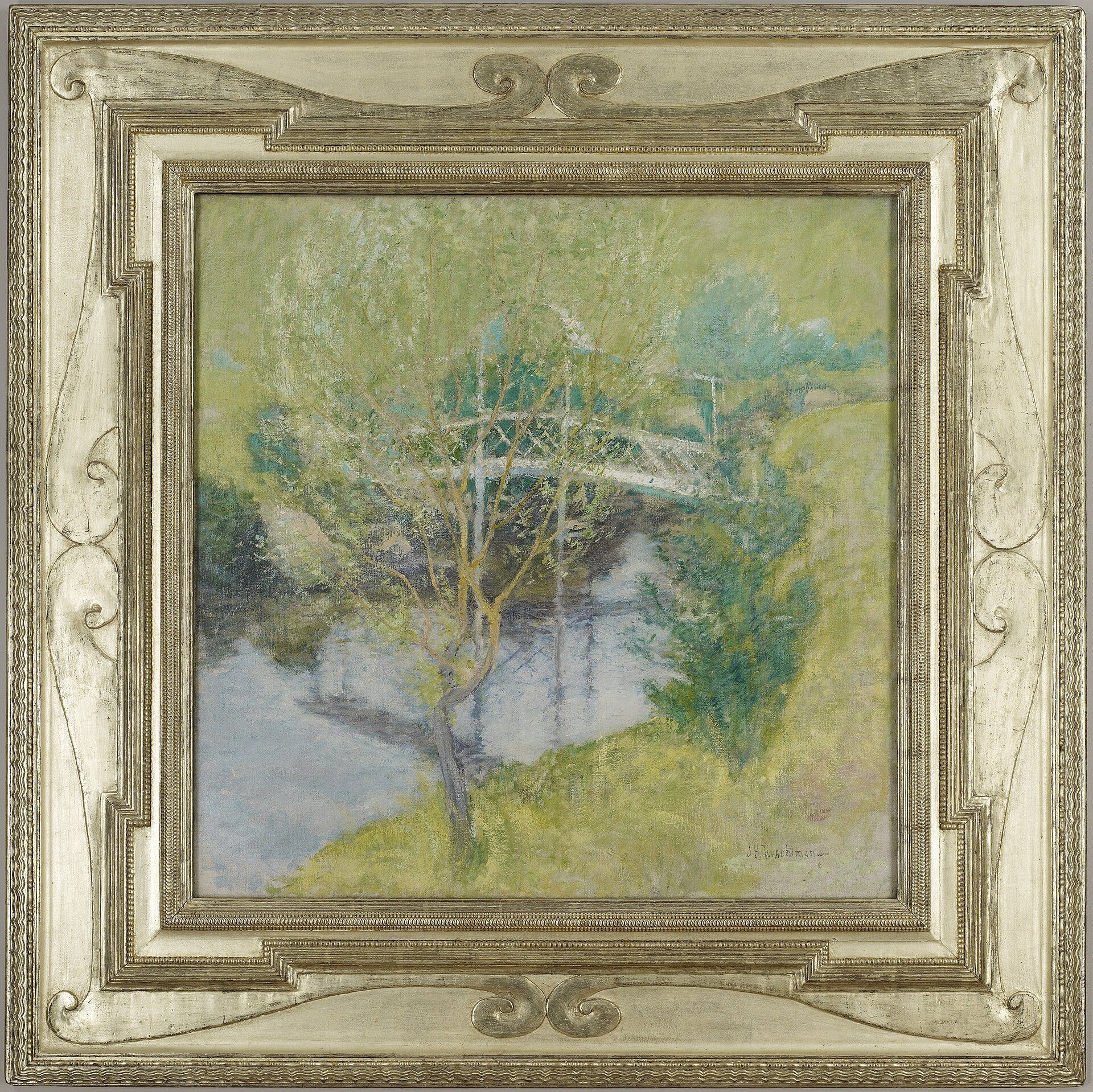
John Henry Twachtman (1853 to 1902) was an American Impressionist painter who spent most of the 1890s painting one small brook on his farm in Connecticut. The White Bridge, at the Minneapolis Institute of Art, shows the brook in spring.
Cool Stories About Art is a newsletter to learn art the fun way.
Join 200,000+ readers and get:
10 new art stories / month
The entire archive of content (140+ articles)
Comment, ask questions, and chat with other readers
Twachtman spent years learning his craft in Europe. He traveled to paint Niagara Falls in the winter of 1893 to 1894, and Yellowstone in 1895, two of the great natural wonders of America. Yet he kept coming back to his own land in Greenwich, Connecticut, and to the brook that ran through it.
John Henry Twachtman was born on August 4, 1853, in Cincinnati, Ohio, a river town where many German families had settled, his parents among them. One of his father's trades was decorating window shades, the painted cloth blinds pulled down over windows.
At about fourteen, John was decorating shades too, and taking drawing classes at night. In Cincinnati he grew close to Frank Duveneck, a local painter who had trained in Munich, in Germany. Duveneck became his teacher, and in 1875 Twachtman followed him to Munich.
The art school of Munich taught a dark way of painting, with backgrounds that were nearly black. From 1883 to 1885, Twachtman studied in Paris, where his colors grew lighter and softer. He brought that lighter painting home to America in 1886.
Twachtman, his wife, Martha, and their three children first rented a cottage in Greenwich, a town on the Connecticut coast a short train ride from New York. In February 1890, Twachtman bought three acres and an old farmhouse there, two miles north of the town center.
The land lay in Hangroot, a district of rolling hills between Round Hill Road and a stream called Horseneck Brook. In December 1891, Twachtman added thirteen more acres, and with them the brook itself.
Horseneck Brook runs down between rocks into a dark pool just west of the house, under hemlock trees, tall evergreens of the American woods, then drops over a small waterfall, the steepest on its course. Twachtman dammed part of the brook so that his children could swim, and painted it in spring and under snow.
What could one small brook in Connecticut give a painter that Niagara Falls could not?
In the rest of the story
Why he almost never dated his paintings, and how we still can.
Why the white bridge in his paintings never looks the same twice.
What he left out when he painted Niagara Falls.
Who made sure his paintings were seen after he was gone.