
John Singleton Copley (1738 to 1815) was the leading portrait painter of colonial America. Born in Boston, he painted Paul Revere and Samuel Adams, then settled in London, where he painted Watson and the Shark, the rescue of a swimmer in the harbor of Havana.
Cool Stories About Art is a newsletter to learn art the fun way.
Join 200,000+ readers and get:
10 new art stories / month
The entire archive of content (140+ articles)
Comment, ask questions, and chat with other readers
Copley painted the men who would lead Boston into the American Revolution. Yet the tea that Boston patriots threw into the harbor in 1773 had been sent to his own father-in-law to sell. A few months later, Copley sailed for London. There he painted the heroes of Britain, at war with the men he had painted in Boston.
John Singleton Copley grew up on the docks of Boston, then the capital of the British colony of Massachusetts. He never knew his father. His mother, Mary, sold tobacco in a shop on Long Wharf, the great pier of the harbor.
In 1748, Mary married Peter Pelham, an English engraver who had settled in Boston. Pelham made mezzotints, a kind of engraving that copies the soft shadows of a painting, and he taught the boy to engrave and to paint.
Pelham died in 1751, when John was thirteen. The boy taught himself the rest by copying engravings of European paintings.
By about 1760, still in his early twenties, Copley was the portrait painter Boston merchants, church ministers and their wives wanted. Yet he complained that Boston saw painting as a simple trade, like making shoes.
In 1765, Copley painted his half-brother, Henry Pelham, at a polished table with a pet flying squirrel on a thin gold chain. No one had ordered A Boy with a Flying Squirrel. Copley made it for a London exhibition, and a friend, a ship captain, took it across the Atlantic.
Shown in London in 1766, the picture impressed Joshua Reynolds, the most famous portrait painter in England, who called it "a very wonderfull Performance." The spelling is Reynolds's own.
Benjamin West, a painter from Pennsylvania who lived in London, urged Copley by letter to come and study in Europe. Copley stayed in Boston eight more years.
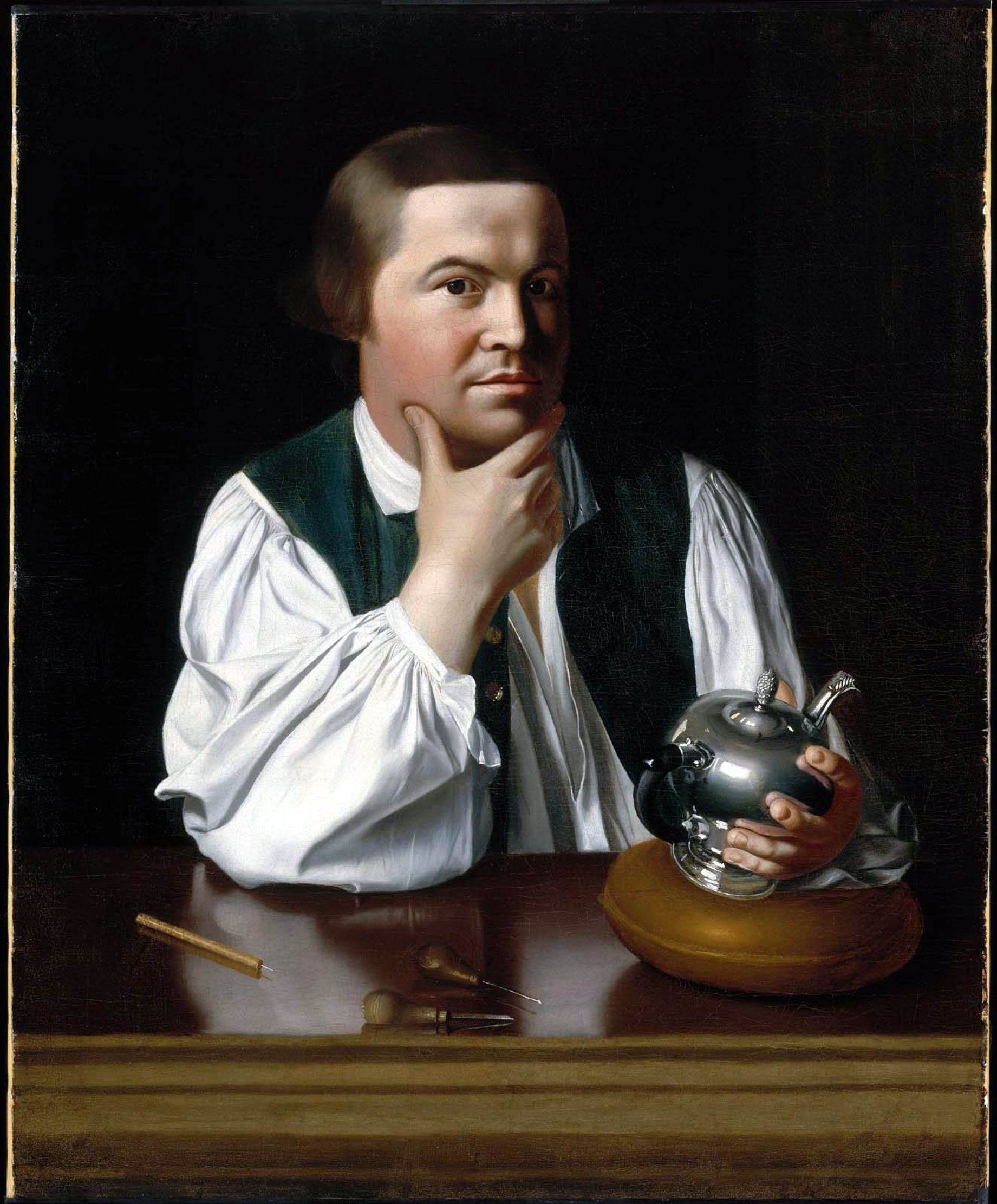
In 1768, Copley painted Paul Revere, a Boston silversmith, in his shirtsleeves, holding a silver teapot he had made. Revere was also one of the Sons of Liberty, the secret society of Boston patriots who fought British taxes.
In 1769, Copley married Susanna Clarke. Her father, Richard Clarke, was one of the richest merchants in Boston, and his firm worked for the East India Company, the British company that shipped tea from Asia.
When Boston turned against the king, what would the city do with a painter tied to both sides, and how would it remember him?
In the rest of the story
What a crowd pounding on Copley's door at midnight warned him.
How one painting earned Copley five times Benjamin West's yearly pay.
Whose faces Copley borrowed for the people fleeing a battle.
What Copley's son, born in Boston, became in the British Parliament.