
Joseph Wright, known as Wright of Derby (1734 to 1797), was an English painter who spent almost his whole life in Derby, a town in central England. He painted scientists, forges and factories lit by a candle, a lamp or a fire.
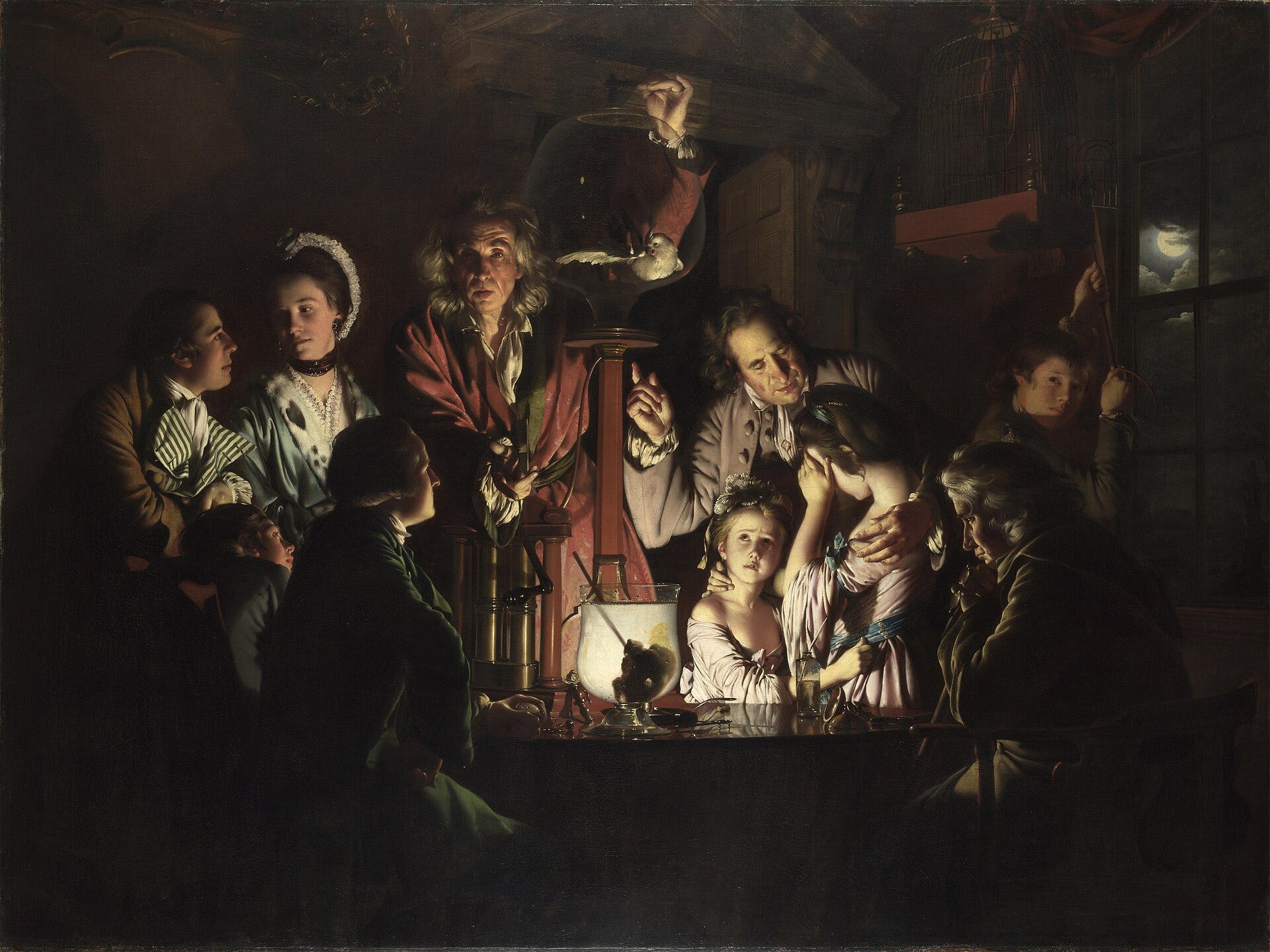
His most famous painting is An Experiment on a Bird in the Air Pump (1768), now in the National Gallery in London. He also painted Vesuvius, the volcano near Naples, in Italy, again and again.
In 1784, the Royal Academy, the official society of British artists in London, elected Wright a full member, the highest title an English painter could receive. Wright refused the title.
Cool Stories About Art is a newsletter to learn art the fun way.
Join 200,000+ readers and get:
10 new art stories / month
The entire archive of content (140+ articles)
Comment, ask questions, and chat with other readers
In 1768, traveling lecturers went from town to town in England with scientific machines and performed experiments in private homes. Joseph Wright turned one of those evenings into An Experiment on a Bird in the Air Pump.
The scene takes place at night, in a large house. A single candle, hidden on the table, lights every face in the room.
The lecturer stands with one hand raised and the other on the valve of an air pump, a machine that sucks the air out of a glass container. Inside the glass lies a rare white cockatoo, and the more air the pump removes, the harder the bird fights to breathe.
A little girl watches the bird while her older sister covers her eyes, and their father puts his arm around the older girl's shoulder. Beside the lecturer, a young couple look only at each other.
Near the window, a boy holds the rope of the bird's empty cage. He waits to learn whether he will lower the cage for a living cockatoo.
The lecturer looks out of the painting, as if the choice to let the air back in belonged to the person looking. The painting never shows what happens to the bird.
Wright showed the Air Pump in London in 1768, the year the Royal Academy was founded there. The Academy's yearly exhibition soon decided which painters London talked about, and only forty artists could be full members.
Sixteen years later, the Academy offered Wright one of the forty seats, and Wright said no.
Why did the painter of the Air Pump refuse the title that every English painter wanted?
In the rest of the story, you'll find out:
why a painter of science lessons ended up painting forges, alchemists and a volcano
how a painting of a volcano became the talk of a town where almost nobody wanted Wright's portraits
how Wright showed London that he could do without the Academy
what the Academy did with the last paintings Wright sent to London