
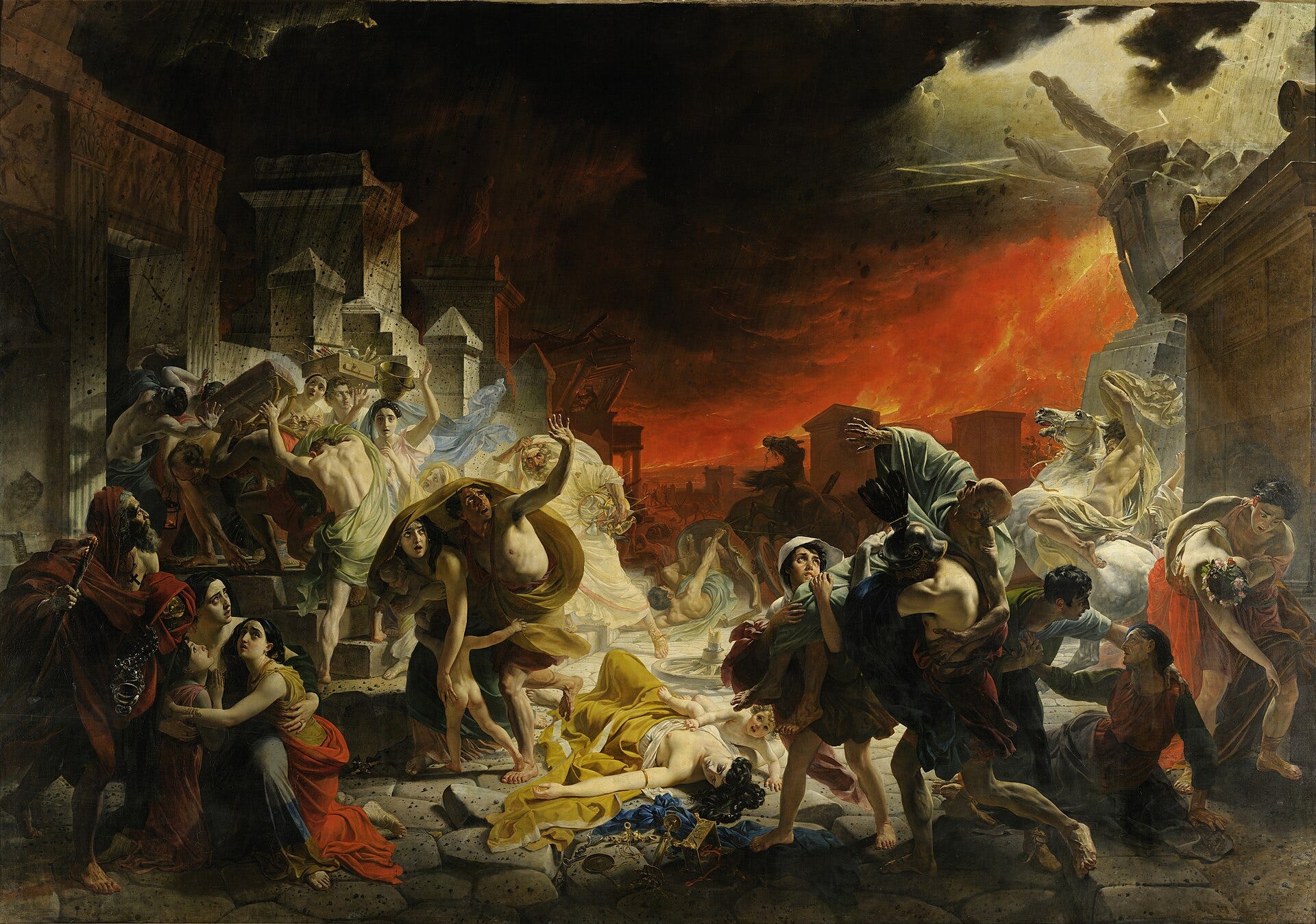
Karl Bryullov (1799 to 1852) was a Russian painter, the first from his country to be celebrated across Europe. He won that fame with one giant canvas, The Last Day of Pompeii, now at the State Russian Museum in Saint Petersburg.
Cool Stories About Art is a newsletter to learn art the fun way.
Join 200,000+ readers and get:
10 new art stories / month
The entire archive of content (140+ articles)
Comment, ask questions, and chat with other readers
The painter of Pompeii became the pride of Russia and went to work for Nicholas I, emperor of Russia from 1825 to 1855. He spent years on huge pictures for the emperor and left several of them unfinished.
Karl Bryullov was born in Saint Petersburg, then the capital of the Russian Empire, into a family of French origin named Brullo. The Brullos descended from Huguenots, French Protestants who had left France after the king of France banned their religion.
Karl's father, Pavel Brullo, carved ornaments in wood and was a member of the Imperial Academy of Arts, the official art school of the empire. Karl entered the Academy at about ten, and in 1821 he won its great gold medal, the first prize.
Before Karl left for Italy, the family name took a Russian ending, and Brullo became Bryullov. In 1822, he and his brother Alexander, a future architect, set off for Rome, sent by the Society for the Encouragement of Artists, a club of rich art lovers.
In the summer of 1827, Bryullov traveled south to Pompeii, a Roman town near Naples. The volcano Vesuvius had buried Pompeii under ash in AD 79, and diggers had been clearing its streets for decades.
Bryullov walked down the Street of Tombs, a road lined with graves just outside the town gate. There he made up his mind to paint the last day of Pompeii, and to set it on that real street.
From that first idea to the last brushstroke, the painting took him six years. When Bryullov came home to Saint Petersburg in 1836, people called him "the Great Karl," and the Academy where he had studied as a boy made him a professor.
In the same city lived a young Ukrainian who belonged, by law, to another man.
Why would the most celebrated painter in Russia fight for that young man's freedom?
In the rest of the story
Which real woman Bryullov painted into the crowd fleeing Pompeii.
What the police found among the young Ukrainian's papers, years later.
Which Bryullov painting stayed on an Atlantic island for 150 years.
Why two rivers are carved on the Great Karl's tombstone.