
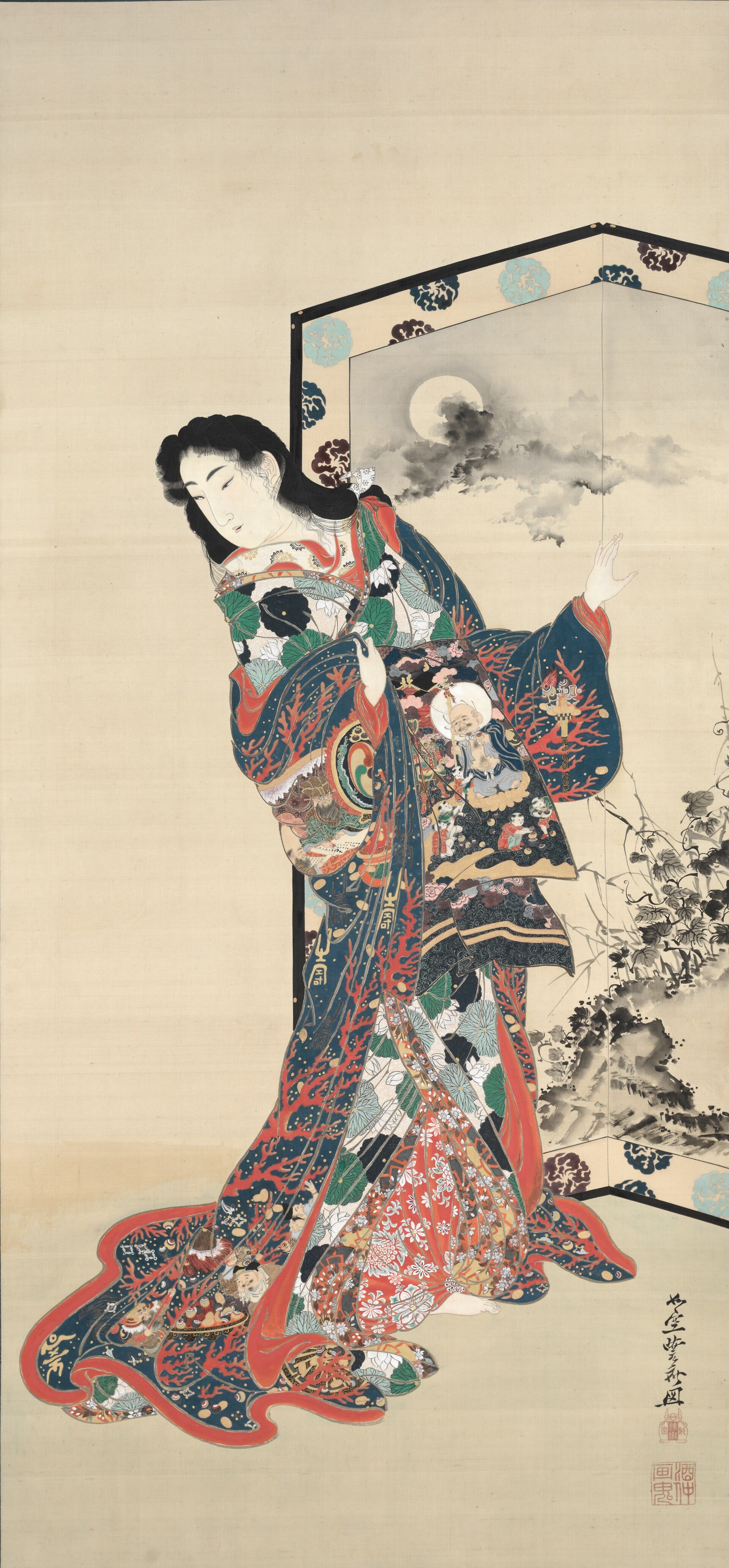
Kawanabe Kyosai (1831 to 1889) was a Japanese painter famous for his demons, crows and caricatures. His Hell Courtesan, a woman of legend who entertained rich men and wore the Buddhist hells on her robe, belongs to the Cleveland Museum of Art in Ohio.
Cool Stories About Art is a newsletter to learn art the fun way.
Join 200,000+ readers and get:
10 new art stories / month
The entire archive of content (140+ articles)
Comment, ask questions, and chat with other readers
For years, Kyosai signed his paintings with a name meaning "the mad studio." In 1870, the government that had just taken power from the shogun, Japan's military ruler, arrested him for a caricature, and in 1871 he was flogged fifty times. Ten years later, a crow he had painted won the top prize for painting at that government's national exhibition.
Kawanabe Kyosai was born in 1831 in Koga, a town north of Edo, the city known today as Tokyo. His father was a samurai, a man of the warrior class, who served the lord of Koga. The next year, the family moved to Edo, the shogun's city.
At about six, the boy entered the studio of Utagawa Kuniyoshi. Kuniyoshi designed woodblock prints, cheap pictures printed from carved blocks of wood and sold in the street, and he was famous for his warriors and monsters.
When the boy was about eight, the Kanda River, which runs through Edo, flooded, and he found a severed human head in the water. He fished it out, carried it home and drew it. The story was told many years later, in 1887, in a book about his life written by his friend Uryu Masayasu and illustrated by Kyosai himself.
Soon afterward, in 1840, his parents sent him to a very different teacher. Maemura Towa belonged to the Kano school, the painters who worked for the shogun himself, decorating his castles and the great temples. Kano pupils spent years copying old models.
Towa nicknamed the boy gaki, from two characters meaning "painting" and "demon": the Painting Demon. When Towa fell ill, the boy went on with Towa's own teacher, Kano Tohaku, and finished his training at about eighteen.
About twenty years later, the shogun his teachers had served was gone, and the men who now ruled Japan had their own opinion of the Painting Demon.
Why would the government that flogged Kyosai in 1871 reward his painting ten years later?
In the rest of the story
What Kyosai changed in his name the day he left prison.
What happened when a French caricaturist challenged Kyosai to a duel.
What the judges really thought of Kyosai when they gave him the prize.
How long it took Kyosai to paint a theater curtain fifty-six feet wide.