
A key in a painting names the person holding it. Two keys, one gold and one silver, mean Saint Peter and nothing else, a bunch of keys at a woman’s waist means she runs the household, and a locked chest in a Dutch interior means there is money in the room.
Learn art the fun way
1 | The keys of Saint Peter
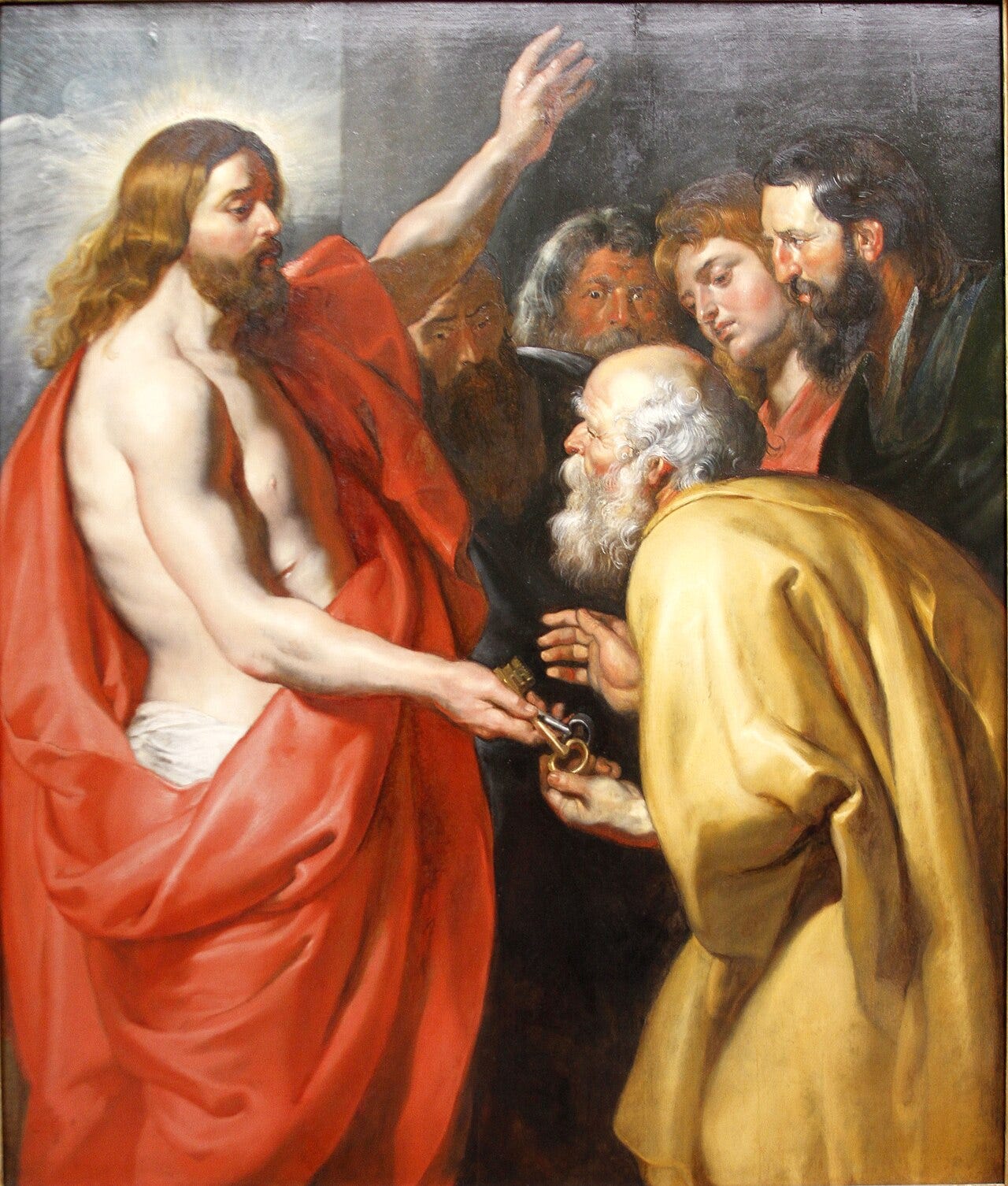
Christ says he will give Peter the keys of the kingdom, so painters gave him two, gold and silver, for heaven and earth. It is the single clearest attribute in Christian art.
More on the system in what is iconography.
The text is Matthew 16, verse 19. Painters settled on two keys, one gold for heaven and one silver for earth, and the pair became the emblem of the papacy itself, still on the Vatican coat of arms.
2 | The Delivery of the Keys, Perugino (1481 to 1482)
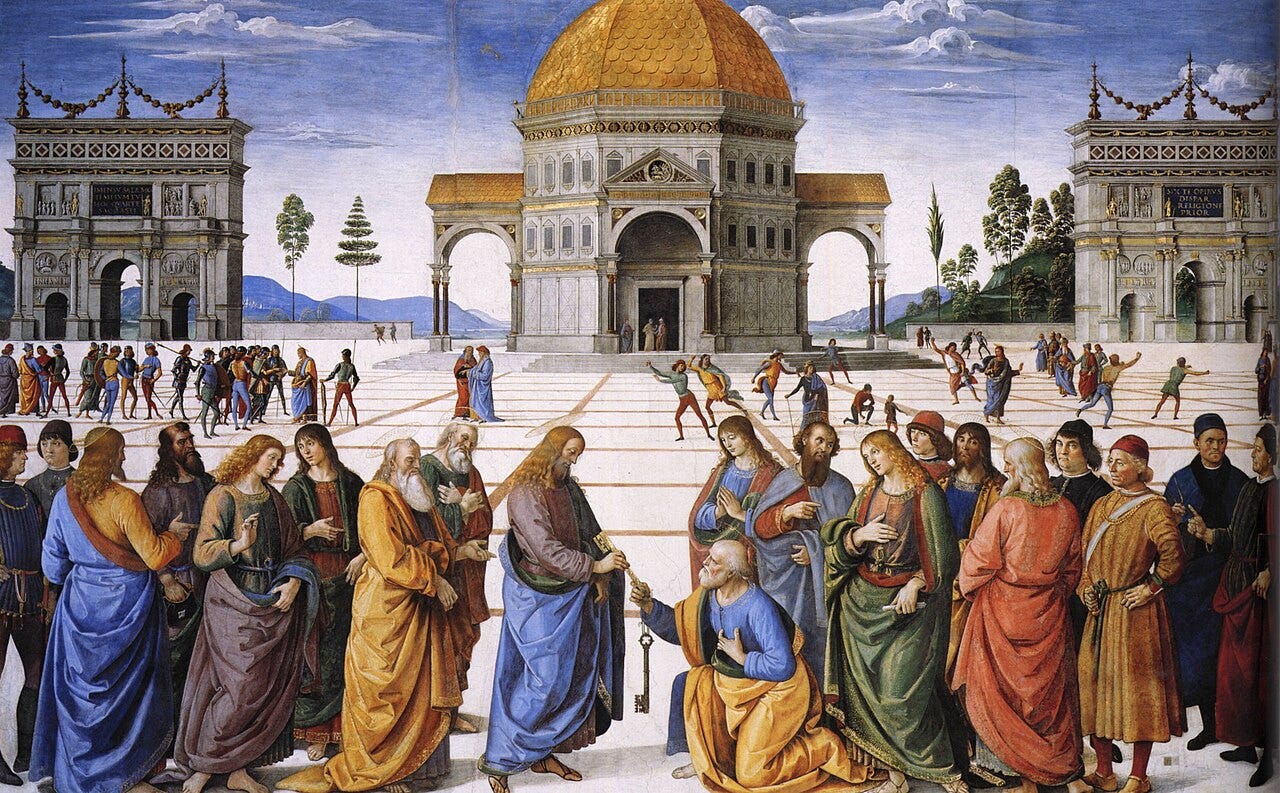
On the Sistine Chapel wall, Christ hands Peter an oversized golden key in front of a wide empty piazza. The whole composition exists to make one object readable from thirty metres.
More on him in Pietro Perugino.
Perugino painted it on the Sistine wall in 1481 and 1482, with two Roman triumphal arches in the background and a paved piazza laid out in exact perspective. Raphael was his pupil, and it shows.
3 | Woman Holding a Balance, Vermeer (around 1664)
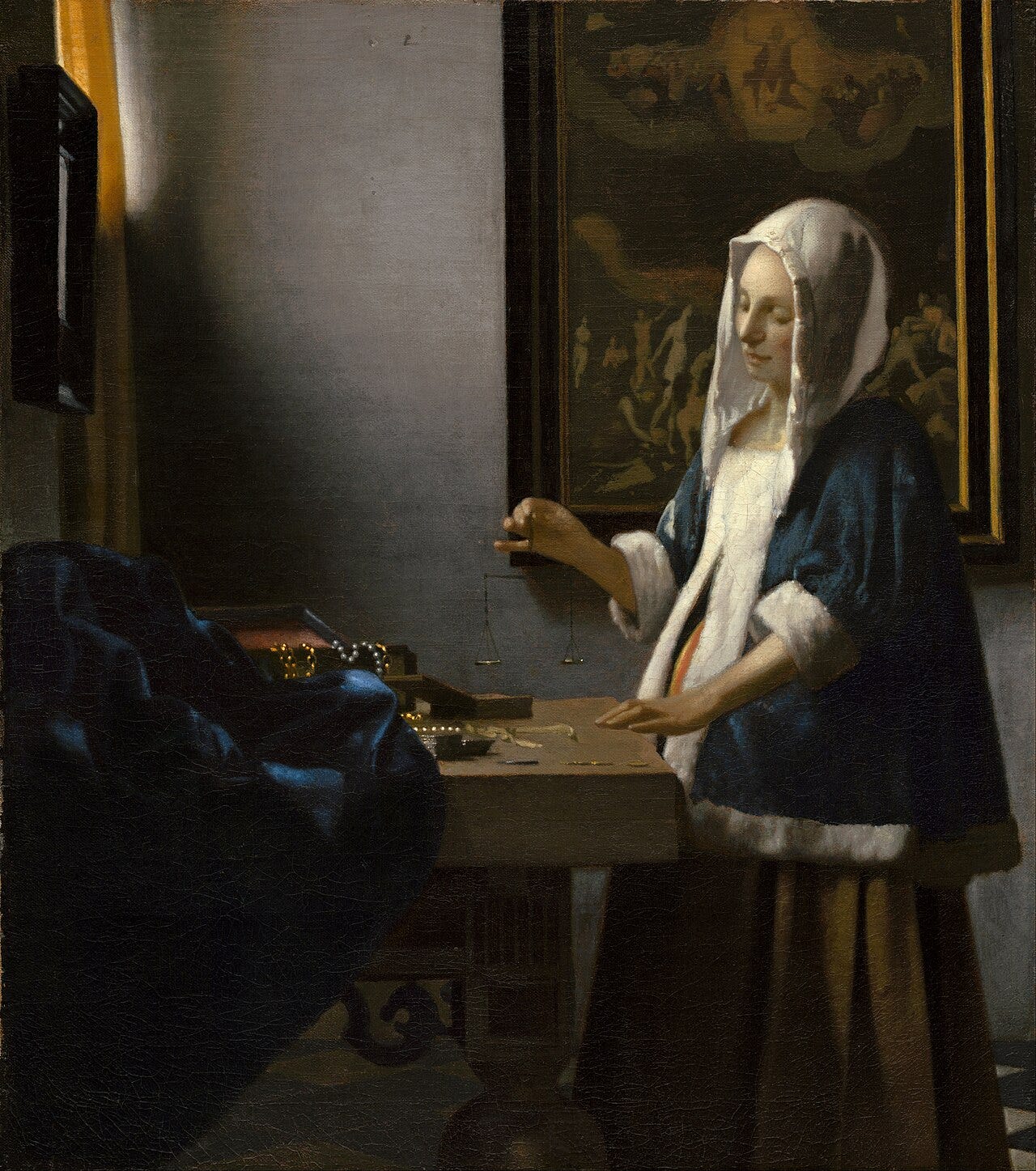
She weighs nothing at all. Pearls and gold lie on the table, a box sits open, and a Last Judgement hangs directly behind her head. The picture is about what is worth keeping.
More on him in Vermeer.
I read that picture inch by inch in Vermeer’s Woman Holding a Balance.
4 | Keys at the waist
In Dutch and Flemish portraits a ring of keys hanging from a woman’s belt is a statement of rank inside the house: she controls the linen, the food and the strongbox.
More in jewellery in portraits.
The Dutch called the household keys the sleutelbos. Handing them to the bride was a legal moment in the marriage, and losing them was grounds for a domestic scandal that appears in genre painting as a joke.
5 | The locked chest
A studded wooden chest with iron bands appears in banking scenes, moneylender portraits and merchant interiors. Its presence tells you the sitter’s trade without a caption.
More on the genre in what is genre painting.
6 | The Arnolfini clogs and the closed room
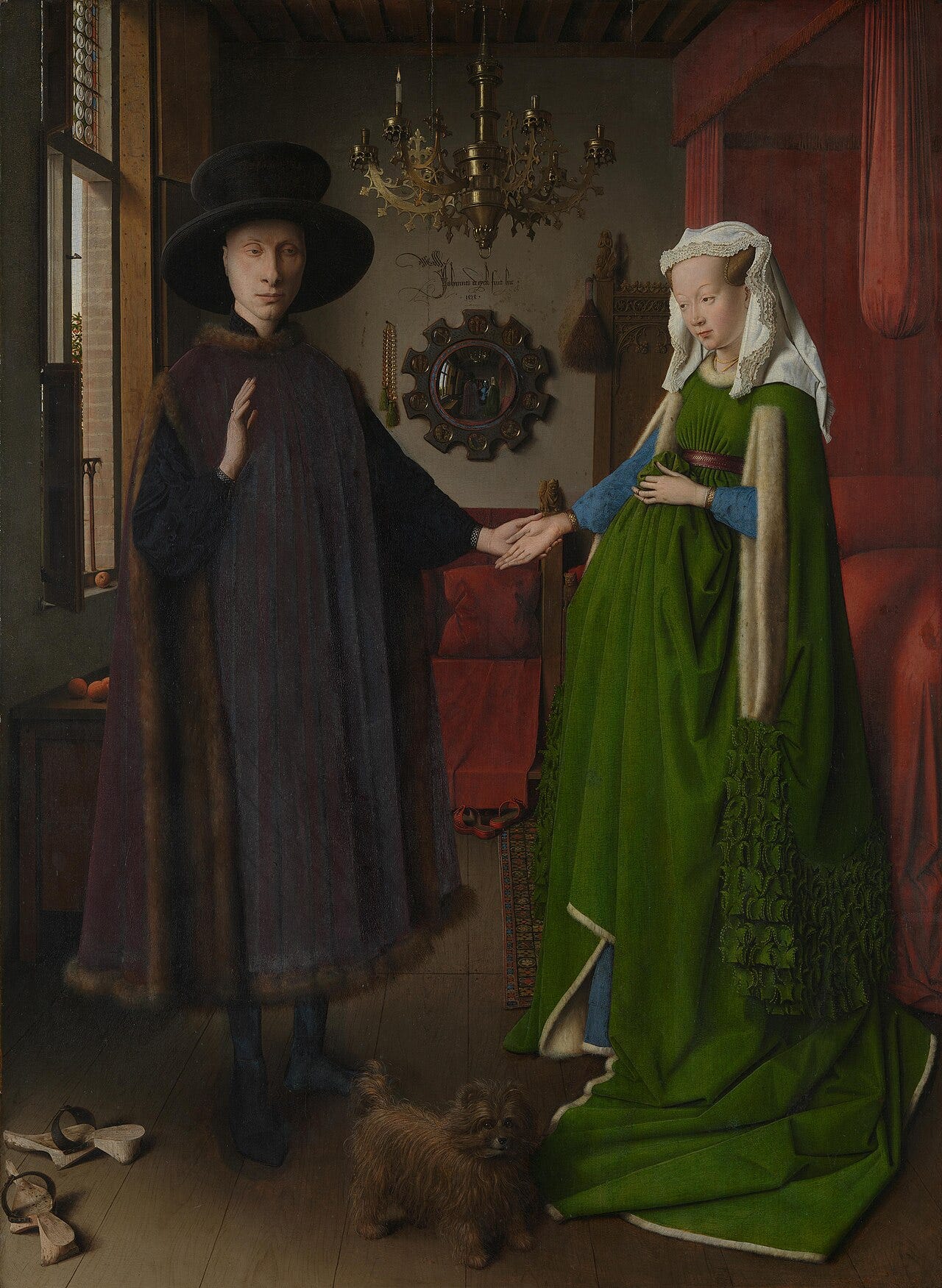
Van Eyck’s interior is a sealed space: one window, a shut door, a convex mirror. Everything about the room says private, and the objects are the terms of the agreement.
More on him in Jan van Eyck.
7 | The key as a wedding object
In marriage portraits the handing over of keys is a real legal moment, not a metaphor. The wife takes charge of the household stores, and the painter records the handover.
More in famous funeral paintings for the other end of the same life.
8 | Locks in Symbolist painting
Around 1900 painters used locked doors and unusable keys to mean the opposite of control: a mind that cannot get out, a room nobody can enter.
More on that world in what is symbolism in art.
9 | Prison keys and the jailer
In scenes of Peter released from prison, the jailer’s keys are shown useless while an angel walks him past the guards. The painter needs the keys visible for the joke to land.
More in prisons in art.
The scene is Acts 12, where an angel leads Peter out past sleeping guards and an iron gate opens by itself. Raphael painted it in the Vatican Stanze, lit only by the angel.
10 | Keys in still life
A key on a vanitas table sits beside the skull and the watch. It means possession, and possession is the thing being argued against.
More on the type in what is vanitas.
A vanitas table typically carries a skull, a watch, a snuffed candle and a purse or key. Each object is a different way of saying the same thing, and the painter counts on you recognising all four.
11 | The key in the hand of a saint
Peter is not alone. Saint Martha, Saint Zita and others carry keys, and their size, number and metal all narrow down who you are looking at.
Two keys almost always mean Peter. One key rarely does.
Saint Zita, patron of domestic servants, carries keys because she ran a household in Lucca. Saint Martha carries them for the same reason. Size and number are the only way to tell them from Peter.
12 | Why painters loved a key
It is small, metallic, unmistakable in silhouette, and it implies a door that is not in the picture. Very few objects can suggest a whole unseen room that cheaply.
Follow the key and ask what it opens. The painter usually left that out on purpose.
Answers to the keys questions
What do two keys mean in a painting? They identify Saint Peter, gold and silver for heaven and earth, from the promise of the keys of the kingdom in the Gospel of Matthew.
Why do women wear keys in portraits? A ring of keys at the belt shows control of the household stores, a real position of authority in a Northern European home.
What is Woman Holding a Balance about? A Vermeer of around 1664 in which a woman holds empty scales beside pearls and gold, with a Last Judgement painted on the wall behind her.
Do locks mean the same thing everywhere? No. In older painting a lock means security and rank. In Symbolist painting it usually means confinement.
Where is Perugino’s Delivery of the Keys? The Sistine Chapel for Perugino, the National Gallery of Art in Washington for the Vermeer, the National Gallery in London for van Eyck.
Vermeer’s scales are empty. Everyone remembers the gold and the pearls, but she is weighing nothing at all, and that is the entire argument of the picture.
The obvious next stop is the Met and the Rijksmuseum.
This subject is one thread in a wider theme. See how it fits into Objects and Symbols in Painting.