
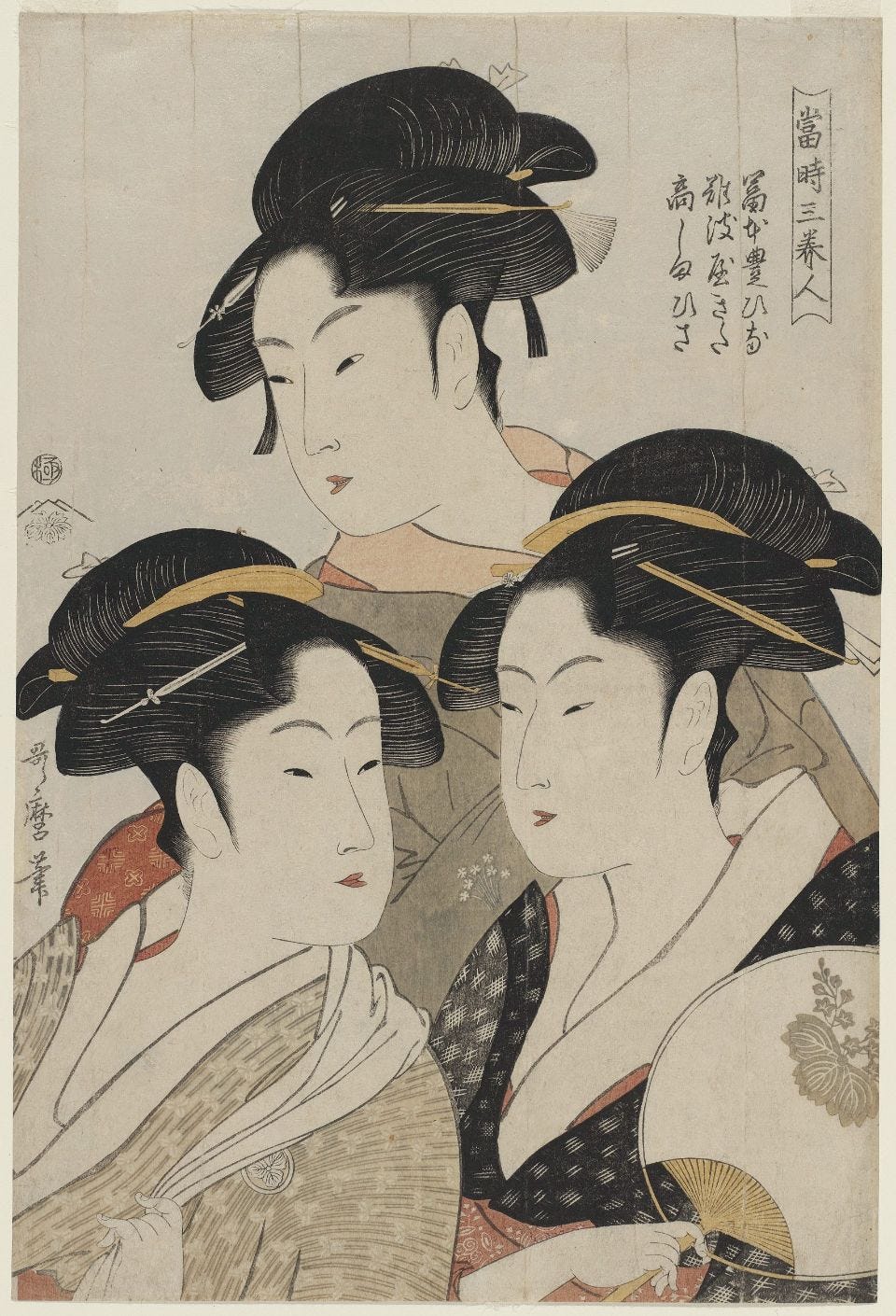
Kitagawa Utamaro (around 1753 to 1806) was a Japanese artist who designed woodblock prints in Edo, the city now called Tokyo. He became famous for portraits of real women of the city, like Three Beauties of the Present Day.
Cool Stories About Art is a newsletter to learn art the fun way.
Join 200,000+ readers and get:
10 new art stories / month
The entire archive of content (140+ articles)
Comment, ask questions, and chat with other readers
Kitagawa Utamaro drew women whom the whole city knew by name, and the government of Japan spent years trying to keep those names off his prints. In the end, another ban, on stories of Japan's distant past, put Utamaro in handcuffs.
No one knows exactly when or where Utamaro was born, or who his parents were. What is known for certain is the name of his teacher, Toriyama Sekien, a painter of Edo who made picture books of yōkai, the monsters and ghosts of Japanese folk tales.
In Japan, the family name comes first, and artists often took a new name for their work. Sekien's young pupil, the future Utamaro, came from a family named Kitagawa. From 1775, he signed his drawings Kitagawa Toyoaki.
Toyoaki's drawings reached the public as woodblock prints. A carver cut each design into blocks of wood, one block for each color, up to twenty for a single print. A printer inked the blocks one by one, laid the same sheet of paper on each in turn and rubbed the back with a round pad.
The man who paid the carver and the printer was the publisher. He chose the subjects and sold the prints in his shop. In the early 1780s, the artist found the publisher who would make him famous, Tsutaya Jūzaburō, and began to sign his work with a new name: Utamaro.
Tsutaya had grown up in the Yoshiwara, the walled district of Edo where the government allowed courtesans to work. Courtesans were women bound by contract to a house, a business of the Yoshiwara that charged men for their company and for sex.
In 1774, Tsutaya opened his own business in the Yoshiwara. His first books were guides to the district, listing its houses and the names of its women. Less than twenty years later, Tsutaya would sell Utamaro's portraits of women of Edo, with their names printed beside them.
Those names would bring trouble in Edo, the city of the shogun, the military ruler who governed Japan in the name of the emperor. Since 1603, every shogun had come from one family, the Tokugawa, and their officials decided what the shops of Edo were allowed to print.
How did the artist who made Edo's women famous end up in handcuffs over a warlord who had been dead for two hundred years?
In the rest of the story
Why the shogun's officials wanted the women's names off the prints.
How Utamaro hid the forbidden names in plain sight.
How officials made sure Utamaro never took off his handcuffs.
How the words of a man handcuffed with Utamaro reached Paris.