
Kitchens and cooks in painting hide their subjects in plain sight: Christ appears in the background of a meat stall, a servant becomes the main event, and Velazquez paints an old woman frying eggs at nineteen. Twelve kitchen scenes and what is really cooking in them.
On the stove
One painter put the Holy Family so far back in a butcher shop you can miss them entirely.
One kitchen maid became the most famous servant in art, and she is pouring an unbroken stream of milk.
One kitchen has two versions, one with Christ in the corner, one without, so the buyer could choose.
One cook is built entirely out of the vegetables she is cooking.
Learn art the fun way
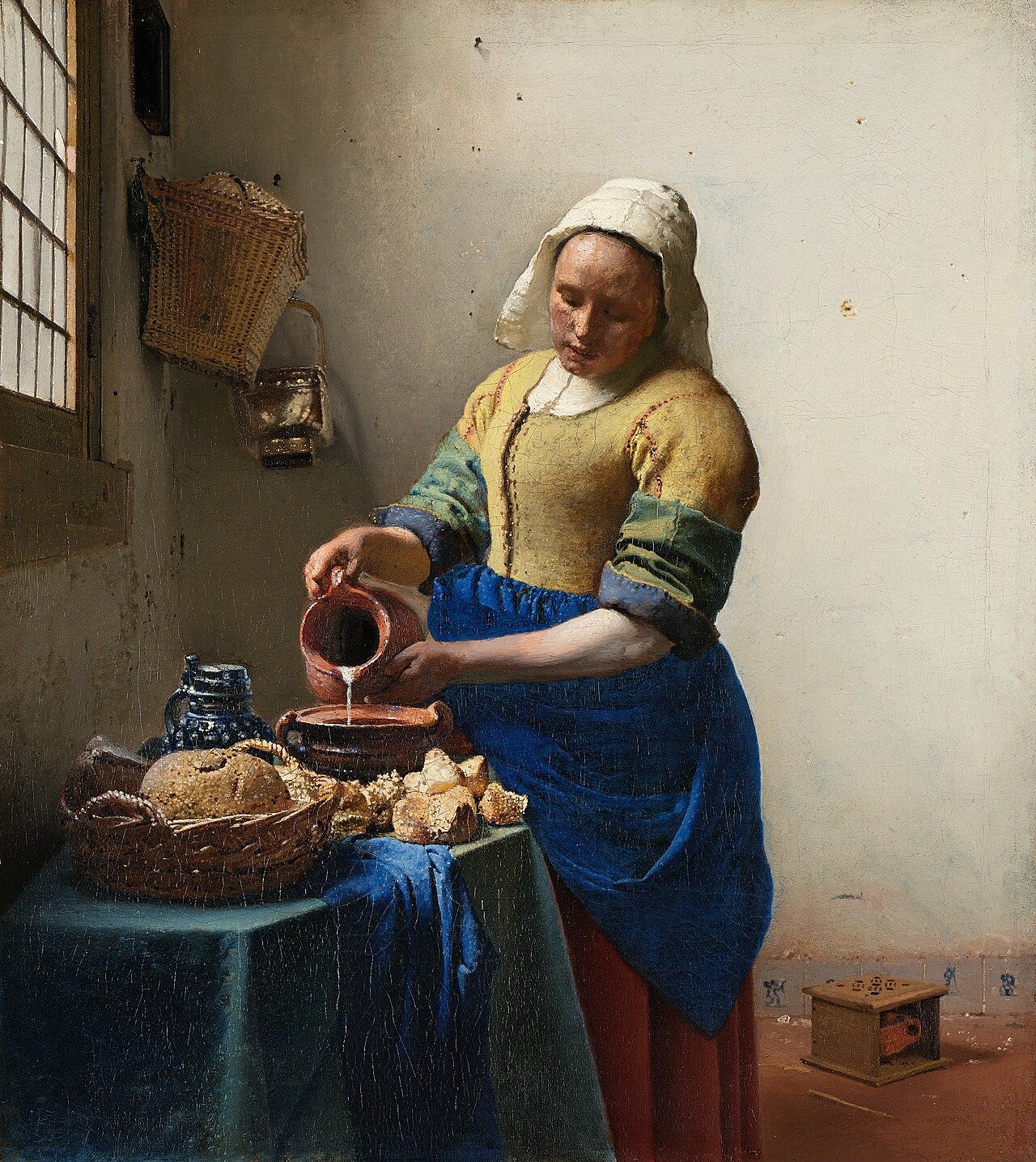
1 | The Milkmaid, Johannes Vermeer (about 1658)
A kitchen servant pours milk in a bare room. Everything is ordinary: bread, an earthenware jug, a foot warmer on the floor, a cracked wall.
Vermeer gave a maid the monumental stillness reserved for saints. The Rijksmuseum keeps her, and the painter More of it in Vermeer.
2 | Old Woman Frying Eggs, Diego Velazquez (1618)
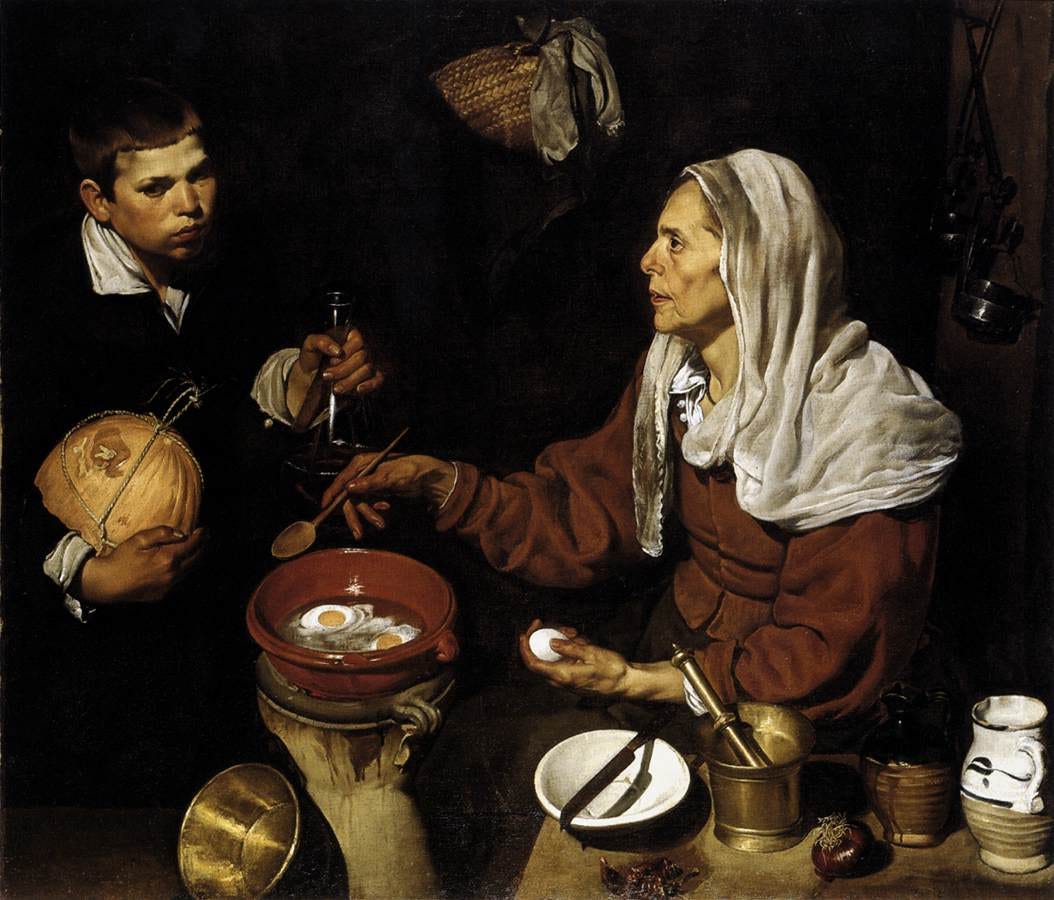
An egg sets in hot oil in real time, a boy carries a melon and a flask of wine, brass and clay catch the light. Velazquez was about nineteen.
These Spanish kitchen pictures are called bodegones, and he used them to learn everything. I go into his whole story in Diego Velazquez.
3 | A Meat Stall with the Holy Family Giving Alms, Pieter Aertsen (1551)
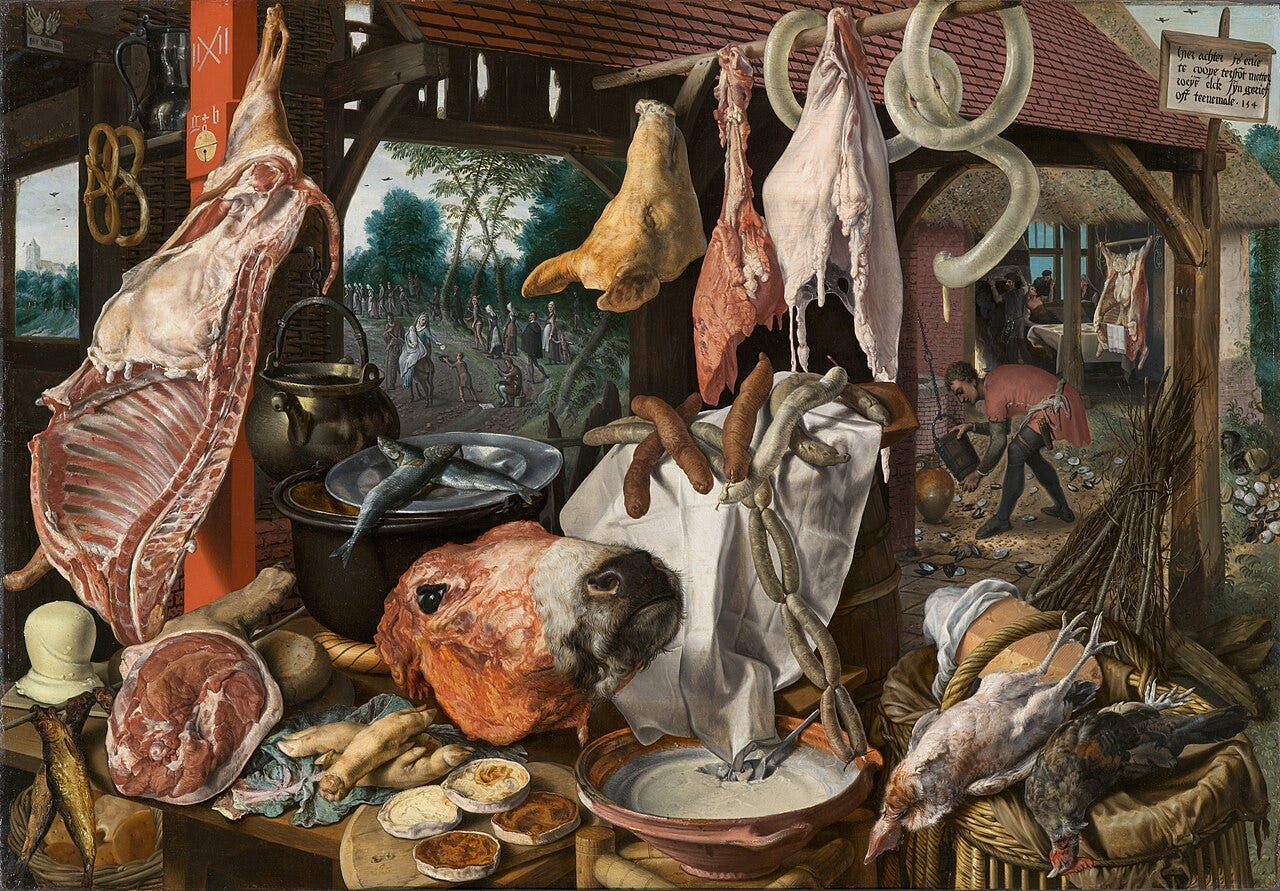
The whole front of the picture is butchered meat: a pig’s head, sausages, a slaughtered ox. Far behind, tiny, the Holy Family hands alms to a beggar.
Aertsen inverted the hierarchy of subjects a century before anyone else. Meat in front, mercy in the distance, and the viewer decides which one they looked at first.
4 | Christ in the House of Martha and Mary, Diego Velazquez (1618)
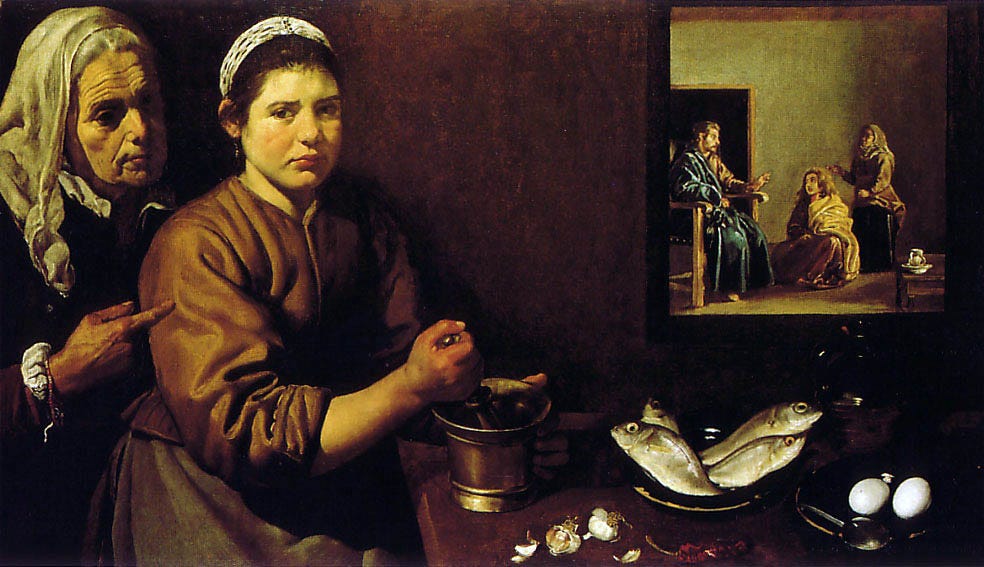
A young woman grinds garlic while an older one nudges her, and in a hatch behind them, Christ sits with Martha and Mary.
Scholars still argue whether the hatch is a window, a mirror or a picture on the wall. The kitchen argument and the Bible story rhyme: who does the work.
5 | The Kitchen Maid, Jean Simeon Chardin (about 1738)
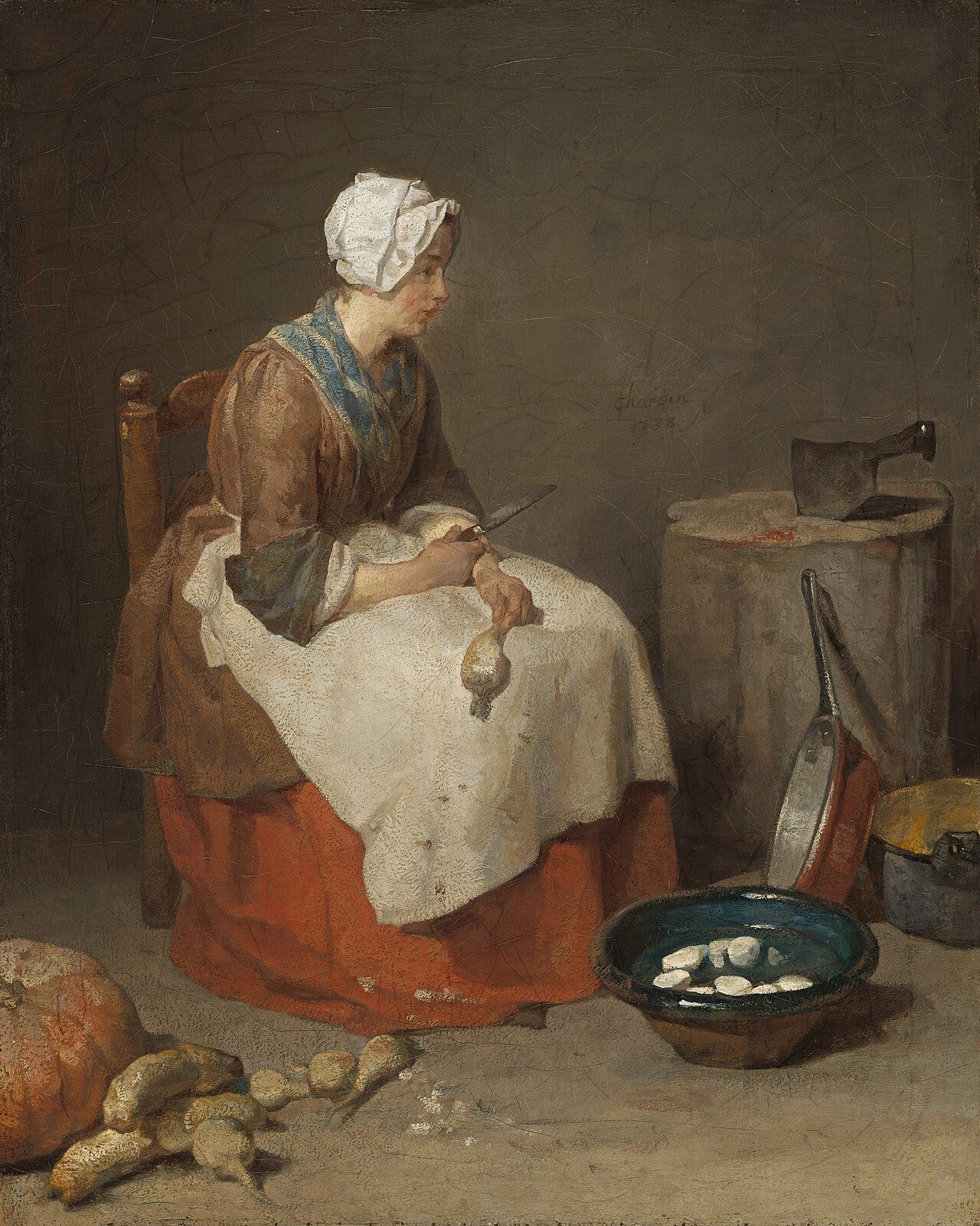
A servant pauses over a turnip, knife in hand, looking at nothing. Chardin painted the exact moment a mind wanders during a repetitive task.
Diderot said Chardin painted not objects but the air between them. The quiet master The full account is in Chardin.
Chardin painted several versions in the late 1730s, all small and all silent. Diderot praised him for making a copper pot worth looking at, which was not a compliment usually paid to still life.
6 | The Cook, Giuseppe Arcimboldo (about 1570)
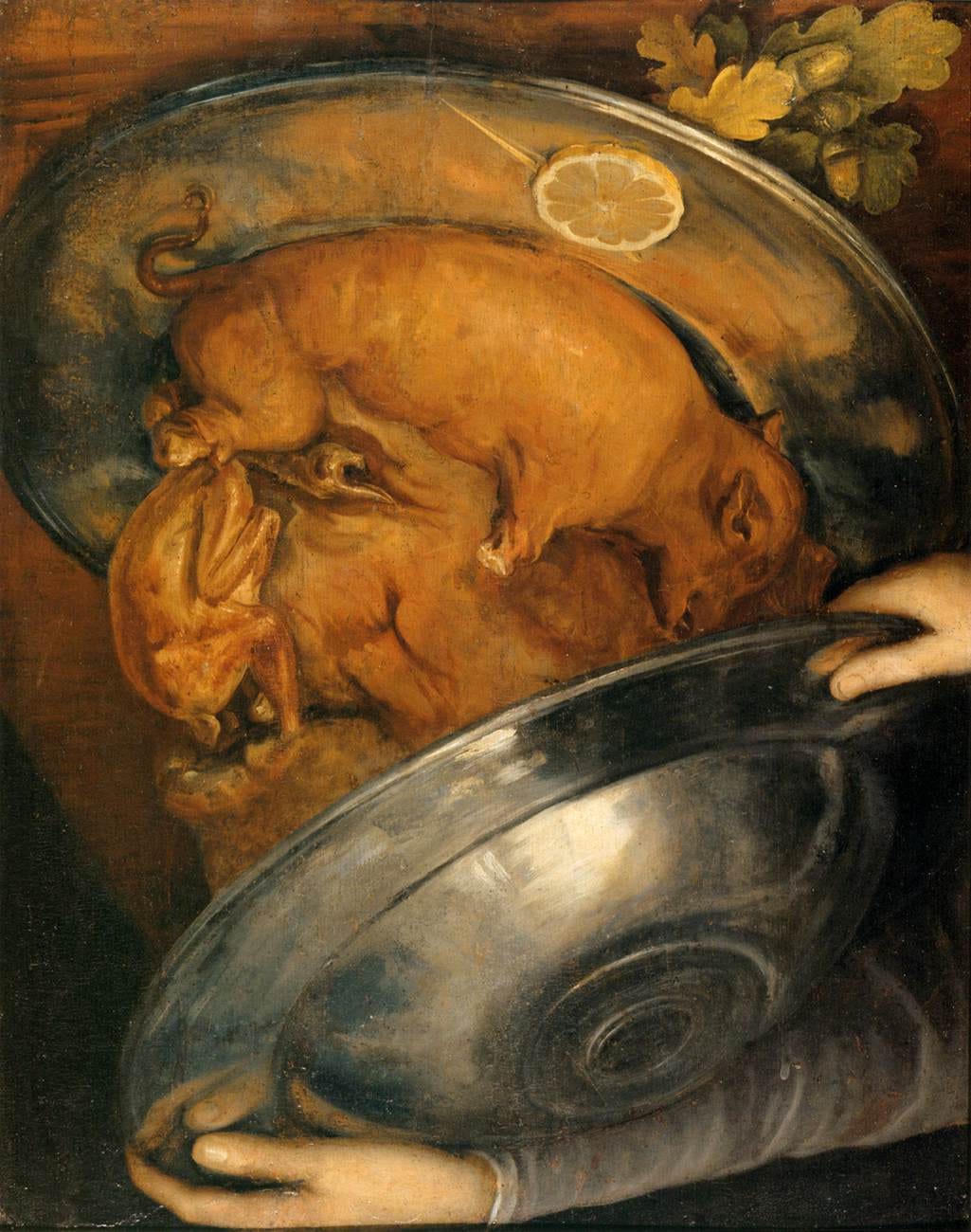
Turn the painting upside down and a platter of roasted meat becomes a cook’s face, helmet and all. Arcimboldo built portraits from ingredients.
The Habsburg court paid him well for these jokes, and museums now hang the picture with a mirror or a note telling you to flip it.
7 | The Bean Eater, Annibale Carracci (about 1585)
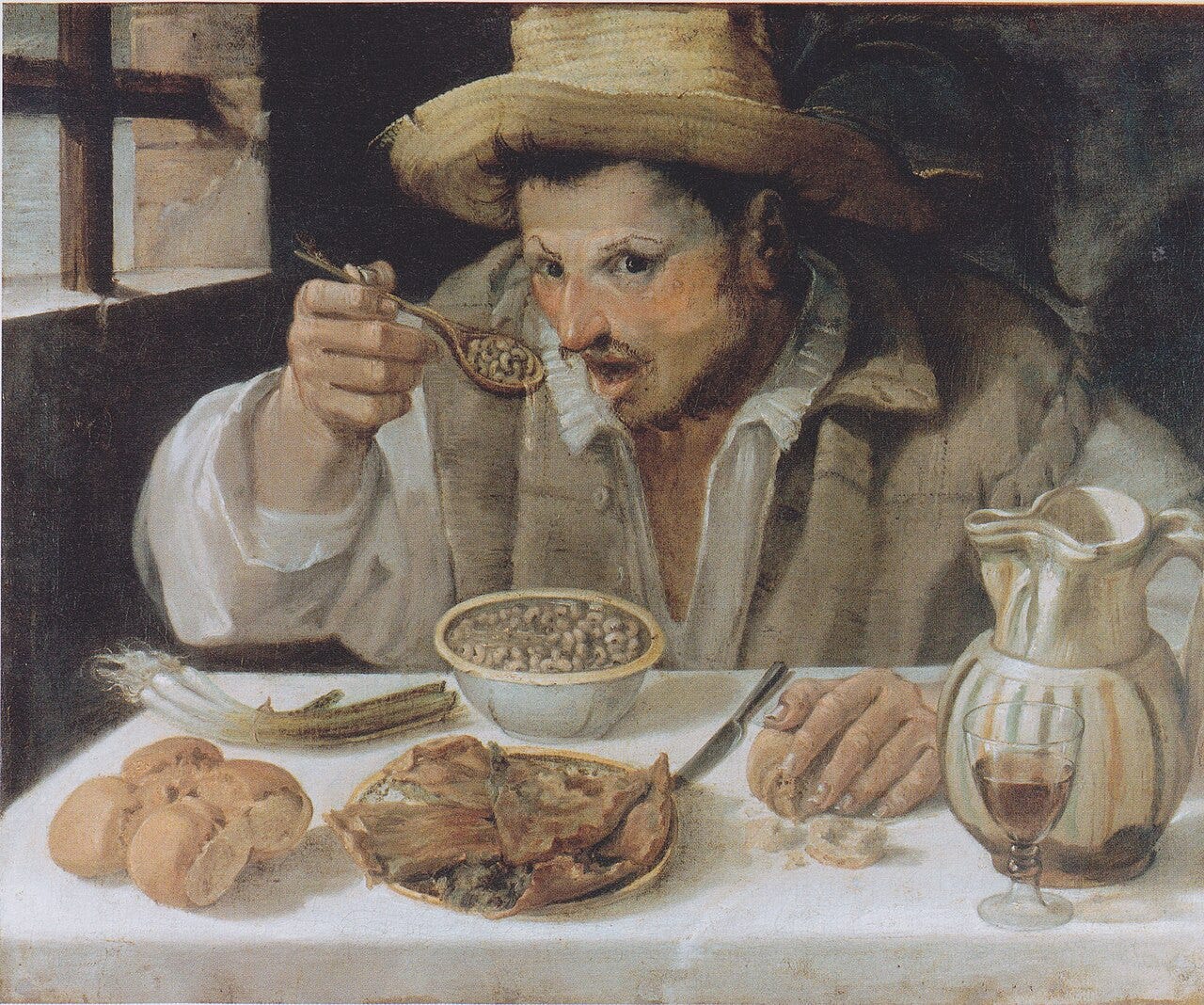
A peasant caught mid mouthful, spoon halfway up, staring at whoever just walked in. Beans, bread, onions, a rough cloth.
Nobody had painted a poor man eating with this much attention before. The reformer of Bologna I go into it in Annibale Carracci.
Carracci painted it around 1585 in Bologna, and it is one of the first pictures of a poor man simply eating, caught mid mouthful with the spoon up. There is no moral, no saint and no joke.
8 | The Kitchen Maid with the Supper at Emmaus, Diego Velazquez (about 1618)
The same trick as Aertsen: a servant girl among her pots in front, and the risen Christ recognized at a table in the background hatch.
The girl has stopped moving. She has heard something. Two versions exist, one where the background scene is missing entirely.
9 | A Kitchen, David Teniers the Younger (about 1644)
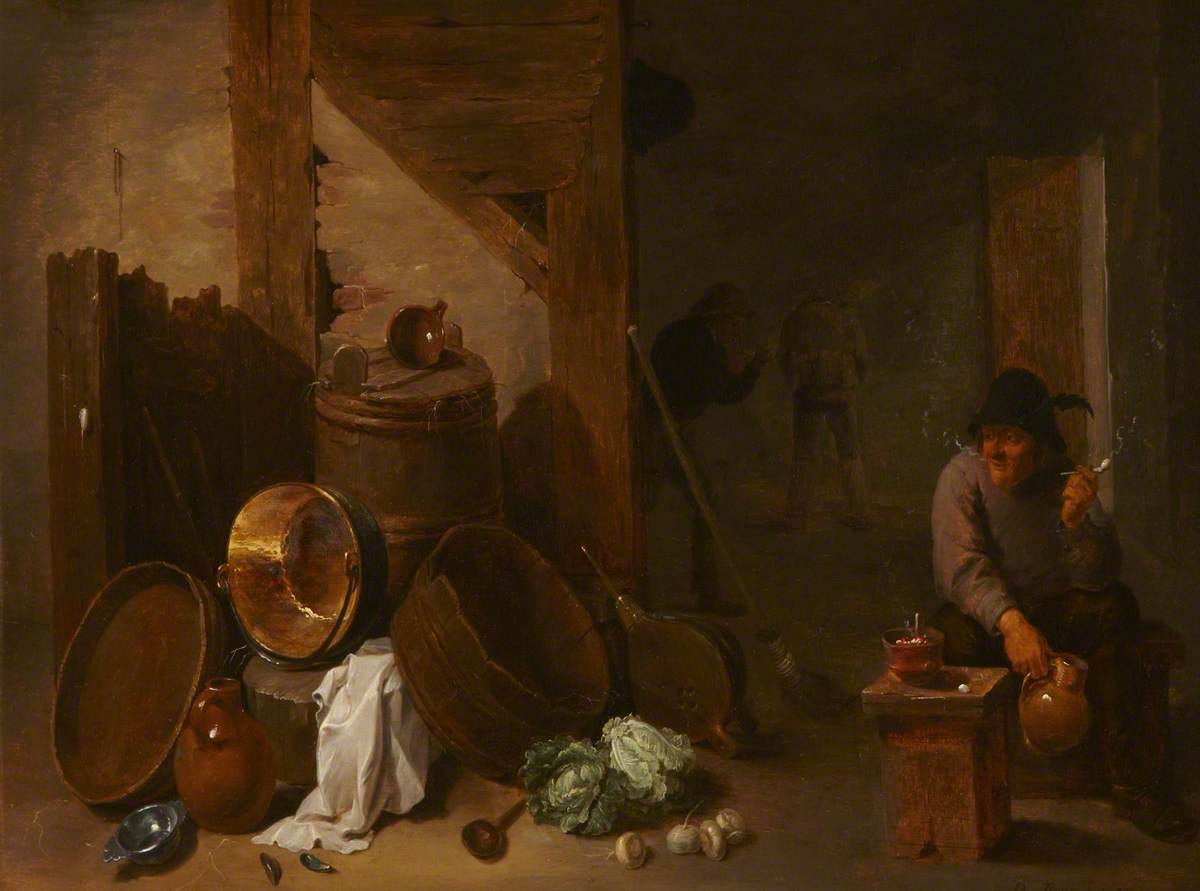
A Flemish kitchen inventoried like a shop: game birds hanging, copper pans, a servant plucking, a cat waiting under the table.
Teniers painted these for collectors who liked seeing wealth expressed in food. The cat is doing what cats have always done.
Teniers ran the picture gallery of Archduke Leopold Wilhelm in Brussels and painted kitchens for the same patrons who owned the gallery. The contrast between the subject and the buyer is the whole genre.
10 | The Ray, Jean Simeon Chardin (1728)
A gutted ray fish hangs open on a hook, oysters below, a cat arching over them with its back up. The fish appears to be grinning.
This painting got Chardin into the Academy at twenty nine. Matisse and Cezanne both copied it. The genre itself is in what is still life painting.
11 | The Kitchen Table, Paul Cezanne (about 1890)
A table of fruit, a basket, a jug, painted from several viewpoints at once so the table edges do not line up.
Cezanne broke the kitchen table and handed the pieces to Cubism. The whole quiet revolt I cover that in Paul Cezanne.
Cezanne painted his still lifes over weeks, using fruit that rotted and was replaced, and sometimes wax substitutes. The table edges famously do not line up, because he moved his own head as he worked.
12 | The Cook, Rembrandt circle drawings and the Dutch kitchen
Dutch households commissioned kitchen scenes as a form of self portrait: what hangs from the beams says exactly how the family is doing.
That whole genre of everyday life has a name and a history: what is genre painting. And the food that ends up on those tables is in famous market paintings.
The Rijksmuseum keeps the Milkmaid, and the Met holds the Spanish and Flemish kitchen pictures.
Aertsen's butcher stall and Velazquez's Kitchen Maid with the Supper at Emmaus both get praised as clever inversions of the sacred, meat up front and Christ hidden behind. That the Velazquez also existed in a version with no religious scene at all suggests the hidden Christ was closer to an optional extra buyers could skip than to the true point of the picture.
Diderot's line about Chardin painting the air between objects gets quoted here as settled praise, though the article never says what a copper pot demonstrates that the phrase actually means. Repeating a flattering quote from 1765 is not the same as showing the reader what to look for in the paint.
Teniers gets described as a contrast, gallery curator by day and painter of servants by night, but running an archduke's collection and selling kitchen scenes to the same wealthy circle is really one job, not two. These paintings were fashionable objects for people who already owned the Titians, not a break from that world.
Velazquez was about nineteen when he painted an egg frying in real time, packing glass, brass, and clay into one canvas. Vermeer, a generation later, stripped his kitchen down to a jug, some bread, and a plain wall. The egg frying shows more technical range, but the Milkmaid is the better painting because Vermeer knew what to cut.
Chardin's Kitchen Maid and The Ray work through stillness, a knife paused over a turnip, a fish hung to dry. Cezanne's Kitchen Table breaks that same quiet register apart, its edges pulling in different directions because he shifted his own viewpoint mid painting. Cezanne's picture is the more ambitious of the two, since it asks the eye to hold two versions of the same table at once.
Aertsen hides the Holy Family so far back that you can miss them entirely; Arcimboldo hides an entire face inside a platter of roasted meat. Aertsen's trick rewards a slow read from front to back, Arcimboldo's needs one physical move, turning the canvas over. The Arcimboldo is the better joke, and the Aertsen is the better painting, because the meat in the foreground holds attention whether or not you ever spot the tiny figures behind it.
What readers ask about these kitchens
If you only look at one, which? Vermeer’s Milkmaid, with Velazquez’s Old Woman Frying Eggs as the Spanish answer.
What is a bodegon? A Spanish kitchen or tavern scene mixing still life and figures. Velazquez made his name with them before going to court.
Why is Christ hidden in the background of kitchen paintings? It let painters sell an everyday scene while keeping a religious subject, and it asks the viewer what they notice first.
Is Arcimboldo’s Cook really upside down? Yes. Right way up it is a platter of meat. Inverted, it becomes a face.
Where is The Milkmaid today? The Rijksmuseum for the Milkmaid, Edinburgh for the Egg Frying, Uppsala for the Cook, the Louvre for Chardin.
One detail worth carrying away: X rays of Vermeer’s Milkmaid found a wall hanging and a basket that he painted over, leaving the bare wall instead. He emptied the room on purpose so nothing could compete with a stream of milk.
Nearly everything on this page is oil on canvas, a medium with its own history of tricks: famous oil paintings.
This subject is one thread in a wider theme. See how it fits into Food and Drink in Art.