
Twelve works made in Korea before 1900, many of them meant for a tomb, a temple or a storeroom rather than for a collector. Among them are a bronze said to call for a child each time it rings, a painted dream signed by men who were later put to death, and a porcelain jar that owes its lopsided shape to the way it was built.
Cool Stories About Art is a newsletter to learn art the fun way.
Join 200,000+ readers and get:
10 new art stories / month
The entire archive of content (140+ articles)
Comment, ask questions, and chat with other readers
From Goguryeo to Joseon
Until 1910, Korea was ruled by a succession of kingdoms, and each left its own kind of art. Goguryeo, which held the north of the peninsula until 668, painted the walls of its tombs. Silla ruled the southeast from its capital, Gyeongju. Goryeo, from 918 to 1392, was the age of green celadon, and Joseon, from 1392 to 1910, the age of white porcelain and ink painting.
Korean craftsmen often took their techniques from China: a glaze, the pose of a Buddhist figure, the manner of the landscape painters. What they then made with them was something China rarely or never made, from white and black designs set into the clay under the glaze to painted views of real Korean places.
The twelve works were all made in Korea before 1900, in paint, bronze, stoneware and porcelain, and no named artist appears twice. Many were made to be used, rung in a temple, hung from a saddle, buried with the dead or filled with grain. Each was chosen for a detail that can be seen and for the story that detail opens.
12. The Divine Bell of King Seongdeok (771)
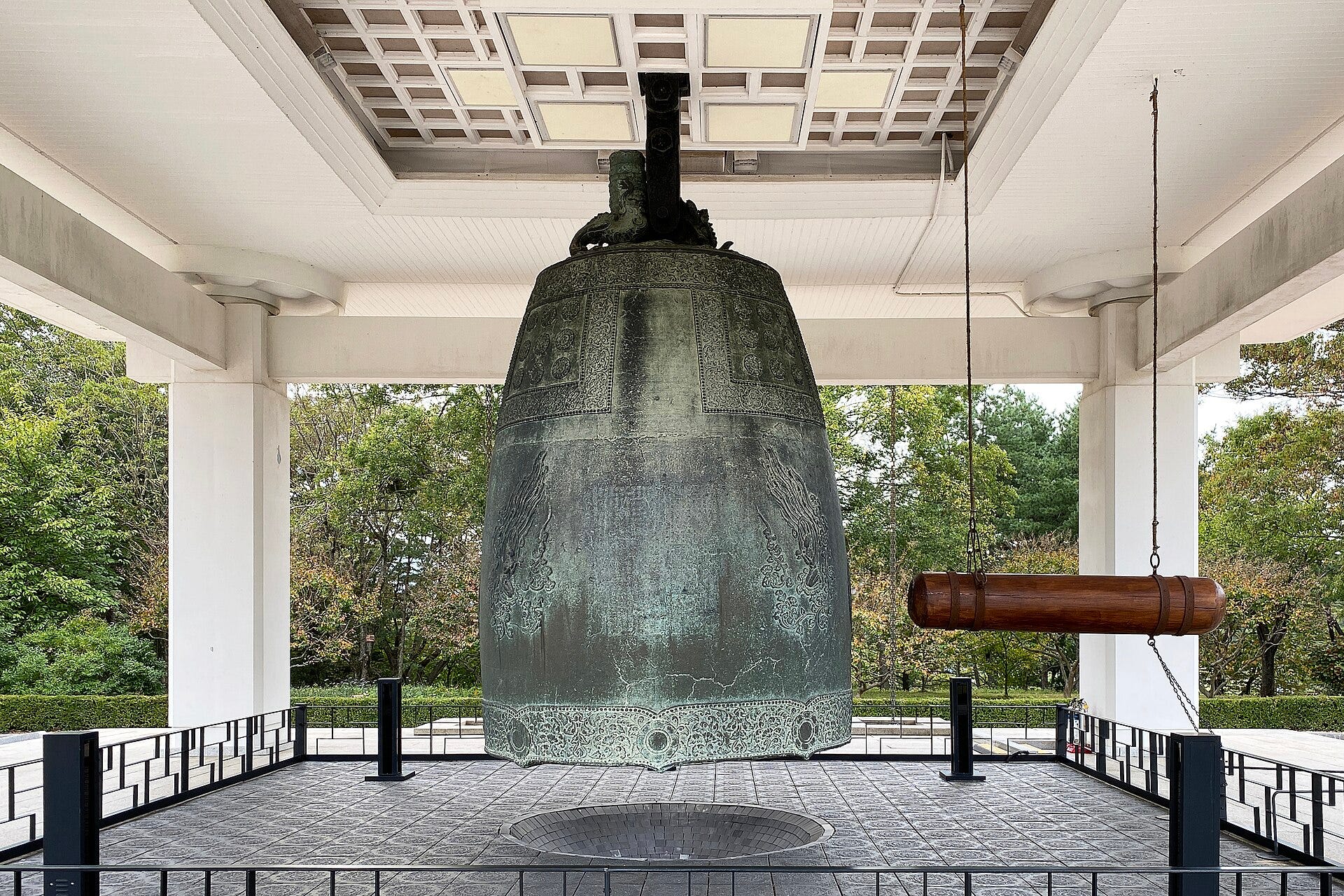
Where the wooden beam strikes this bronze bell, the metal carries a lotus with eight petals, cast in relief. On either side of it, heavenly beings kneel two by two on lotus cushions, facing each other as they make an offering, their scarves floating upward.
Each time the bell rings, the sound starts at that lotus, and that sound was the whole purpose of the Divine Bell of King Seongdeok. It was finished in 771 in the kingdom of Silla, and an inscription of about 1,000 characters on its side says what it was for: its sound must carry the virtue of the dead King Seongdeok everywhere.
The sound also gave the bell its legend. When the monks went from house to house collecting metal, the story goes, a poor woman told them that all she had to give was her child. A monk then dreamed that the bell needed that child, and the child was thrown into the molten bronze.
In the legend, that is why the bell cries "emille" when it rings, heard as "because of mommy," and why it is also called the Emille Bell. Yet no old chronicle tells this story. The earliest known written version appears to be in English, by an American, in 1895, and the legend took the form told today only in the twentieth century.
In 1998, researchers took samples from the bronze to look for the child. Their test could not settle the question completely, because a body is lighter than molten copper and might have floated up as slag to be skimmed off. But the samples showed not a trace of phosphorus, one of the main components of bone.
At a Glance
Artist: Bronze casters of Unified Silla
Made: Completed in 771
Medium: Bronze
Size: 366 cm high, 227 cm across the mouth (144 × 89 in)
Where to see it: Gyeongju National Museum, Gyeongju, South Korea
11. Yun Du-seo, Self-Portrait (about 1710)
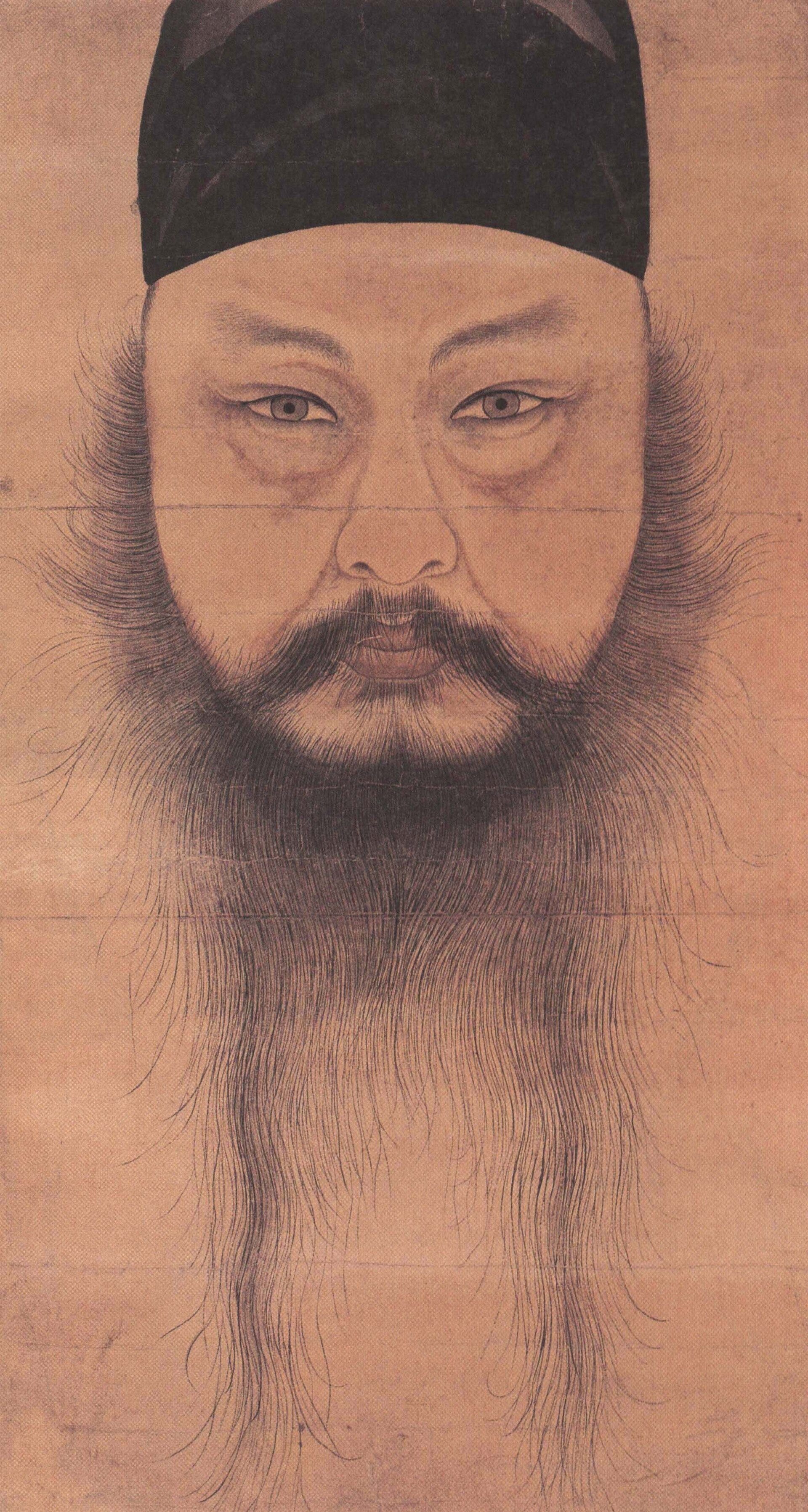
A man's face fills the whole sheet. The top of his black cap runs past the upper edge of the paper, his beard and whiskers are drawn hair by hair in long curves, and he stares straight at the viewer. There is no neck and there are no shoulders, only the face. In eighteenth-century Korea, a portrait showed a man in his robes, with the badges of his rank. The paper below the beard is not as blank as it looks.