
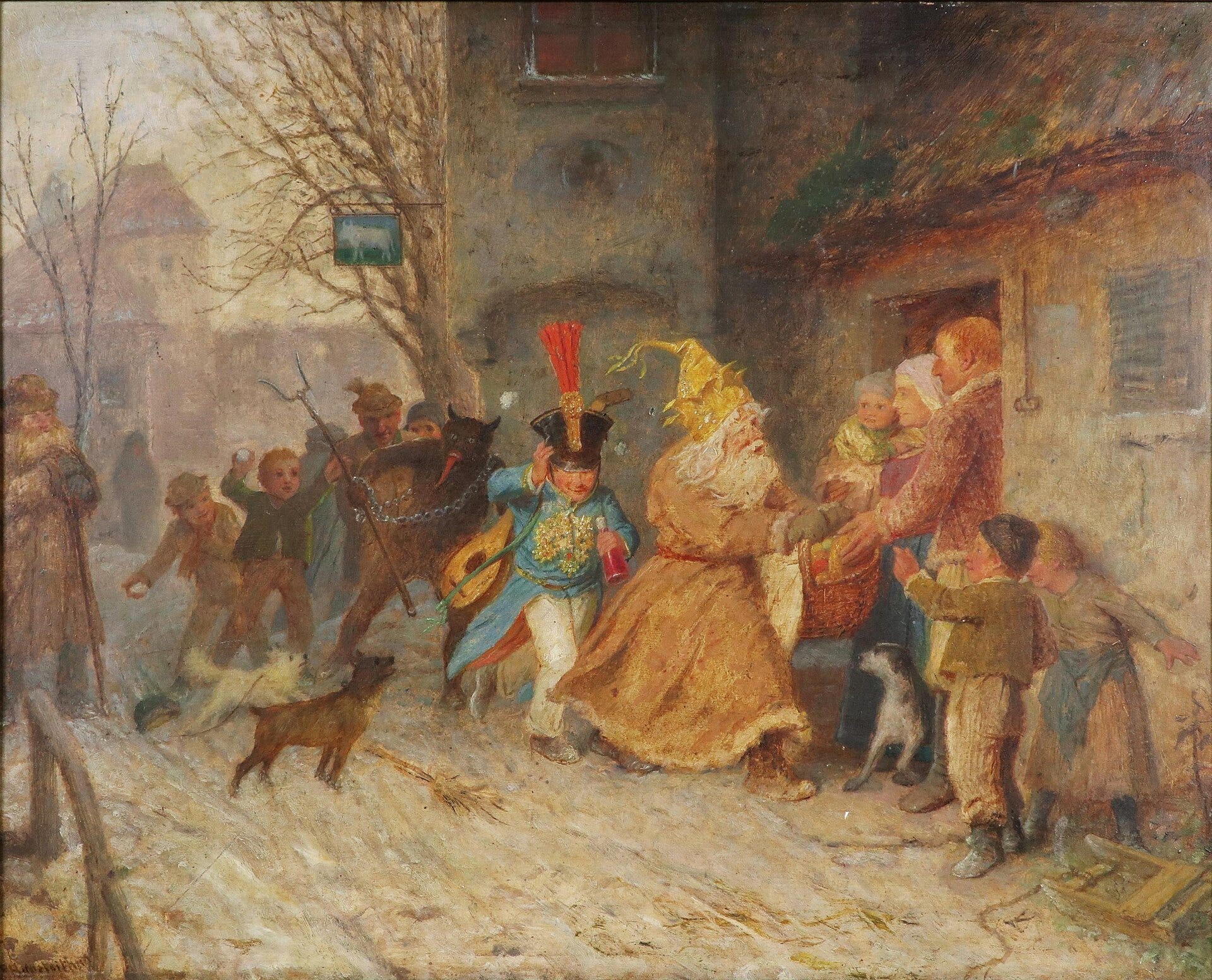
On the evening of December 5, a hairy devil with horns, a long red tongue and a bundle of birch twigs comes to Alpine homes at the side of Saint Nicholas. Academic painters almost never took him on. His face was made instead by candy makers, mask carvers, newspaper illustrators and the printers of cheap color postcards.
Cool Stories About Art is a newsletter to learn art the fun way.
Join 200,000+ readers and get:
10 new art stories / month
The entire archive of content (140+ articles)
Comment, ask questions, and chat with other readers
The Devil Who Comes With Saint Nicholas
In the German-speaking Alps, the Krampus travels with Saint Nicholas. On the eve of the saint's feast, Nicholas hands out presents while the Krampus threatens bad children with a birch rod, chains and a basket, and the rod is his emblem.
What he was before that is thinly documented. He appears in folk plays from the 1600s on, and his name may come from an old German word for a claw or a hook. Pagan roots are often claimed for him, but no source supports them.
The Church disliked how closely he resembled the Devil, and no campaign against him ever lasted. Artists met him in the things people made, bought and mailed for the feast, from the candy shops and weeklies of the 1880s to an American novel of 2012.
12. Joseph de La Nézière, The Crampus Made of Prunes (1894)
Under one arm, the little devil carries a birch rod, meant for children who misbehave, and his body is made of prunes. In March 1894, the Revue des traditions populaires, a Paris journal of folklore, printed a drawing of him and presented him as a souvenir sent from Vienna, the kind of gift the Viennese mailed one another for Saint Nicholas.
The drawing is by Joseph de La Nézière, a French artist then twenty years old, and it describes the object piece by piece. The figure, called a Crampus, stood about 50 centimeters tall. Its head, deeply wrinkled, and its hands were papier-mâché in a dark brown tone, and a red ribbon hung out as its tongue.
Below the head, the costume was edible. Dried almonds lined the shoulders and the belt, a breastplate of currants covered the chest, a skirt of scarlet satin hung from the waist, and the black legs ended in horse's hooves.
In Vienna, such a thing surprised no one. A prune Krampus, a Zwetschkenkrampus, was already a subject in a Vienna daily in December 1889, five years before this one went to Paris by mail. The journal names neither the sender of the parcel nor the confectioner who made it.
What it does record is the best part. The fat body of prunes opened like a box, and the box was full of candy.
At a Glance
Artist: Joseph de La Nézière (1873 to 1944), after a figure by an unknown Vienna confectioner
Made: 1894
Medium: Drawing reproduced in print
Size: Not published for the drawing (the prune figure was about 50 cm, or 19.7 in, tall)
Where to see it: Revue des traditions populaires, March 1894, digitized on Gallica, Bibliothèque nationale de France, Paris
11. Unknown carver, Krampus Mask from Bad Mitterndorf (about 1950)
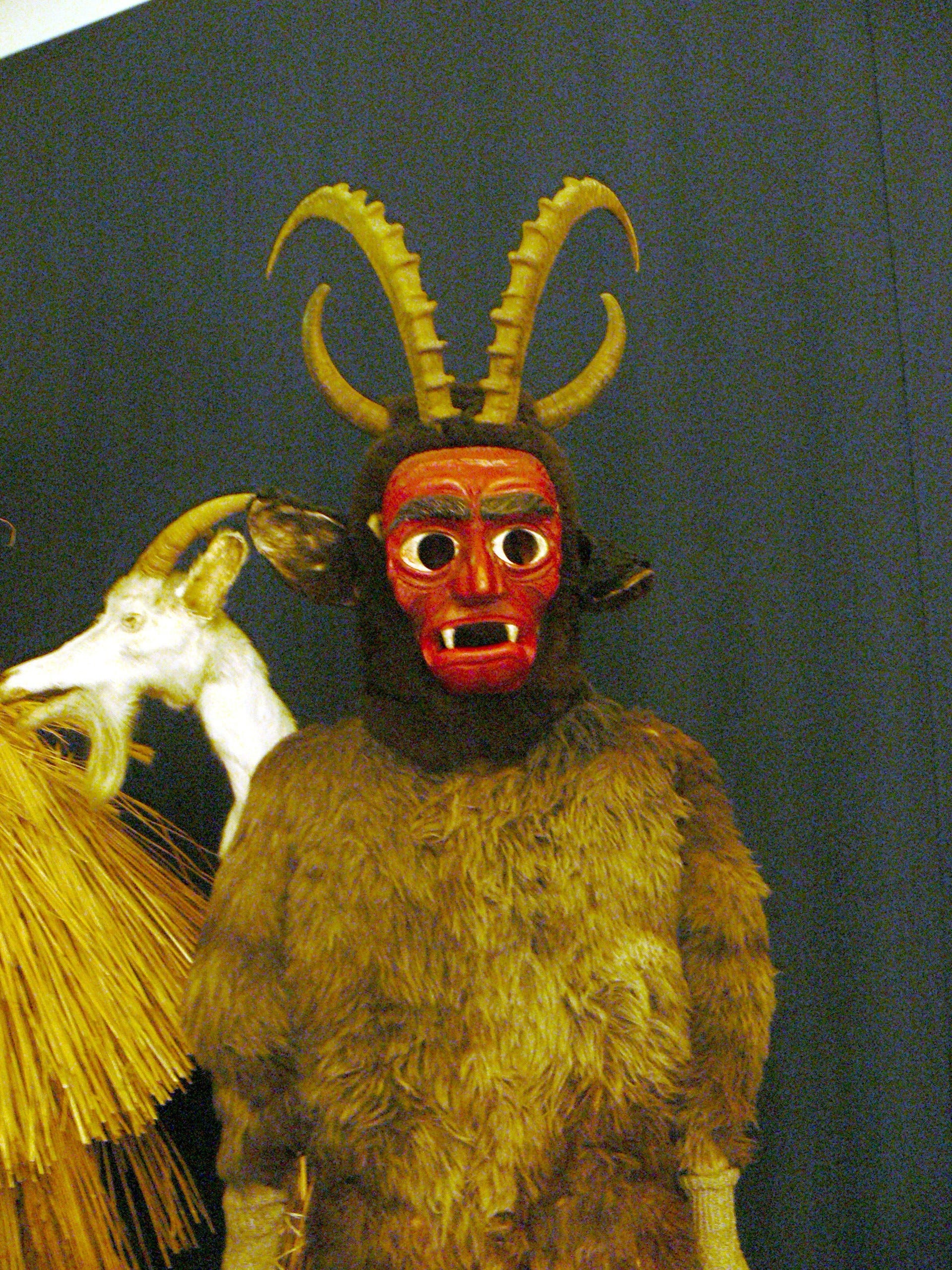
On the evening of the saint's feast, more than 120 people set out together through the hamlets of Bad Mitterndorf, a village in the mountains of Styria, in central Austria. They are performing the Nikolospiel, a play about Saint Nicholas, and its two central roles are the saint, called Nikolo, and the Krampus.