La Grande Odalisque: The Deliberate Anatomical Error

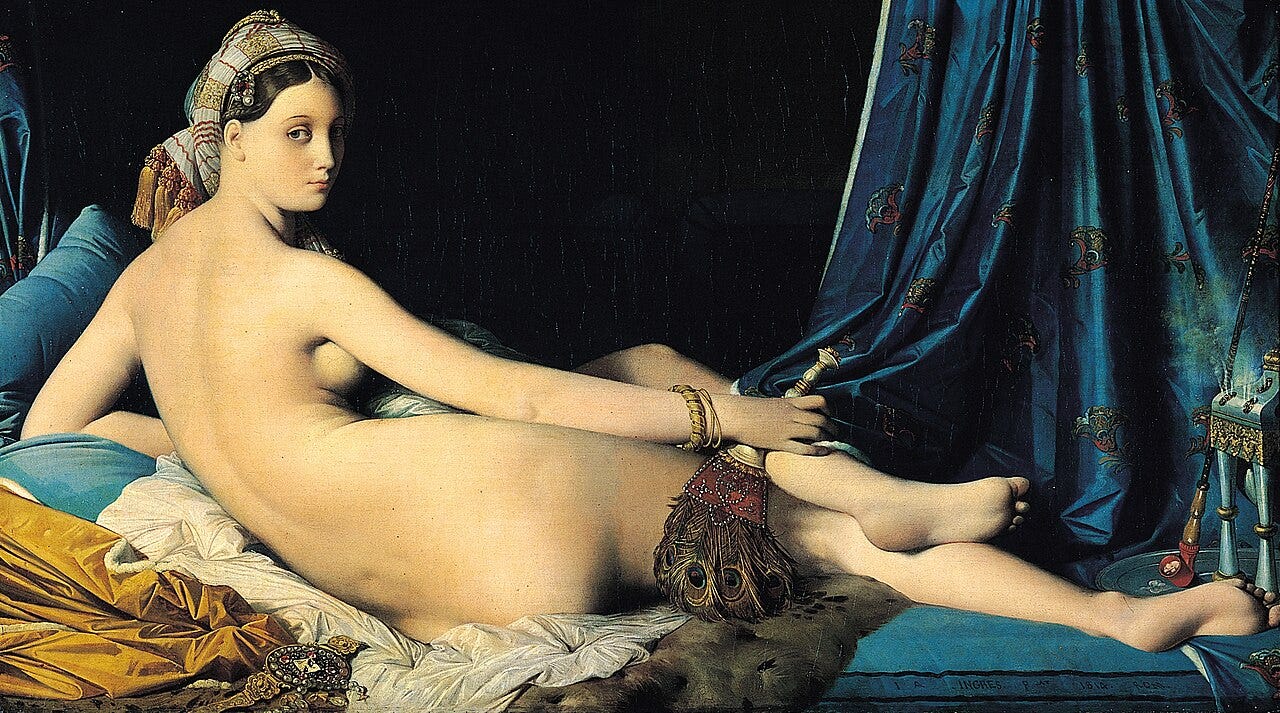
La Grande Odalisque is an 1814 painting by Jean Auguste Dominique Ingres, in the Louvre in Paris. It shows a reclining nude in a Turkish harem, looking back over her shoulder.

Her back is anatomically impossible: Ingres gave her about three extra vertebrae, and he did it on purpose.

Reclining nude looking over her shoulder in a harem setting
Jean Auguste Dominique Ingres, La Grande Odalisque, 1814

Critics said she had no bones and no muscle, and they were right. Ingres bent the human body to make a longer, cooler, more perfect line. Here is what an odalisque was, why the anatomy is wrong, and why it became famous anyway.


Learn art the fun way. Free stories every week, no boring lectures.


The back that cannot exist

Look along her spine. It is too long. The old complaint was that she had three lumbar vertebrae too many; a modern measurement put the excess closer to five.

Her pelvis tilts at an angle no real spine allows. If a woman were built this way she could not stand.

None of it is a mistake, and that is what I love about it. Ingres could draw anatomy perfectly when he chose to. He stretched her deliberately, because a smooth unbroken curve running from her shoulder to her hip was more beautiful to him than a correct skeleton.

He was willing to break the body to get the line, and that decision is the whole argument of the picture.

What an odalisque was

The title is not a name. An odalisque was a chambermaid or attendant in the harem of an Ottoman sultan, and in the Western imagination the word had drifted into meaning something more, an available woman in an exotic, faraway palace.

Ingres never went east. He built the fantasy from props: a peacock feather fan, a jeweled turban, a long pipe for opium or tobacco, heavy silk curtains, a cool blue interior.

This is Orientalism, Europe painting an East it had mostly imagined, a distant setting that made a nude respectable by placing her safely somewhere else.

Why the Salon called her boneless

When the picture was shown in Paris in 1819, the critics were merciless. One famously complained that she had neither bones nor muscles, neither blood nor life, that Ingres had painted a beautiful shape and forgotten she was supposed to be a person.

They were attacking exactly what Ingres was proud of. He belonged to a camp that prized line and smooth finish above all, against the rival camp that prized color and energy.

La Grande Odalisque was his manifesto for line, and the very coldness the critics hated is what later painters came to admire. What looked like incompetence in 1819 was recognized as a choice within a generation.


Join 130,000 readers who get the secrets behind the paintings. Free.


The commission that vanished

The painting was ordered by Caroline Murat, Queen of Naples and a sister of Napoleon, as a companion to another nude. By the time Ingres finished it, Napoleon had fallen and the Murats had lost their throne, so the queen who commissioned it never took delivery.

Ingres was left with a large nude and no buyer, and it drifted for years before entering a French collection. The most famous odalisque in art was painted for a queen who was deposed before she could hang it.

A short walk from the Mona Lisa

La Grande Odalisque is in the Louvre in Paris, a short walk from the Mona Lisa, and it does not travel often. It carries no price; as a pillar of the French national collection it is treated as beyond sale.

It has since had a second life as a feminist emblem: the Guerrilla Girls put her body, with a gorilla mask, on their 1989 poster asking whether women had to be naked to get into the museum.


La Grande Odalisque, quick answers

  • What is wrong with the anatomy? Her back is too long, by the equivalent of two or three extra vertebrae, and her proportions are impossible. Ingres distorted her on purpose for a longer, smoother line.

  • What does odalisque mean? An attendant or chambermaid in the harem of an Ottoman sultan. In Western art it came to mean a reclining nude in an imagined Eastern setting.

  • Who painted it and when? Jean Auguste Dominique Ingres, in 1814. It was shown at the Paris Salon in 1819.

  • Why is it famous? For its beauty and for the scandal of its anatomy. Critics said the figure had no bones; later artists saw a deliberate pursuit of line.

  • Where is La Grande Odalisque? The Louvre in Paris.


If this painting pulled you in, you will love these too:


The error that scientists measured

The distortion was so obvious that it eventually got the attention of doctors. In 2004 a pair of French physicians measured the figure and calculated that her lower back held roughly five extra vertebrae, publishing the finding in a medical journal as a study of artistic licence.

Ingres spent his life defending the primacy of drawing, and two centuries later the proof that he broke the rules on purpose came from a radiology paper rather than an art critic.

You can see La Grande Odalisque in person at the Louvre. For more by the artist, browse the Metropolitan Museum collection.

What people ask about the Grande Odalisque

  • What is an odalisque? An odalisque was a female attendant or concubine in an Ottoman harem. In European art the word came to mean a reclining exotic nude.

  • Why does her back look so long? Ingres stretched her spine, adding what looks like extra vertebrae. It was a deliberate choice for a longer, smoother line, not a mistake.

  • Who painted it? Jean Auguste Dominique Ingres, in 1814.

  • Where is La Grande Odalisque? It hangs in the Louvre in Paris.

  • Why is it famous? It joins cool Neoclassical drawing to an Orientalist fantasy, and its distorted, elegant body has fascinated viewers for two centuries.


Two new stories a week, 130+ secrets unlocked. Start free.