
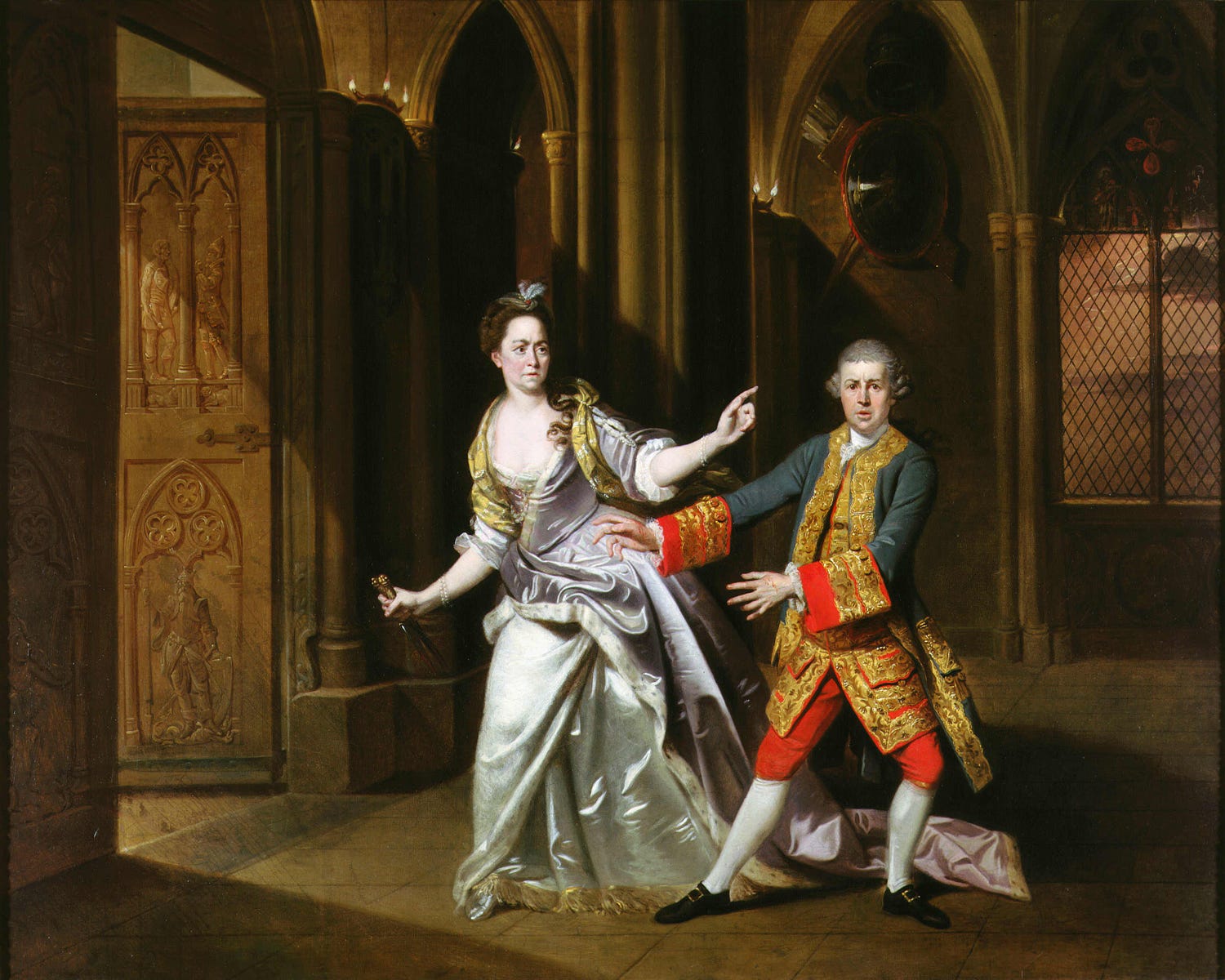
Shakespeare never gives Lady Macbeth a first name, and he says almost nothing about how she looks. For over a hundred years, her face was decided by the actresses who played her on the London stage, and painters followed them into the theater. Later, artists began to recognize themselves in her, and an actress who had become a printmaker drew her own face in the role.
Cool Stories About Art is a newsletter to learn art the fun way.
Join 200,000+ readers and get:
10 new art stories / month
The entire archive of content (140+ articles)
Comment, ask questions, and chat with other readers
Painting a Woman From the Stage
Lady Macbeth is the wife who pushes her husband to kill King Duncan and take his crown, and who then loses her hold on herself. That turn, from ambition to guilt, made her a figure of both, and it is why artists kept coming back to her.
Two moments return more than any other. In the second act, she takes the daggers from her husband. In the fifth, she walks in her sleep with a candle, while a doctor and a gentlewoman watch and listen.
Every work chosen here shows her, not only her husband or the witches. Half of the twelve were made by a woman or show an actress in the part, and that is the thread: for a long time, picturing this queen meant painting a real woman.
12. Elisabet Ney, Lady Macbeth (1905)
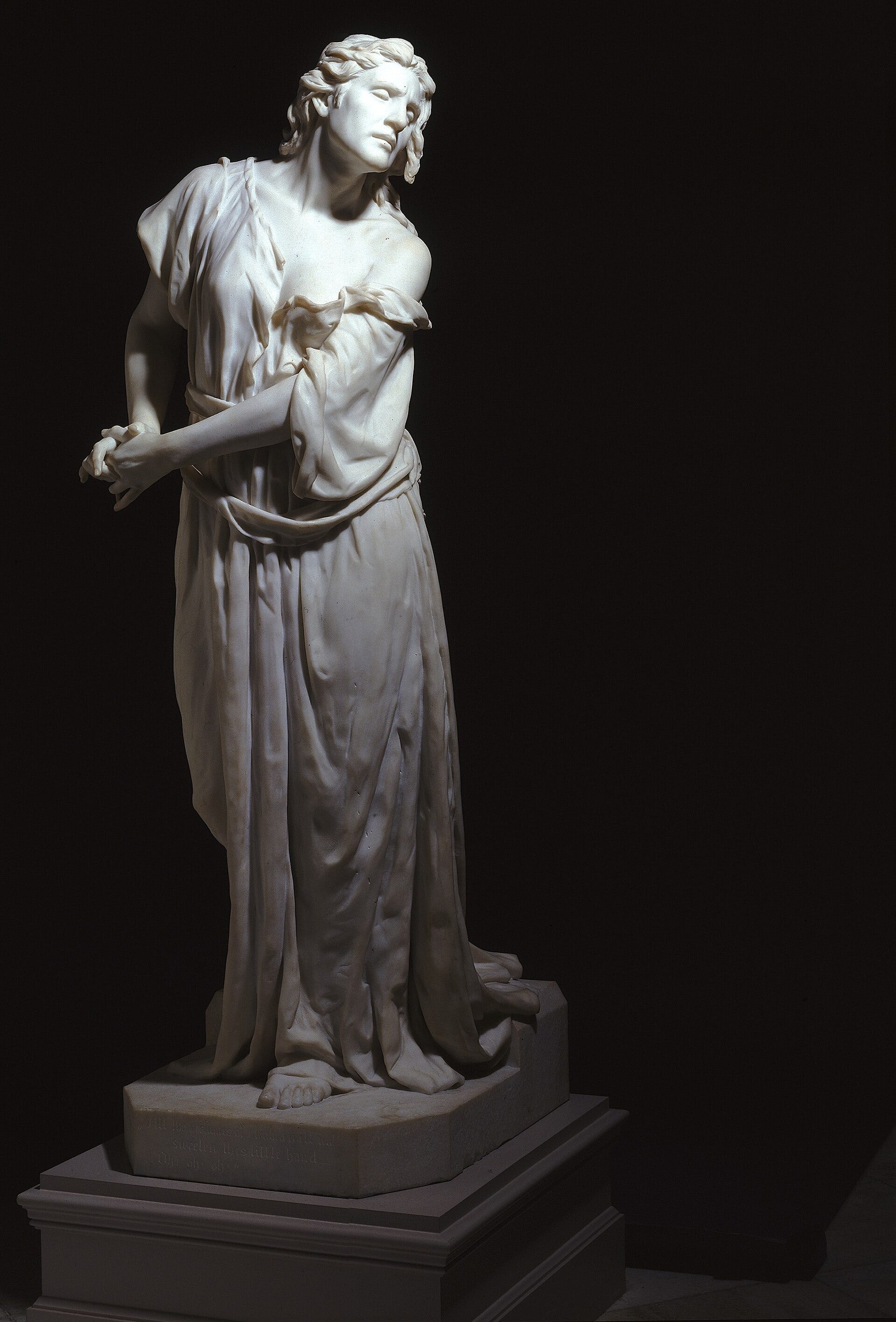
This marble woman is life-size, and she walks with her eyes half closed. Her brow is furrowed, one arm hangs stiff at her side, and the folds of her gown cut across her body in sharp diagonals. She is Lady Macbeth walking in her sleep in the fifth act, and the sculptor who made her was past seventy when the marble was finished.
That sculptor, Elisabet Ney, had made her name in Europe long before she reached Texas. Born in Münster, in Germany, in 1833, she became the first woman to study at the Royal Academy of Fine Arts in Munich, and she went on to model portraits of the philosopher Arthur Schopenhauer and of Giuseppe Garibaldi, the hero of Italian unification.
She then left Europe behind. In the early 1870s she emigrated with her husband, the Scottish doctor Edmund Montgomery, and settled in Texas. In 1892 she built a studio in Austin, which she called Formosa, and the state commissioned from her statues of Stephen F. Austin and Sam Houston, two founding figures of Texas.
Lady Macbeth, though, was a much older idea. Ney said it had come to her in Germany, and her biographer traced it back to when she was nineteen. In Austin, she finally modeled the figure around 1899 and finished the plaster in 1902.
The last step took her back across the Atlantic. The plaster went to Europe to be cut in marble, a block large enough proved hard to find, and Ney made one last journey to see the work through. The marble was finished in 1905, two years before her death at Formosa.
Ney left no word on what the figure meant to her. Since it reached Washington, the figure has been interpreted as a self-portrait as much as a Lady Macbeth: a woman who refused the conventions of her time, and a mother who felt guilty toward her son Lorne, who had broken with her as a teenager.
That reading seems right to me, because out of the whole play, Ney picked the moment when Lady Macbeth can no longer hide what she has done.
At a Glance
Artist: Elisabet Ney (1833 to 1907)
Made: Plaster model 1902, marble finished 1905
Medium: Marble
Size: 187.2 × 65.4 × 75 cm (73 ¾ × 25 ¾ × 29 ½ in)
Where to see it: Smithsonian American Art Museum (Luce Foundation Center), Washington, D.C.
11. Dante Gabriel Rossetti, The Death of Lady Macbeth (about 1875)
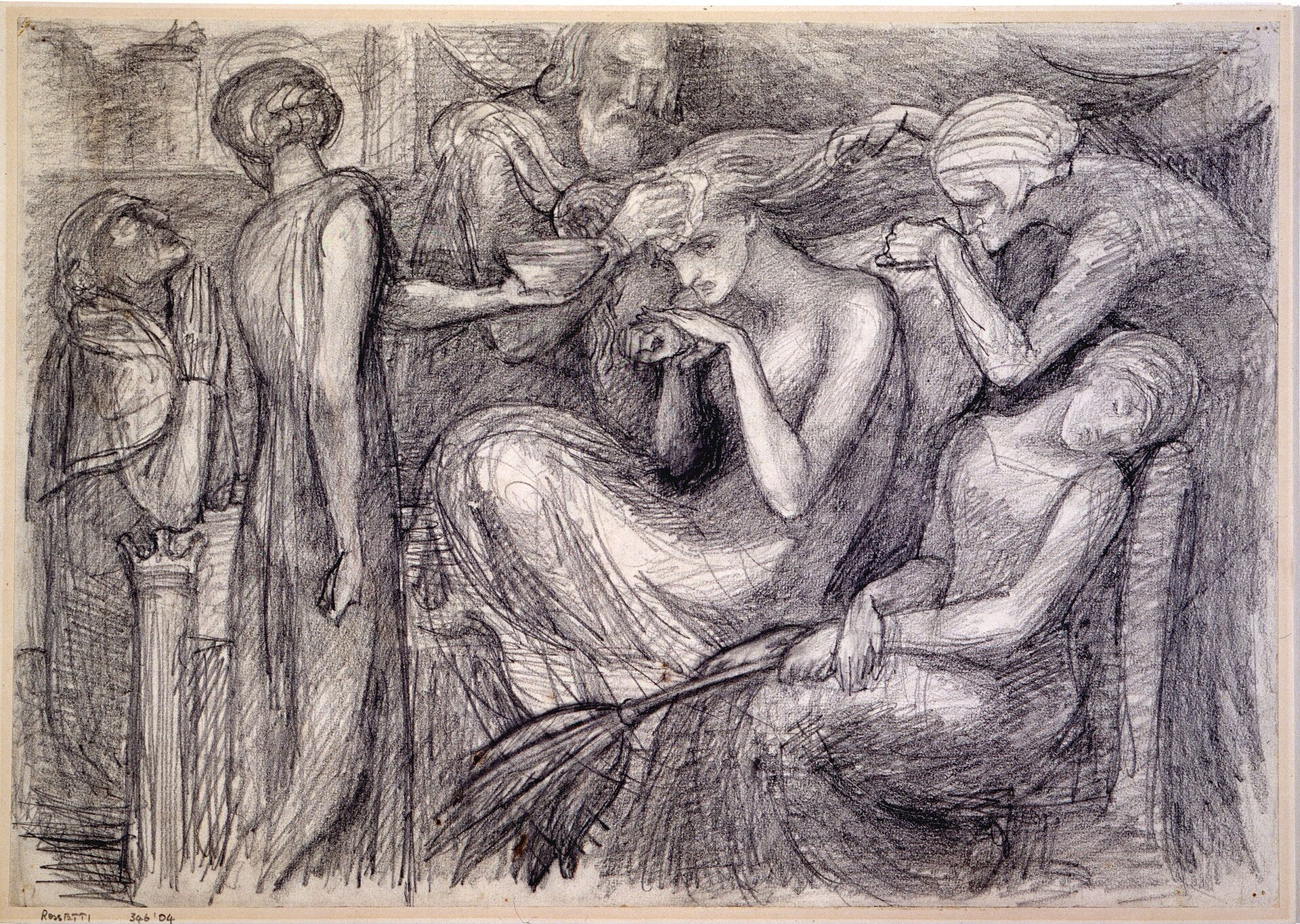
A woman with loose hair sits slumped among cushions, her hands pressed to her mouth, while an old man holds out a bowl and other women pray or weep around her. This is the death of Lady Macbeth, a scene Shakespeare never wrote. In the play she dies offstage, and her husband hears of it in a single line. Around 1875, a painter set out to give that missing scene a large canvas of its own.