

200 000+ readers learn art the fun way.
This is a preview. Paid subscribers get the full story.
You’ll also get:
10 new stories / month
The full archive (140+ Art stories)
Your personal art guide. Comment, ask questions, DM me anytime
Apple user? Subscribe at coolstoriesabout.art, not via the app. Apple adds 30% to the price.
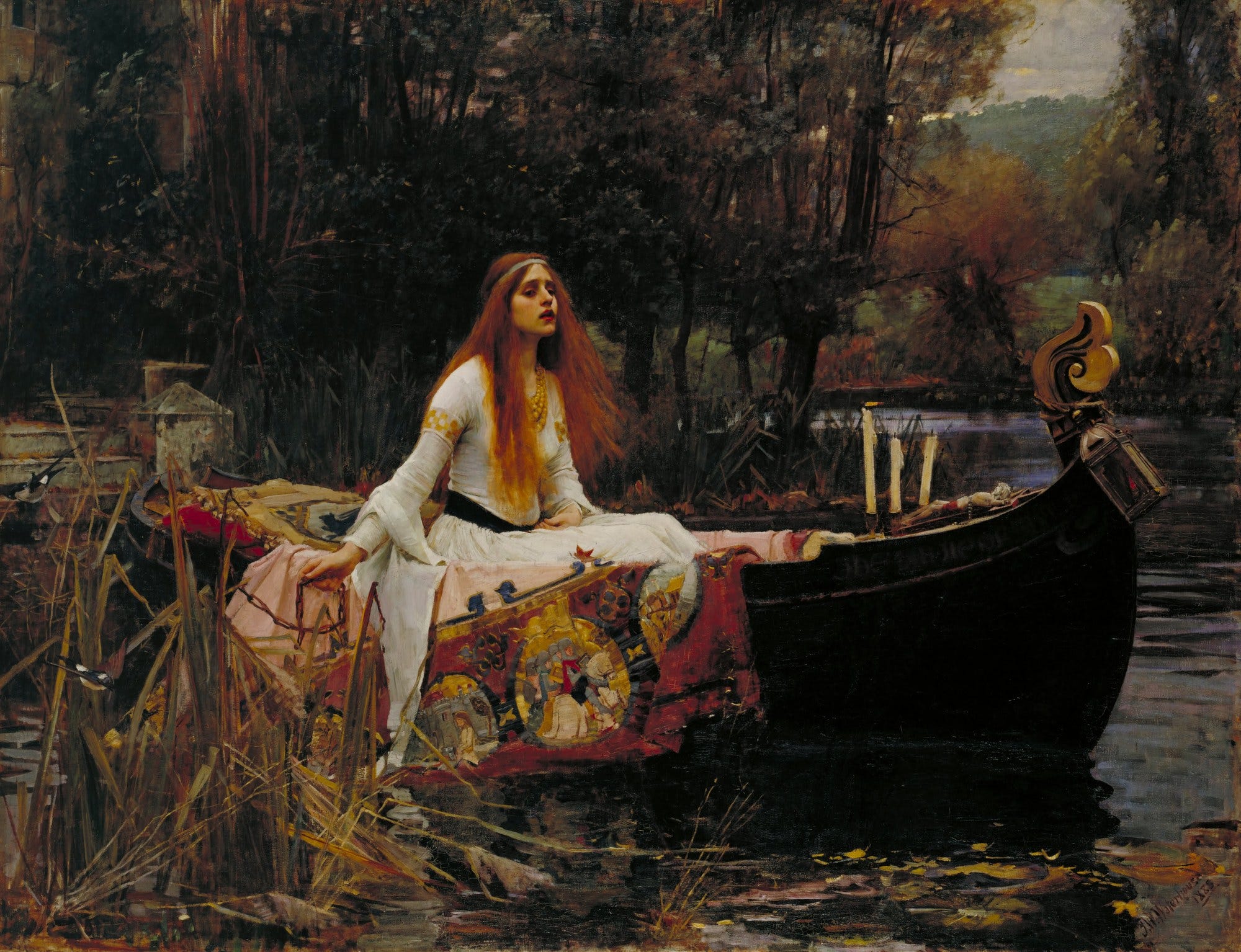
A woman in white drifts down a river in a boat, under a gray autumn sky. She is very pale, her lips parted. With one hand, she holds a chain that hangs over the side. In the bow, the front of the boat, near a crucifix, three candles stand, and two of them are out.
John William Waterhouse painted her in 1888, and the canvas hangs today at the Tate in London. Who is she, and how did she end up alone in this boat?
In 1980, Elizabeth Taylor stars in a murder mystery with an odd title, "The Mirror Crack'd." The film is adapted from an Agatha Christie novel, and the novelist didn't invent that title. She borrowed it from a line by Alfred Tennyson, the greatest English poet of the Victorian era.
That line comes from a poem, "The Lady of Shalott," which English painters of the late nineteenth century never tired of illustrating. None returned to it as often as Waterhouse, heir to the Pre-Raphaelites, the English painters who had made the legends of the Middle Ages fashionable again. He painted it three times.
The boat is the most famous of the three. To understand what it shows, you first have to know the story the poem tells.
The island
The story is set in the days of King Arthur, the legendary king of early Britain, whose knights, in the medieval tales, gather at a Round Table where no seat outranks another. His city is Camelot. But the story doesn't begin at the palace.
It begins on the bank of a river that runs down to Camelot, between long fields of barley and rye, beside a road traveled by everyone headed for the city.
In the middle of the river lies a small island, Shalott. Four gray walls and four gray towers rise above a garden of flowers, and a woman lives there, the Lady of Shalott.
No one has ever seen her. Travelers on the road have never glimpsed her face at a window. Only the reapers, cutting barley at dawn, sometimes hear a song drifting over from the island, and they whisper to one another that it is the fairy Lady of Shalott singing.
No one sees her because she never goes out. Behind her gray walls, she spends her days and nights at her loom, the big wooden frame on which threads are woven. She is bent over a vast, brightly colored tapestry, and she never lifts her eyes to the window.
A voice once whispered to her that a curse would fall on her if she looked toward Camelot. What sort of curse, she has no idea. The voice never said. So she weaves.
The mirror
She does see the world, but only in reflection. A large mirror hangs in front of her, above the loom, and the whole road behind her appears in it. In the glass she sees girls on their way to market, an abbot riding past, a little shepherd driving his flock, knights riding two by two, everyone heading down to Camelot while she stays on her island.
The poem calls these reflections shadows. They are what the Lady weaves, thread by thread, into the web of her tapestry: the market girls, the abbot, the shepherd and the knights file through it one after another, reversed, exactly as the mirror gives them to her. Of life she knows nothing but these shadows.
At night, she sometimes sees a funeral procession pass through the mirror, heading down to Camelot with torches and music. And one evening, under the moon, the mirror shows her two young lovers, newly married, walking down the road together. Then the Lady speaks, for the first time since the poem began.
I am half sick of shadows
Waterhouse painted that weariness.
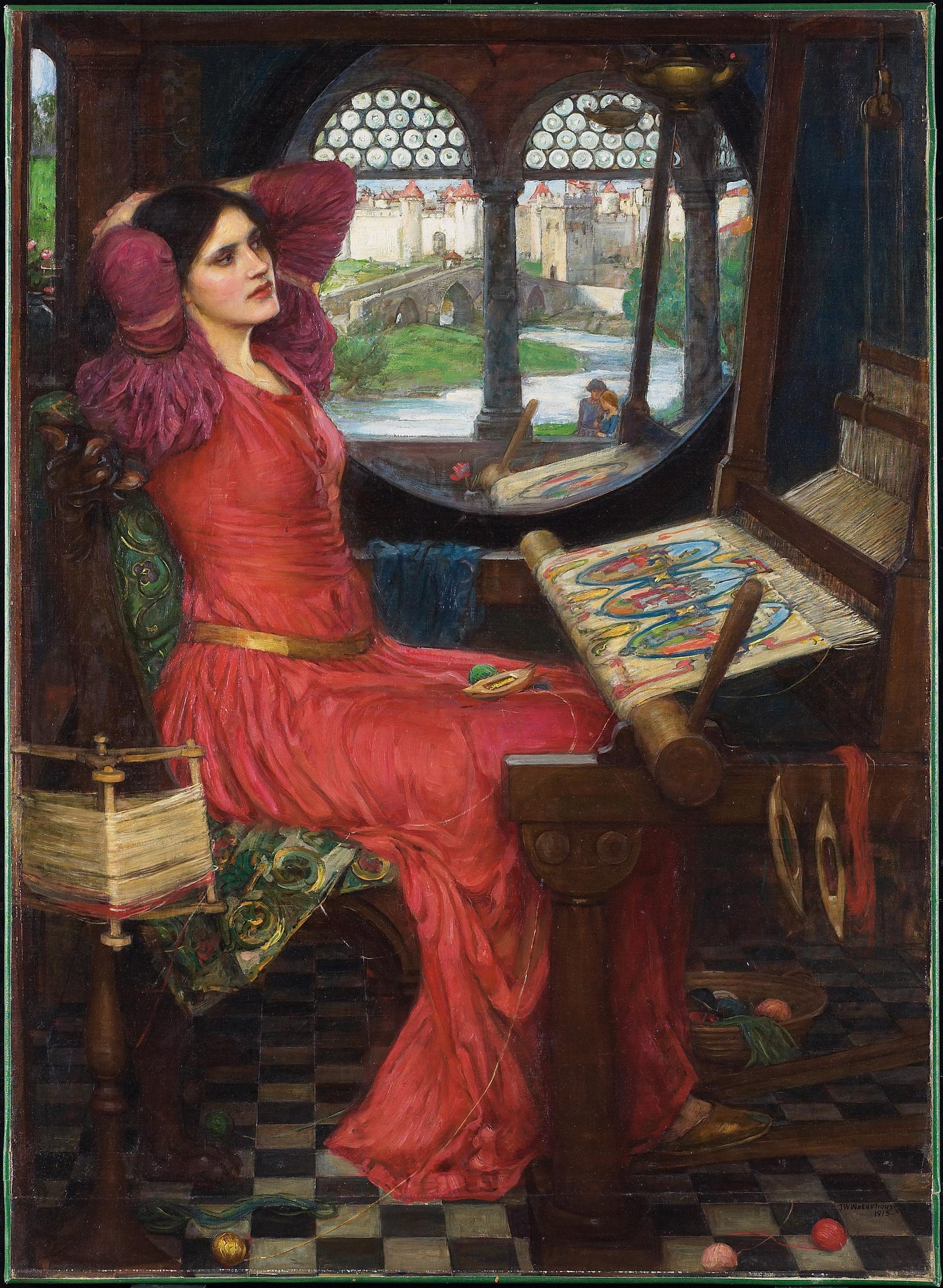
In the version now in Toronto, the Lady sits before her loom in a long red dress, her arms raised and her hands clasped behind her head, the way you stretch at the end of a day that has gone on too long. She has turned her face away from the mirror, and her eyes stare at nothing.
In the oval mirror she has left at her back, you can make out what she is no longer looking at: the river, a stone bridge, towers, and, at the water's edge, two small figures side by side.
Near the loom hang two shuttles, the slender wooden tools that carry the thread from one side of the tapestry to the other, and a third lies in her lap. They are shaped like little boats.
Keep those shuttles in mind.
The knight
And then, one day, a rider passes through the barley fields, close by the island. The sun sets his armor ablaze, the bells on his bridle jingle with every step of his horse, and he sings as he rides along the river. His name is Lancelot, the most famous of Arthur's knights, the one whose deeds fill every story of the Round Table.
His reflection streaks across the mirror like lightning. He is no longer one shadow among many: he is a man in armor, in the sun, singing.
The Lady leaves her loom. She takes three steps across the room. With her own eyes, not through the mirror, she sees the water lilies blooming on the river, the knight's helmet and plume. And she looks toward Camelot.
The tapestry rips free of the loom and flies out the window. The mirror cracks.
The mirror crack'd from side to side
There it is: the line Agatha Christie took for her title.
The Lady cries out.
The curse is come upon me
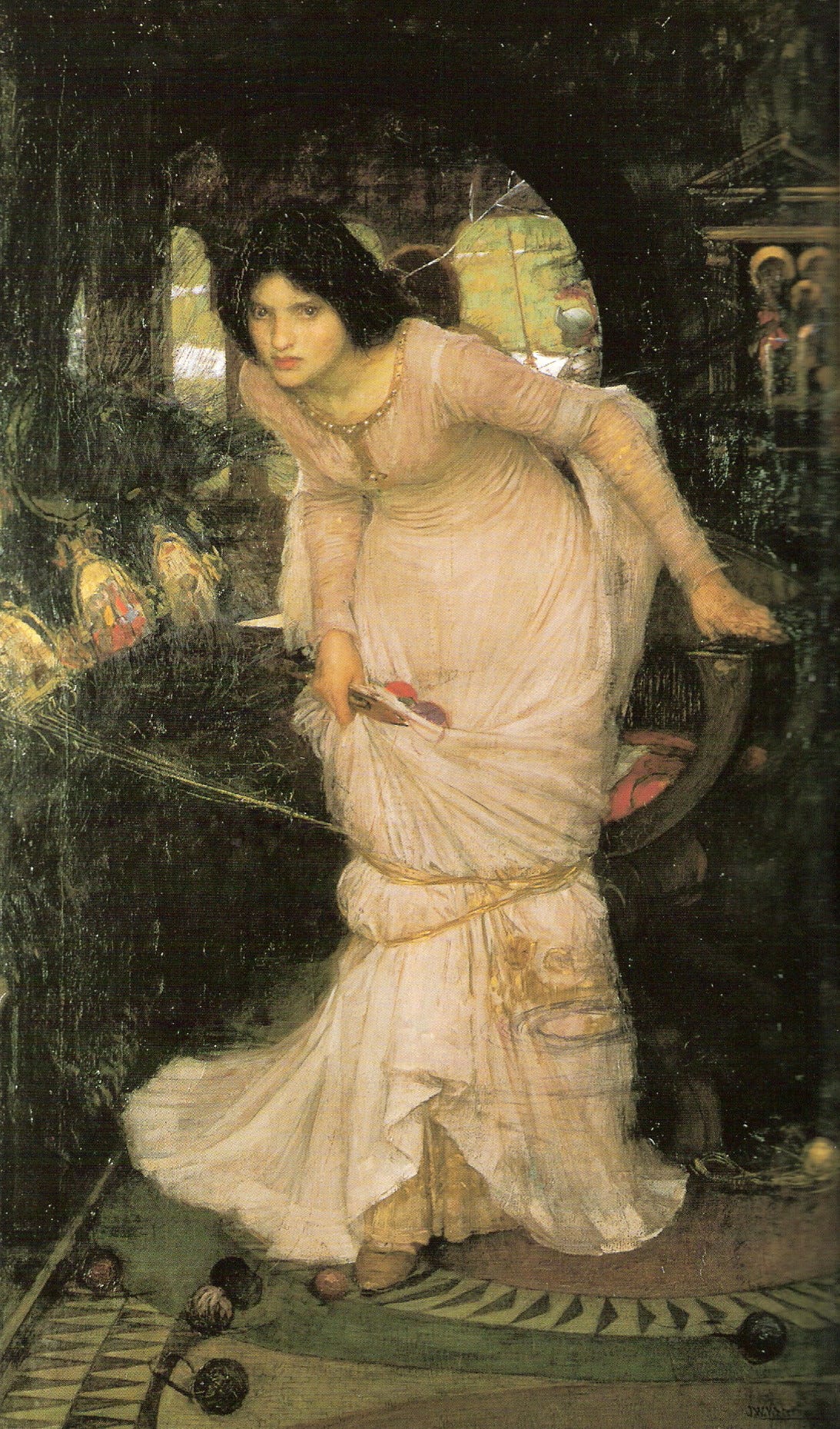
Waterhouse painted that moment too, in the version now in Leeds. The Lady leans out from her loom, caught at the hips in golden threads that bind her like cords, as if the tapestry itself were trying to hold her back.
Her face is strained, her brow knit, her gaze fixed beyond the frame, on what she should never have seen. Behind her, the oval mirror is laced with cracks.
Discover my new newsletter !

The boat
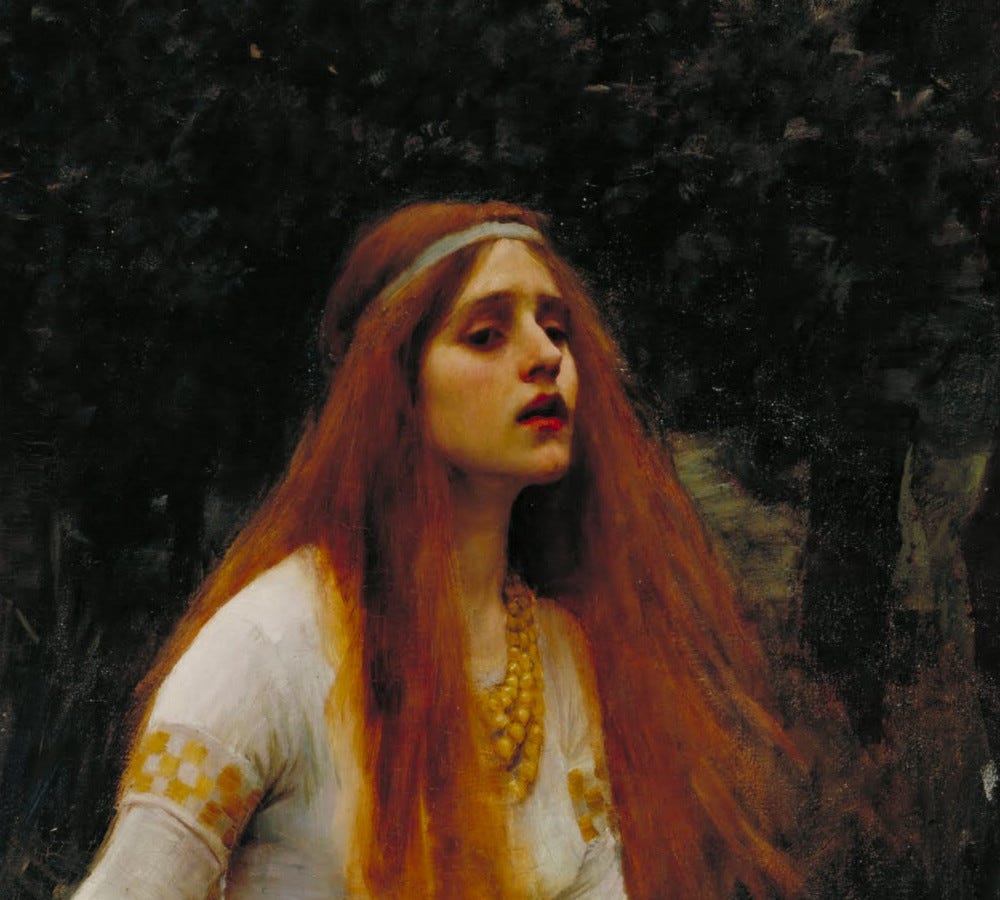
Which brings the story back to the Tate painting. The room is gone, and the loom, and the mirror. The Lady is outdoors, adrift on the water, the chain in her hand, two of her three candles out, a large red cloth spread beneath her.
What happened between the cry and this boat?
What You’ll Discover
Who the Lady of Shalott really is.
What the curse of the Lady of Shalott really is.
What happens to her after the cry.
Why she holds that chain.
Why two of the three candles are out.
What the large red cloth she sits on really is.
Whether her story is true.