Las Meninas: Meaning, the Mirror, and Who Is in It
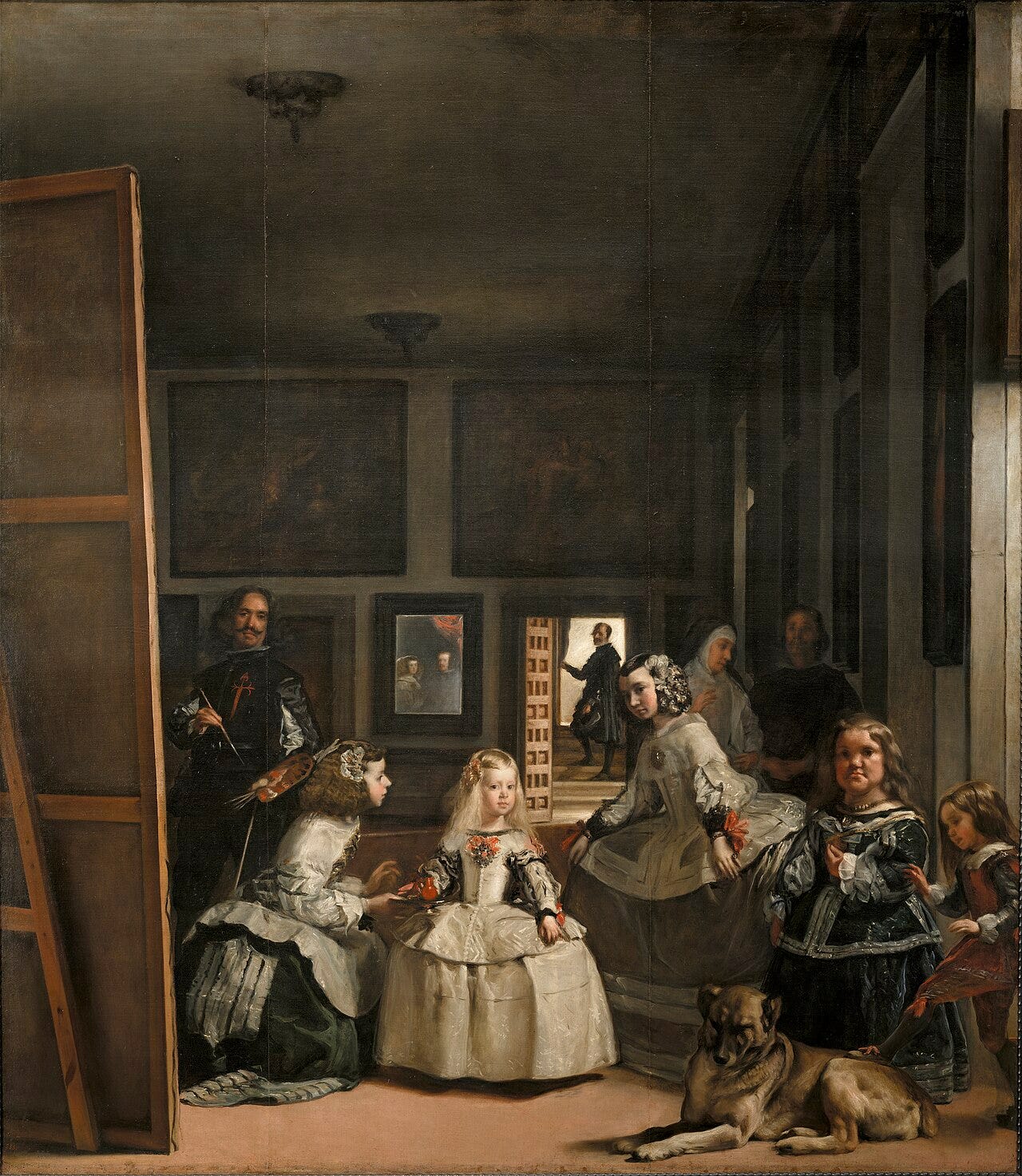
Las Meninas is a 1656 painting by Diego Velazquez, in the Prado in Madrid. Its title means the maids of honor. The five year old princess stands in the light, the painter stands at a huge canvas, and a mirror at the back shows the king and queen, who are standing exactly where you are.
It is often called the finest painting in the world, and the reason is that odd mirror. Here is who everyone is, what the mirror does, and the secret Velazquez painted into his own chest.
Everyone in the room
At the center, in a pool of light, is the Infanta Margarita Teresa, aged five, at that point the only surviving child of King Philip IV and his second wife Mariana of Austria.
Two maids of honor, the meninas of the title, attend her, one kneeling with a small red jug.
On the right stand two people of short stature employed at the court, Maria Barbola and Nicolas Pertusato, who nudges a sleepy mastiff with his foot.
Behind them a chaperone and a bodyguard talk in shadow. In the lit doorway at the very back, one hand on a curtain, is Jose Nieto, the queen's chamberlain, caught either coming or going.
And on the left, at a canvas taller than himself, brush in hand, is Velazquez himself.
The mirror that puts you in the picture
Look at the back wall. Among the dim paintings is one small frame that glows, and it is not a painting. It is a mirror, and in it are the blurred faces of King Philip IV and Queen Mariana.
If the mirror reflects the king and queen, then they must be standing in front of the scene, in the exact spot you occupy as you look.
You are standing where the monarchs of Spain stood. That is the engine of the whole picture: the huge canvas Velazquez is painting, its back turned to us, is most likely their double portrait, and we are seeing the moment from behind it.
The infanta and her maids have come to watch their parents pose.
The key and the cross
At Velazquez's waist hangs a key. It marked him as chamberlain of the royal palace, a man with access to every door, and he was as proud of that rank as of any brushwork.
On his chest is the red cross of the Order of Santiago, Spain's grandest chivalric honor. Here is the secret: it was not there when he finished the painting.
Velazquez spent years trying to be admitted to the order, was rejected twice for lacking noble blood, and only got in shortly before he died in 1660.
The cross was painted onto his chest afterwards, and tradition says the king ordered it added with his own hand. Velazquez put himself in his greatest picture as a nobleman he had not yet been allowed to be.
What it actually means
The real subject is not the princess. It is the dignity of painting itself. For centuries a painter was a craftsman who worked with his hands, ranked below a poet or a scholar.
Velazquez wanted painting treated as a liberal art and himself treated as a gentleman.
So he painted himself at work, in the royal apartments, in the company of the king's own family, wearing the key of office and the cross he was chasing.
It is a picture made for two viewers above all, the king and queen reflected in that mirror, arguing without a single word that the man holding the brush belongs in their world.
The painting other painters cannot leave alone
In 1957 Pablo Picasso shut himself away and painted the whole thing fifty eight times, taking it apart figure by figure; that series now fills a room in Barcelona.
In 1966 the philosopher Michel Foucault opened his book The Order of Things with a long analysis of Las Meninas, calling it a picture about the act of representation itself.
Painters from Goya to Francis Bacon have circled back to it. No other single canvas has been rebuilt by so many later artists.
The Prado, and the fire it survived
Las Meninas hangs in the Museo del Prado in Madrid, in its own carefully lit room, and it does not travel. It carries no price. As the painting many artists and historians call the greatest ever made, it is treated as beyond sale, which is one reason I would tell anyone to see it in Madrid rather than in reproduction.
The paintings on the back wall
Above the mirror hang two dim canvases, and they are not decoration. They show two scenes from Ovid in which mortals challenge the gods and are punished for their pride: Arachne, who dared Pallas Athena to a weaving contest, and the music contest that ends with Apollo flaying his challenger.
Velazquez, whose whole argument was that painting is a noble art, hung a quiet warning and a boast on his own back wall: art is a gift close to the divine, and the mortal who claims it takes a real risk.
The two pictures are copies, painted by his son in law Juan del Mazo after compositions by Rubens and Jordaens.
What the scans found under the paint
Modern X ray and infrared study of the canvas shows Velazquez changing his mind as he worked. His own head was repositioned, and earlier arrangements of the figures lie beneath the surface.
He did not plan the scene to the last inch and then execute it. He built it, shifted it and adjusted it on a canvas over ten feet tall, which is part of why a picture so grand still feels caught in an ordinary, unposed instant.
The short life of the girl in the middle
The five year old at the center, the Infanta Margarita Teresa, did not have long. She was the great hope of a dwindling dynasty, painted and repainted by Velazquez and sent as portraits to the Vienna court she was promised to.
She married her maternal uncle, the Holy Roman Emperor Leopold the First, endured a run of pregnancies in a few short years, and died at twenty one.
The luminous child guarded by her maids in the picture was, even as Velazquez painted her, a marriage token for a family marrying itself into extinction.
Las Meninas, quick answers
Who is in Las Meninas? The five year old Infanta Margarita Teresa at the center, two maids of honor, two court dwarfs, a chaperone and guard, a chamberlain in the doorway, and Velazquez himself at his easel. The king and queen appear in the mirror.
What does the mirror mean? It reflects King Philip IV and Queen Mariana, who stand where the viewer stands. You are looking at the scene from the royal couple's position.
What does Las Meninas mean? It argues that painting is a noble art and the painter a gentleman. Velazquez shows himself at work among the royal family, wearing his key of office.
Who painted it and when? Diego Velazquez, in 1656, for King Philip IV of Spain.
Where is Las Meninas? The Museo del Prado in Madrid.
If this painting pulled you in, you will love these too:
The Arnolfini Portrait, detail by detail, the mirror, the dog, and the question everyone asks
Six women, one monster, what Picasso did to the women who loved him
The darker truth about Gauguin, the part of the Tahiti story that never makes the wall label
The cross he did not live to earn
Velazquez died in 1660, four years after finishing Las Meninas, having finally been made a knight of Santiago the year before. He did not paint the cross onto his own chest; someone else did, after his death.
And the picture nearly did not survive at all: in 1734 the royal Alcazar palace burned to the ground, and Las Meninas was carried out through the flames, taking damage that later restorers had to repair.
The greatest painting in Spain came within a corridor of being ash.
You can see Las Meninas in person at the Museo del Prado. For more by the artist, browse the Metropolitan Museum collection.
The puzzles inside Las Meninas
The Arnolfini Portrait, detail by detail, the mirror, the dog, and the question everyone asks
Vermeer, Woman Holding a Balance, what is actually on those scales
Inside Monet house at Giverny, room by room, including his own bedroom