
For centuries, people in church did not have to imagine the end of the world. It was painted in front of them, above the arch that leads to the altar or on the wall they faced on the way out. Painters kept reworking that image for more than five centuries, and one of these Judgments resurfaced after a single night of rain.
Cool Stories About Art is a newsletter to learn art the fun way.
Join 200,000+ readers and get:
10 new art stories / month
The entire archive of content (140+ articles)
Comment, ask questions, and chat with other readers
Heaven, Hell and the Wall Between
Its source is the Gospel of Matthew, together with the Book of Revelation. At the end of time, Christ returns, the dead rise from their graves, and he separates the saved from the damned. A painter had to fit all of humanity into a single image that a congregation could read from the far end of the nave.
That challenge kept painters at the subject for a long time. The layout barely moved: Christ above, the saved on his right, the damned on his left. So each generation changed everything else, from the size of the picture and its place in the building to the way a body comes back to life.
Each picture chosen shows the Judgment itself, or a scene from a painted cycle built around it, from about 1305 to 1853, at every scale, from two panels small enough to carry to a painted dome.
12. Unknown painter, The Wenhaston Doom (about 1480 to 1520)
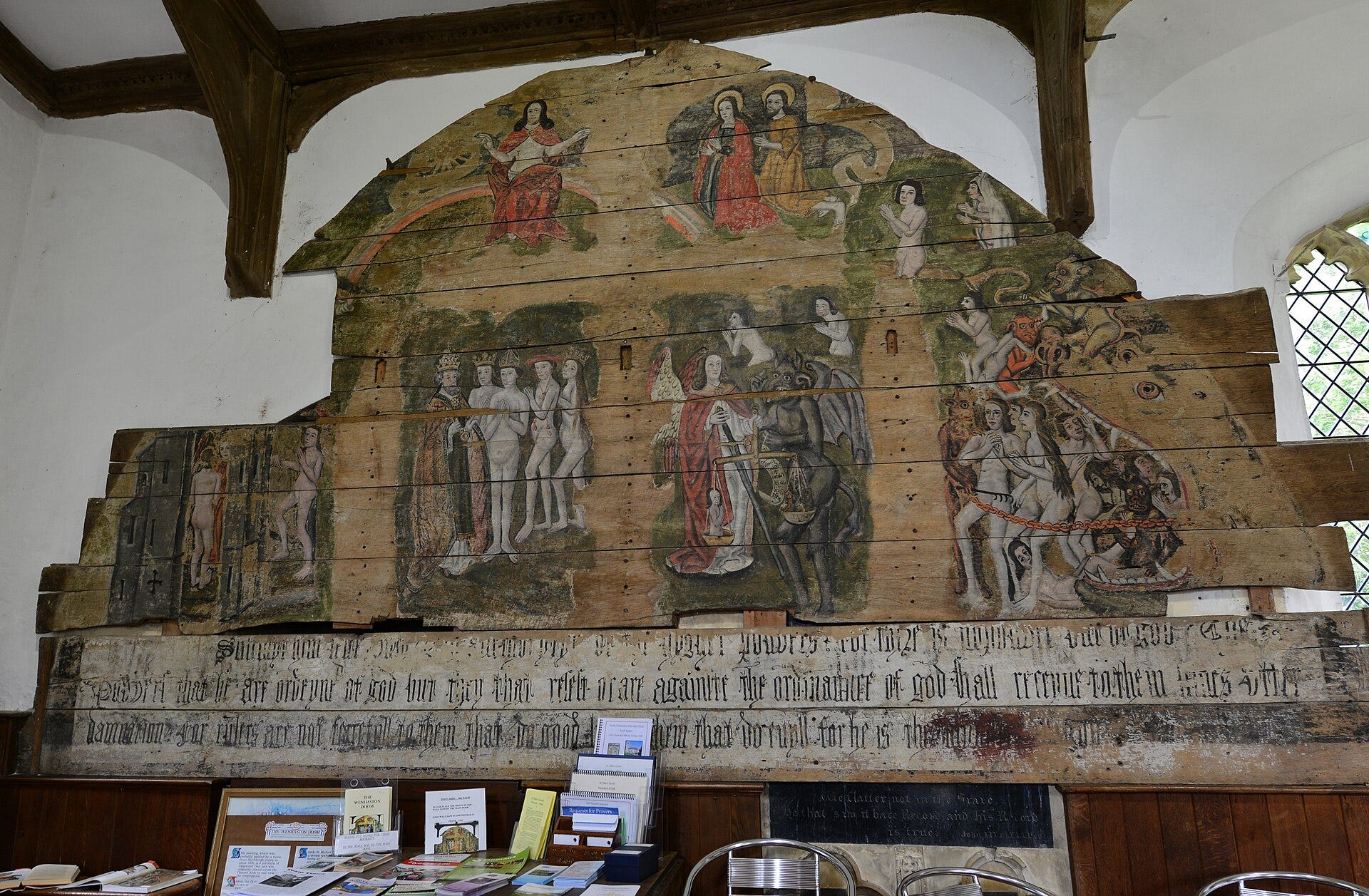
Pale, empty shapes interrupt the top of the Wenhaston Doom: the outlines of a cross and two statues once nailed to its boards. They explain what the painting was for. In English parish churches, a Last Judgment painted over the chancel arch, the opening between the nave and the altar, was called a doom, an old word for judgment.
At Wenhaston, a village in Suffolk, carved figures of Christ on the cross, Mary and Saint John stood in front of the boards. The painting behind them was the work of a local artist, by tradition a monk from nearby Blythburgh, around 1500. Its life in plain sight was short. Within a century, the Reformation stripped images from English churches, and the boards disappeared under whitewash.
That coat of lime hid them until 1892. That year, workmen restoring the chancel threw the white boards out into the churchyard, some say as firewood. Rain fell during the night, washed off the lime and brought the colors back. The parish clerk saw them and had the boards saved.
The whitewash had also protected the picture from the image breakers of the 1600s. Christ still sits on a rainbow. Below him, Saint Peter, dressed as a pope and holding his key, welcomes a king, a queen, a bishop and a cardinal. All four are naked, but each can still be recognized by what they wear on their heads.
At a Glance
Artist: Unknown, traditionally said to be a monk of nearby Blythburgh Priory
Painted: About 1480 to 1520 (proposed dates vary)
Medium: Oil on oak boards
Size: Not published
Where to see it: St Peter's Church, Wenhaston, Suffolk, England
11. Fra Bartolomeo and Mariotto Albertinelli, The Last Judgment (1499 to 1501)
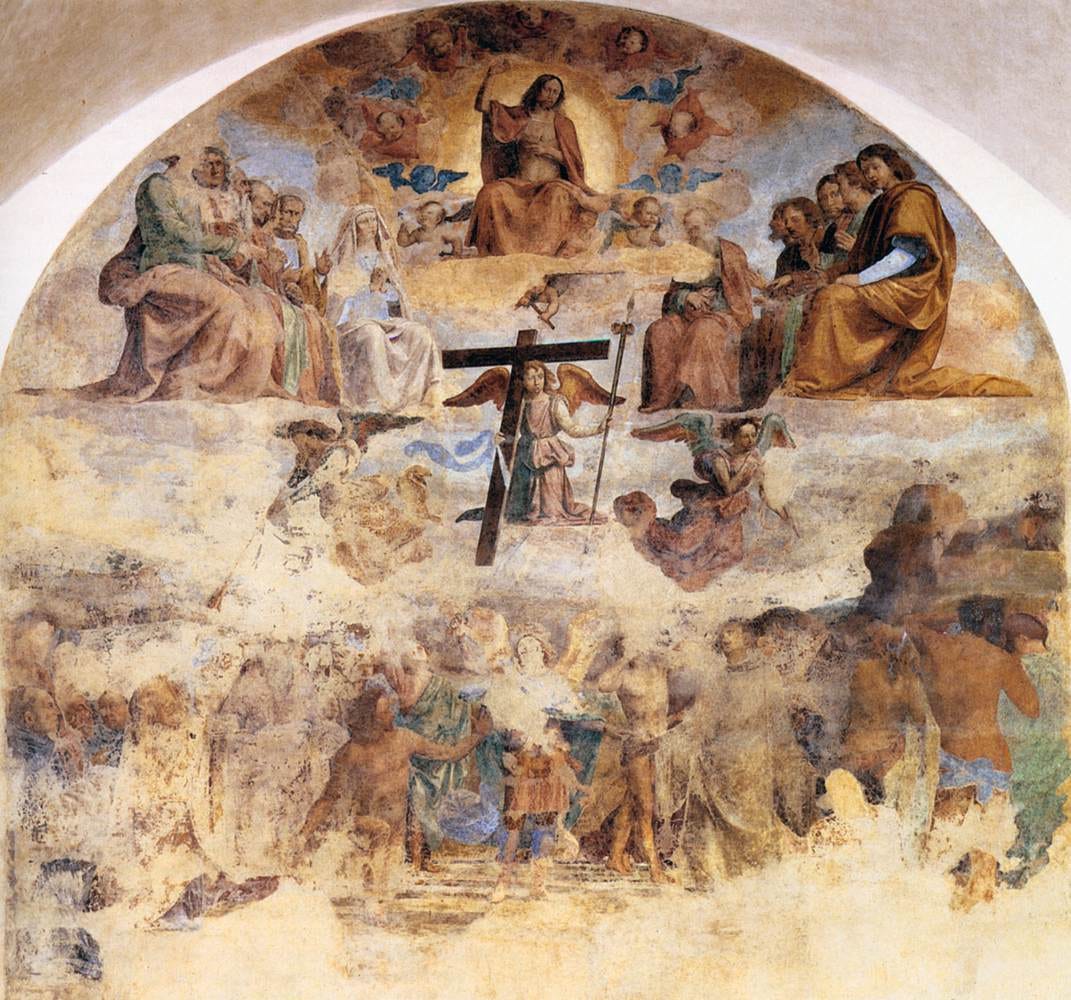
Only the top half of this fresco, Christ, the Virgin and the apostles seated on clouds, is by the painter who was hired for it. The reason is a vow. In April 1498, a mob besieged the convent of San Marco in Florence to seize the preacher Girolamo Savonarola. Trapped inside with his followers was a young painter, Baccio della Porta, later Fra Bartolomeo, so afraid that he swore to become a monk if he got out alive.