
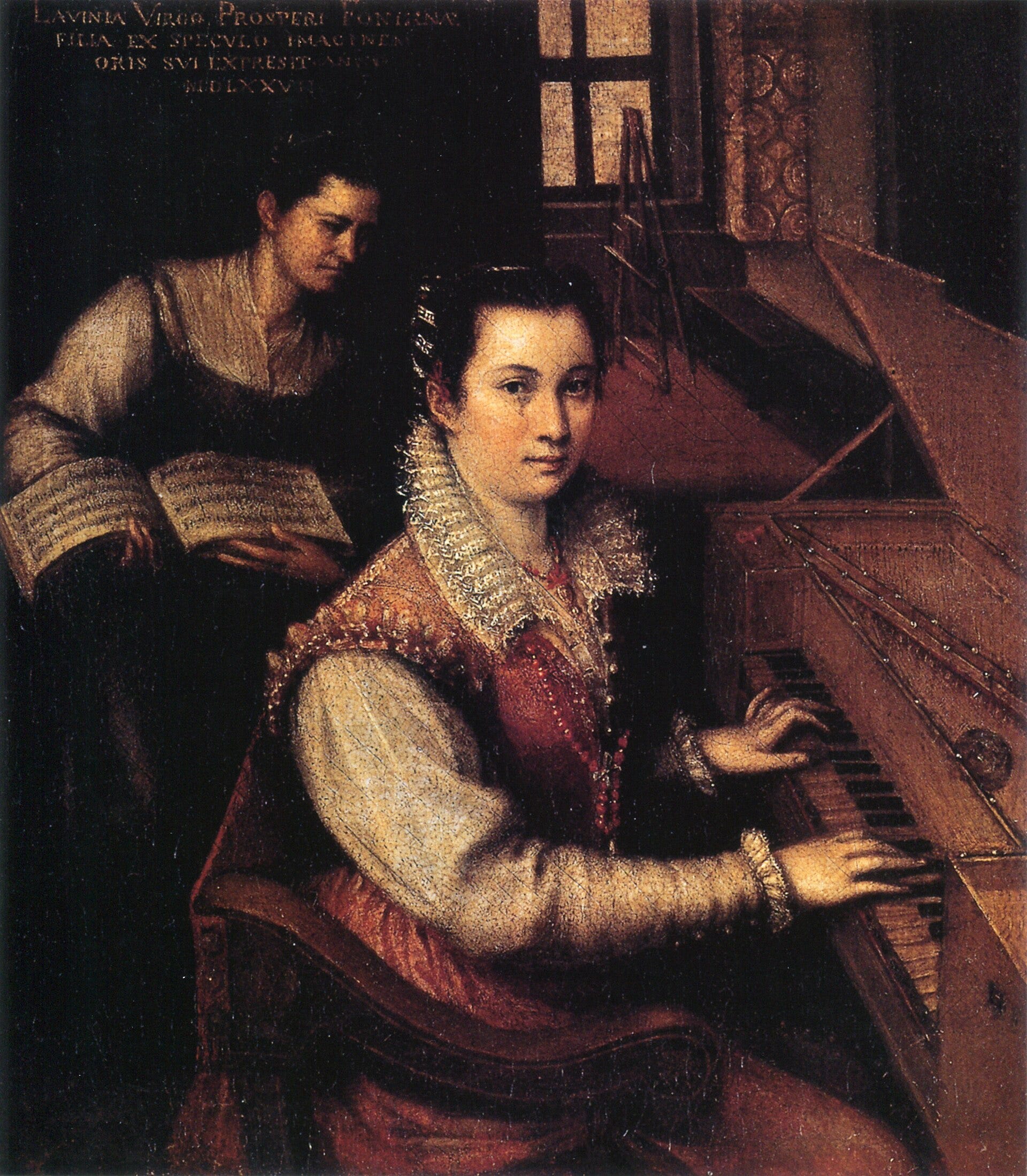
Lavinia Fontana (1552 to 1614) was an Italian painter from Bologna. The noble ladies of her city paid her well to portray them and their families. Her best-known works include her Self-Portrait at the Spinet and Minerva Dressing.
Cool Stories About Art is a newsletter to learn art the fun way.
Join 200,000+ readers and get:
10 new art stories / month
The entire archive of content (140+ articles)
Comment, ask questions, and chat with other readers
In 1577, Lavinia Fontana painted herself as a well-bred young lady at a spinet, a small keyboard instrument, with her easel pushed into the background. That same year, she married without a dowry, the money or goods a bride usually brought to her husband's family. Her paintings were expected to bring in money instead.
Lavinia was baptized in 1552 in Bologna, a university city in northern Italy, then ruled by the pope. Her father, Prospero Fontana, was one of the best-known painters of the city. He had painted for a pope in Rome, and young painters came to his workshop to train.
Lavinia learned to paint in that workshop. One of her earliest surviving pictures, from 1576, shows Christ with the symbols of his Passion, the objects linked to his suffering and death. That picture is now in the El Paso Museum of Art, in Texas.
Prospero's health was fragile. By her early twenties, his daughter was being prepared to take over the workshop, and with it the family's income.
One of Prospero's pupils, Gian Paolo Zappi, was the son of Severo Zappi, a rich merchant from Imola, a town near Bologna. In 1577, at twenty-four, Lavinia became engaged to Gian Paolo.
The little self-portrait at the spinet, about eleven inches high, was painted for the Zappi family during the engagement. Behind Lavinia, a servant holds out an open book of music.
In the upper corner, Lavinia wrote in Latin: "Lavinia, maiden, daughter of Prospero Fontana, made this likeness of her face from a mirror, in the year 1577." A maiden was an unmarried young woman.
In February 1577, the two fathers, the groom and three witnesses signed the marriage contract. The newlyweds would live in Prospero's house, and Lavinia would go on painting for the family workshop. Prospero stayed her legal guardian, the owner of all her earnings.
The wedding took place in early June. From then on, everyone under Prospero's roof would live largely on what Lavinia painted and sold. Could a young bride's brush keep an aging father, a husband and the children to come?
In the rest of the story
Why Lavinia's richest clients stood beside the cradles of her children.
How a painting made in Bologna ended up in the palace of a king.
What happened to the giant painting Lavinia made for a great church in Rome.
Who sits at the easel on a bronze medal made in Lavinia's honor.