Lee Krasner: The Complete Story

Lee Krasner was a founder of Abstract Expressionism who spent decades filed under her husband's name. Born in Brooklyn in 1908, she was an abstract painter before she ever met Jackson Pollock, and one of the movement's fiercest editors after him.

The full career runs half a century, with the Pollock years as one chapter. It has taken the museums most of that time to reread the book properly.

Krasner at a glance:

  • Born in Brooklyn in 1908 to Russian Jewish immigrants.

  • Was an abstract painter years before meeting Pollock.

  • Reworked her own canvases into collages with scissors.

  • Ran the Pollock estate for three decades after 1956.

  • The Eye is the First Circle sold for 11.7 million dollars in 2019.

Lee Krasner
Lee Krasner

Hofmann's best backhanded compliment

Daughter of Russian Jewish immigrants, Krasner trained through the Depression, painted murals for the WPA, and studied with Hans Hofmann, who paid her the era's definitive compliment: this is so good you would not know it was done by a woman. By the late 1930s she was exhibiting with the American Abstract Artists, fluent in Picasso and Matisse while her future husband was still finding his line.

Springs, and the Little Images

She met Pollock in 1942, married him in 1945, and moved to a farmhouse at Springs, Long Island, taking a bedroom as her studio while he took the barn. There she made the Little Images, dense small canvases of hieroglyphic marks, from 1946 to 1949, all while managing the career, the dealers and the drinking of the movement's most volatile star.


Hooked on Lee Krasner? Get more art secrets and stories in your inbox, free.


More incredible painter stories

If Lee Krasner pulled you in, you will love these too:


The barn, after

Pollock died in the car crash of August 1956 while Krasner was in Paris. She came home, moved her easel into his barn, and scaled up.

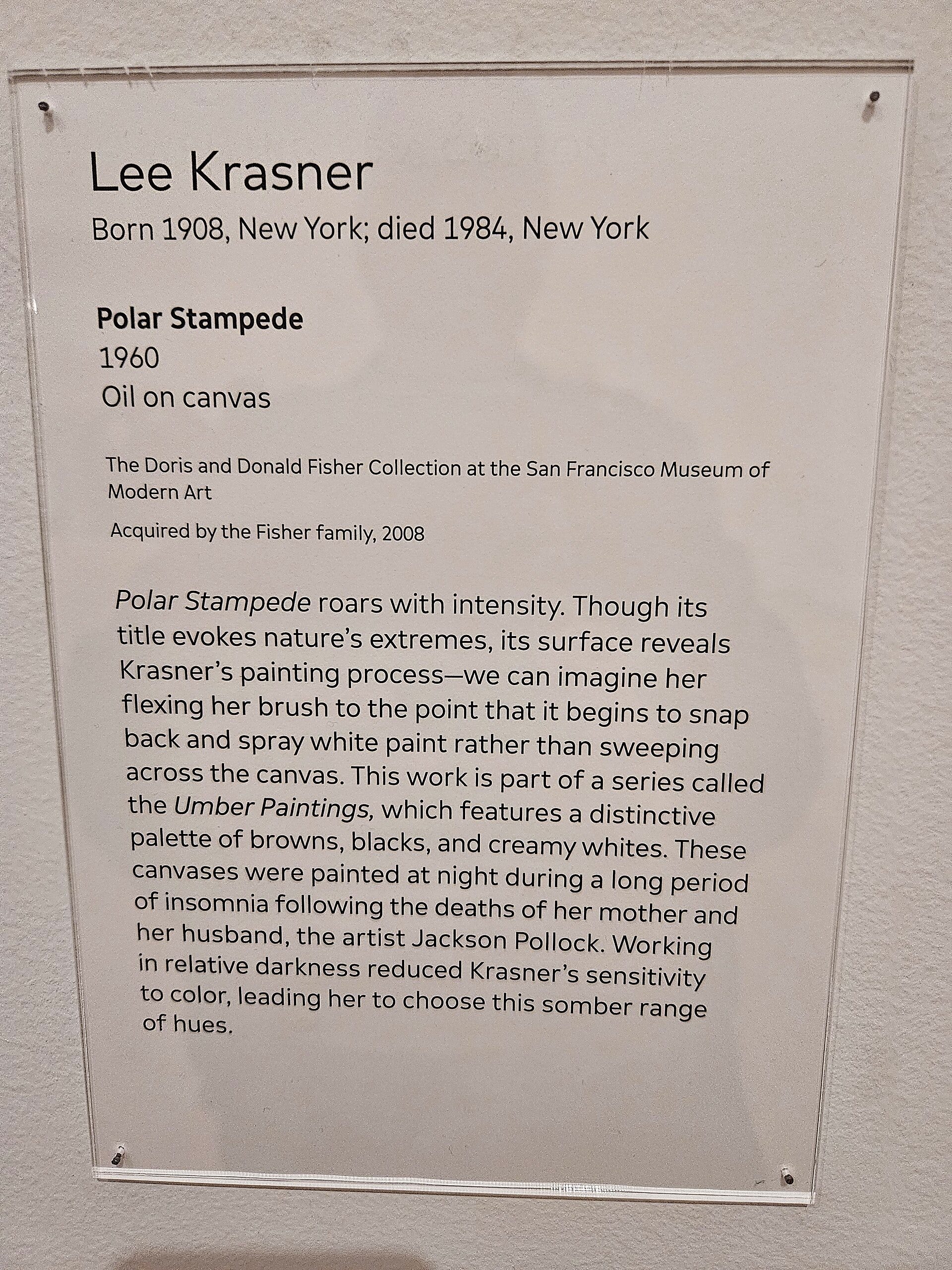
The Umber paintings of 1959 to 1962, made at night in brown and white because her insomnia made her distrust colour under electric light, are among Abstract Expressionism's rawest documents of grief.

Later she cut up her own and Pollock's discarded works and rebuilt them as collages, editing history with scissors.

The myth: Mrs Pollock

For decades she appeared in the histories as the wife who kept the flame.

The correction is now official: her retrospective opened at MoMA in 1984, months after her death in June that year, making her one of the few women then given the museum's full honours, and the Barbican's 2019 survey toured Europe to record crowds.

7 million dollars. The movement's editor turned out to be one of its authors.


Join 130,000 readers who learn art the fun way. Free.


Where to see Krasner

MoMA, the Whitney and the Met in New York hold the key canvases; the Pollock-Krasner House at Springs preserves both studios, her hard edged late work hanging where the drips fell. The barn floor is still splattered; the house tells both careers now.

Hofmann's compliment, kept as a wound

Her teacher Hans Hofmann praised a canvas by saying it was so good you would not know it was done by a woman.

Krasner repeated the line for fifty years, without a smile. It became the epitaph for everything the New York School asked her to swallow.

The scissors period

In the mid-1950s she cut up her own drawings and paintings, and some of Pollock's discards, and rebuilt them as large collages.

Destruction as revision: the works made of her own failures are now considered among her strongest, and the method predates most famous cut-up art.

The widow who built the market

After 1956 she rationed Pollock's canvases to museums one at a time, refusing bulk sales, and prices climbed for thirty years.

The Pollock-Krasner Foundation she endowed has given more than 80 million dollars to artists since 1985. The person history filed as a wife turned out to be the best estate strategist of the century.

The Lee Krasner questions that keep coming up

  • What is she known for? Founding era Abstract Expressionism: the Little Images, Umber paintings and collages.

  • Was she a painter before Pollock? Yes, a trained abstractionist exhibiting years before they met in 1942.

  • What are the Umber paintings? Night works of 1959 to 1962, brown and white because insomnia made her distrust colour by lamplight.

  • When did she die? In June 1984, in New York, months before her MoMA retrospective opened.

  • Did Krasner paint before Pollock? Yes, she exhibited with the American Abstract Artists in the late 1930s while Pollock was still figurative. The influence ran both ways.

  • What is the Pollock-Krasner Foundation? The foundation her will created in 1985, funding working artists worldwide with over 80 million dollars distributed so far.


More secrets to unlock


One last fact

Her will created the Pollock-Krasner Foundation in 1985, funded by both estates. It has since given more than 80 million dollars to artists in need worldwide: the woman who managed one difficult painter's survival ended up underwriting thousands of others.


Get the secrets behind the paintings. Free, every week.


Polar Stampede by Lee Krasner at SFMOMA
Polar Stampede (1960), one of the Umber paintings, at SFMOMA