
Lists of left-handed painters circulate everywhere online, and they rarely say where a name comes from. Followed back to its origin, a claim can shrink to a rumor or to a single line in an old reference book.
Some claims even turn upside down under a laboratory lamp. Here are twelve works, and what each one proves about the hand that held the brush.
Cool Stories About Art is a newsletter to learn art the fun way.
Join 200,000+ readers and get:
10 new art stories / month
The entire archive of content (140+ articles)
Comment, ask questions, and chat with other readers
How These Were Chosen
To test those lists, the first step is to ask who could know. Before the twentieth century, almost nobody wrote down which hand a painter used. Museum records describe the sitter and the materials, rarely the hand.
So specialists look for clues in the drawings themselves. Shading is often built from rows of short parallel strokes, called hatching. A right hand pulls those strokes one way and a left hand the other, so their slant betrays the hand behind them.
On an unsigned drawing, that slant can decide the attribution. Each entry below pairs one work with one statement about its maker, and follows that statement back to where it began. A right-handed verdict counts as much as a left-handed one.
Along the way, one habit of the past keeps coming back. Children who favored the left were often made to write with the right, so several of these artists come down to us using both.
12. Kubo Shunman, Woman Playing the Tsuzumi (about 1800)
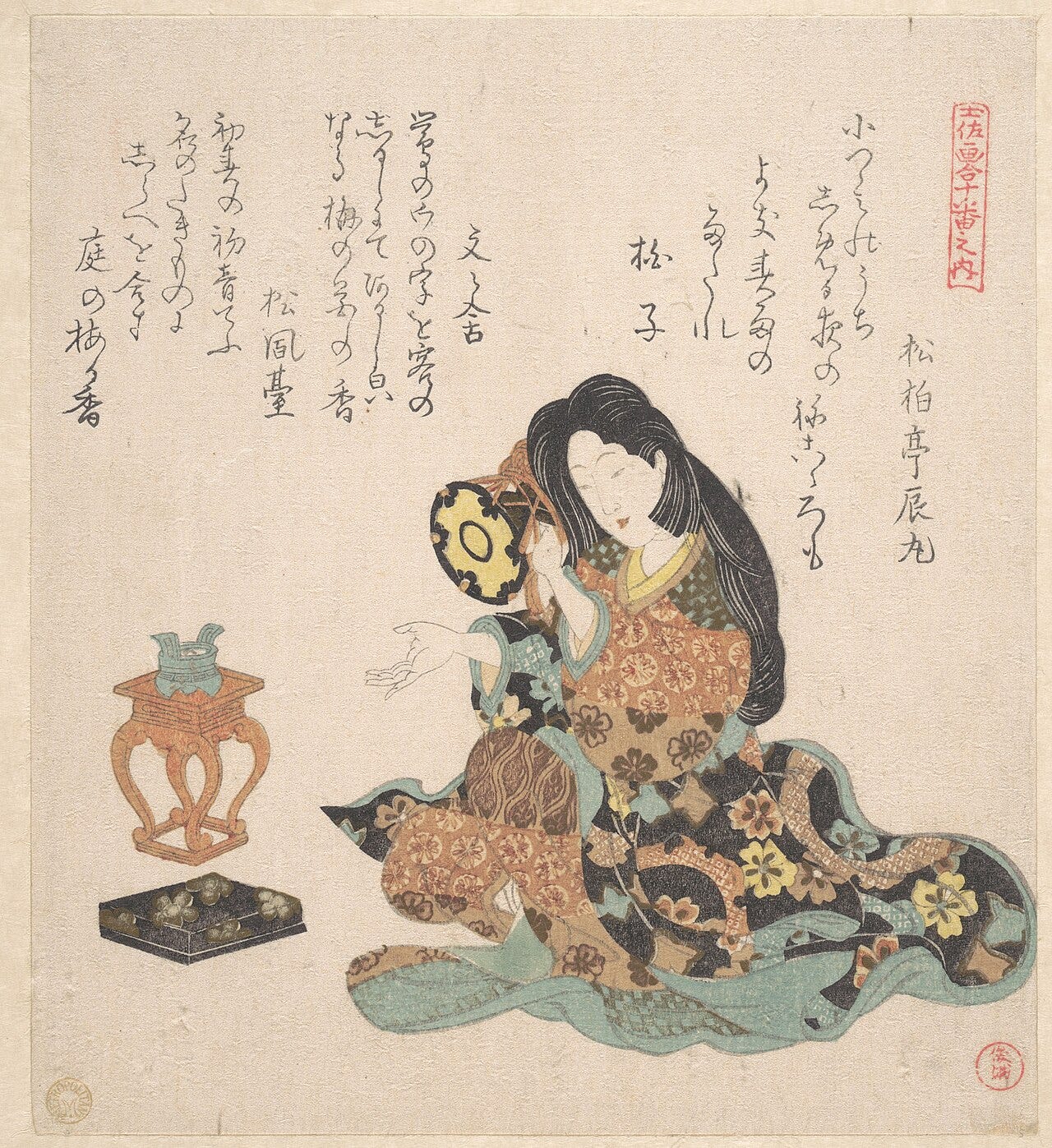
The list opens in Japan. A woman plays the tsuzumi, a small hourglass-shaped drum of Japanese theater held at the shoulder, in a print designed around 1800 by Kubo Shunman.
Shunman was a printmaker and poet in Edo, the old name of Tokyo. The drum gives the print its title, Woman Playing the Tsuzumi, and the sheet is a surimono, a small luxury print paid for privately, often by clubs of amateur poets who sent them as gifts, rather than sold in shops.
A Japanese woodblock print passed through several hands. The artist drew the design on thin paper, a carver pasted it on a block of wood and cut it away line by line, and a printer inked the block. Shunman's own drawing was destroyed in the process.
That matters here, because the usual test for a left hand is the slant of the hatching in a drawing. On a woodblock print, the test has nothing to work with.
For Shunman, the evidence lies instead in his art names, the professional names Japanese artists chose for themselves. Two of them, Shōsadō and Sashōdō, contain the character 左, which means left.
His English-language biographies explain that he took those names because he was left-handed. Beyond that explanation, the trail goes quiet. Nothing shows that this particular print carries either name, and nobody on record describes him at work.
At a Glance
Artist: Kubo Shunman, Japanese
Made: About 1800
Medium: Surimono print
Size: 20 × 17.9 cm (7 7/8 × 7 1/16 in)
Where to see it: The Metropolitan Museum of Art, New York
11. Vladimir Borovikovsky, Portrait of M. I. Lopukhina (1797)
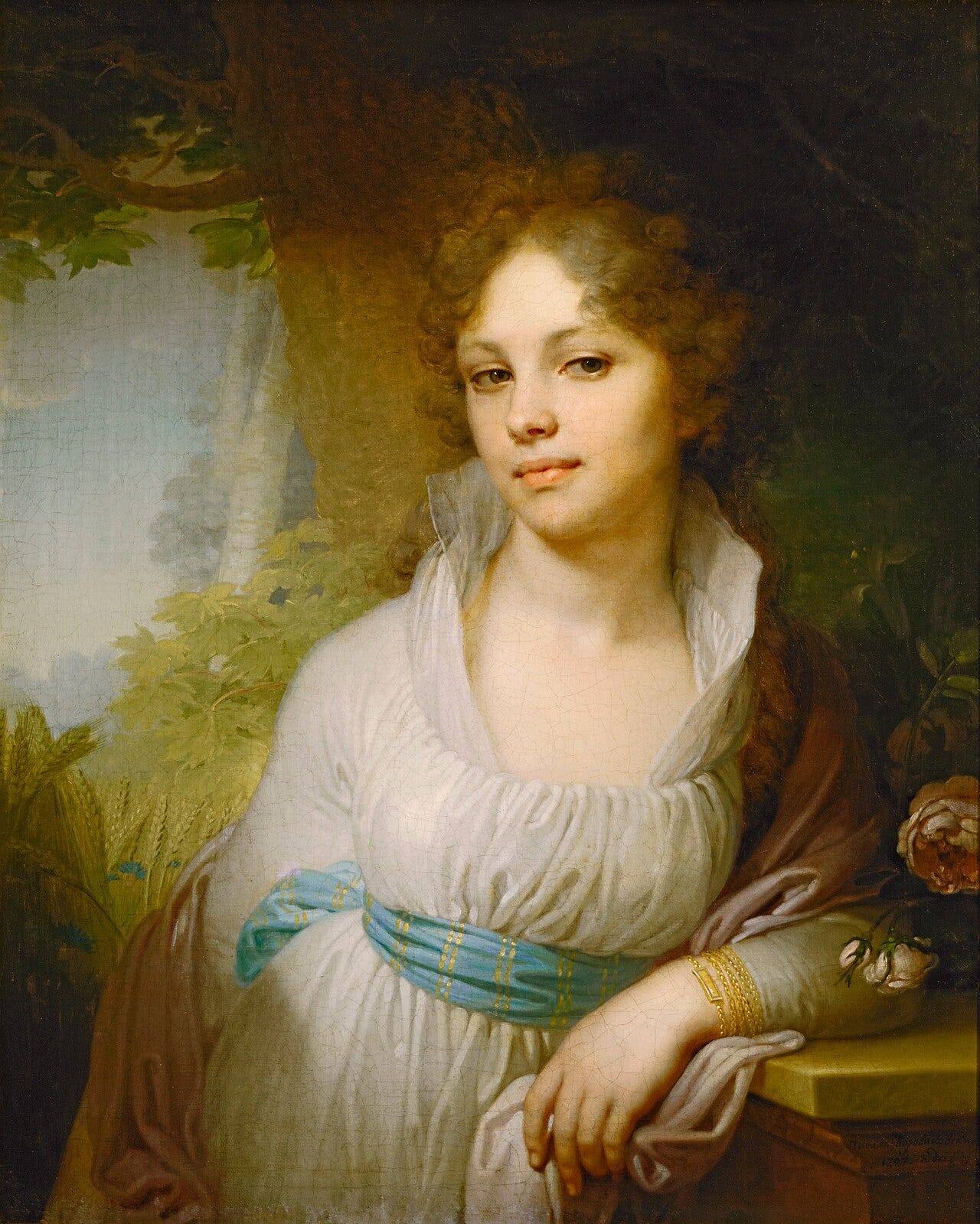
From Japan the list moves to Russia, a few years earlier. A young woman in a white dress leans her elbow on a stone ledge, her head tilted, with roses at her side. Vladimir Borovikovsky, a portrait painter working in St. Petersburg, painted her in 1797.
The canvas is known as the Portrait of M. I. Lopukhina, and nothing in it shows the painter's hand. Yet many lists say he painted it with his left, and that claim depends on three Russian words. Everything turns on who wrote them, and on what that person had seen.