

200 000+ readers learn art the fun way.
This is a preview. Paid subscribers get the full story.
You’ll also get:
10 new stories / month
The full archive (140+ Art stories)
Your personal art guide. Comment, ask questions, DM me anytime
Apple user? Subscribe at coolstoriesabout.art, not via the app. Apple adds 30% to the price.
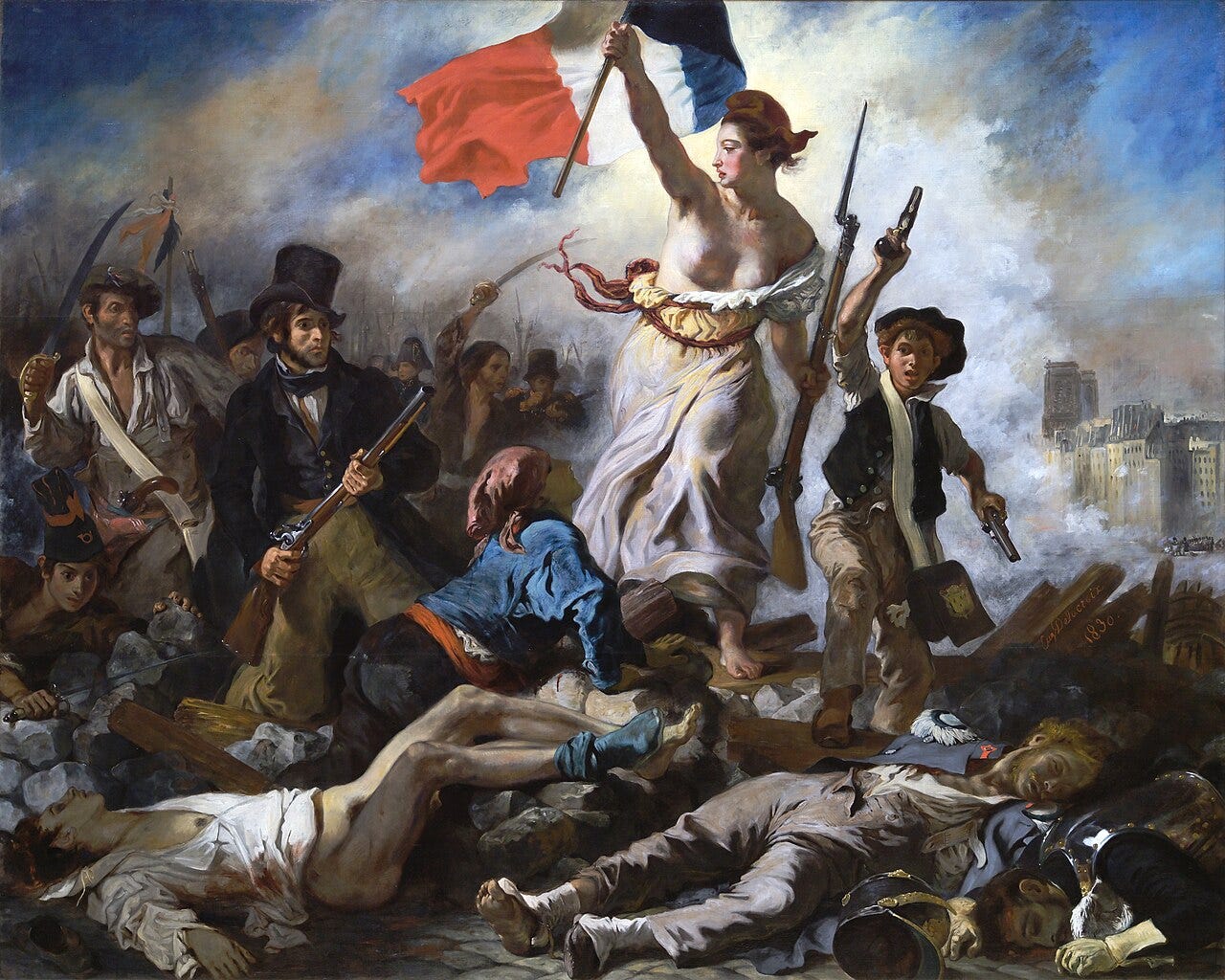
You have seen this painting somewhere before.
Coldplay put it on an album cover and painted “Viva la Vida” across it in white letters. Protesters hold it up on their signs, from one end of the world to the other. Pornhub even displayed it on its homepage, recolored orange, the day a French law blocked the site.
A rock band, angry crowds, an adult site. All of them pick the same woman with the flag, and no two of them are fighting for the same cause.
What she herself stands for, and for whom, you could no longer say.
Let's look at it together. You will never see this painting the same way again.
A Raw Red
Paris, the quai Voltaire, facing the Seine, nearly two centuries ago. The woman with the flag is there, not yet finished, on a canvas that fills the whole easel of a studio, 2.60 meters high by 3.25 wide, almost twice the height of the man standing before it.
A brush works over the folds of the flag, yet again. The painter steps back, looks, comes back to straighten a fold, darken a red, set a highlight on the cloth.
Eugène Delacroix.
Some evenings he leaves this easel for Victor Hugo's table on the rue Notre Dame des Champs, where Musset and Balzac also take their seats. Stendhal runs into him at the same gatherings. There, poets and novelists read aloud plays that are causing scandals in the theaters, and take the old rules apart one by one.
This new movement has a name, Romanticism, and Delacroix belongs to it: passion and imagination over cold reason, each person's own emotion over inherited rules. In painting, that means movement instead of the frozen pose, and color laid on in decisive strokes instead of the tidy line.
Under his brush, here and now, the break is visible. A raw red, laid down in one go, never blended into the tone beside it, and left just as it is.
The fold holds. The brush moves up the canvas, toward a piece of red cloth resting on a bowed head, and adds a little more cap.
Discover my new newsletter !

The Cap, Then the Flag
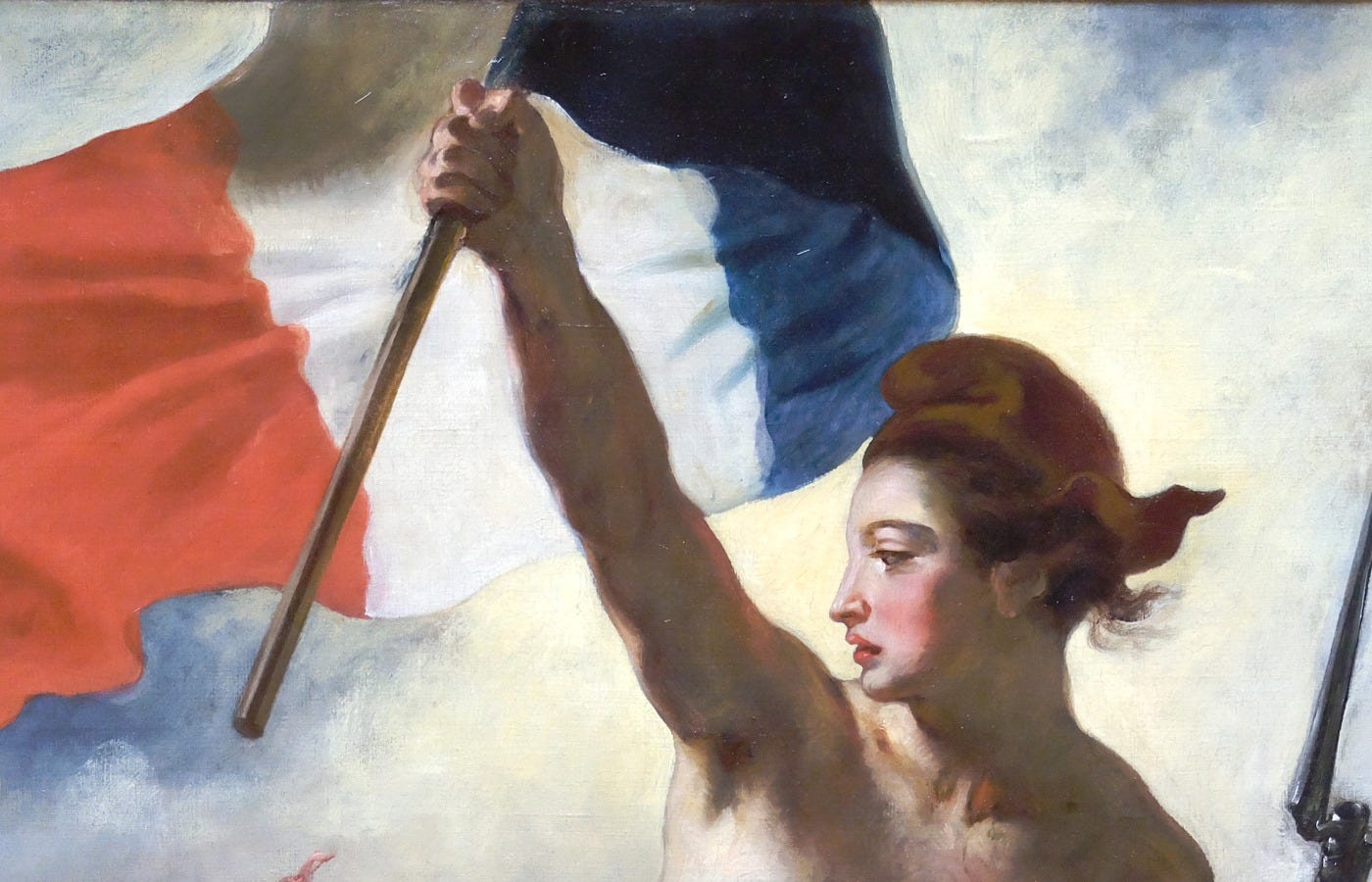
Under the brush, the red cap takes shape, and strands of hair slip out from under it and float free.
A cap like this one was already known in antiquity: it was placed on the heads of freed slaves, the day they stopped belonging to anyone, as the mark of chains that had fallen away.
Paris took it up again in 1789. The people in revolt wore it in the streets, and one day they forced it onto the head of the king himself. Within a handful of years, this scrap of cloth became the sign of liberty wrested from tyranny.
Below the cap, an arm holds out a flag of three colors, gripped by its staff, the pole it hangs from. That flag was born the same year, in 1789: the blue and red of Paris, and in the center the white of the king, slipped in there by a general, La Fayette, to seal an alliance between the people and the crown.
The people seized on it fast, as a cockade first, then as a banner, well beyond that promise of an alliance.
Delacroix steps away from the easel, and from farther back the painting looks almost finished.
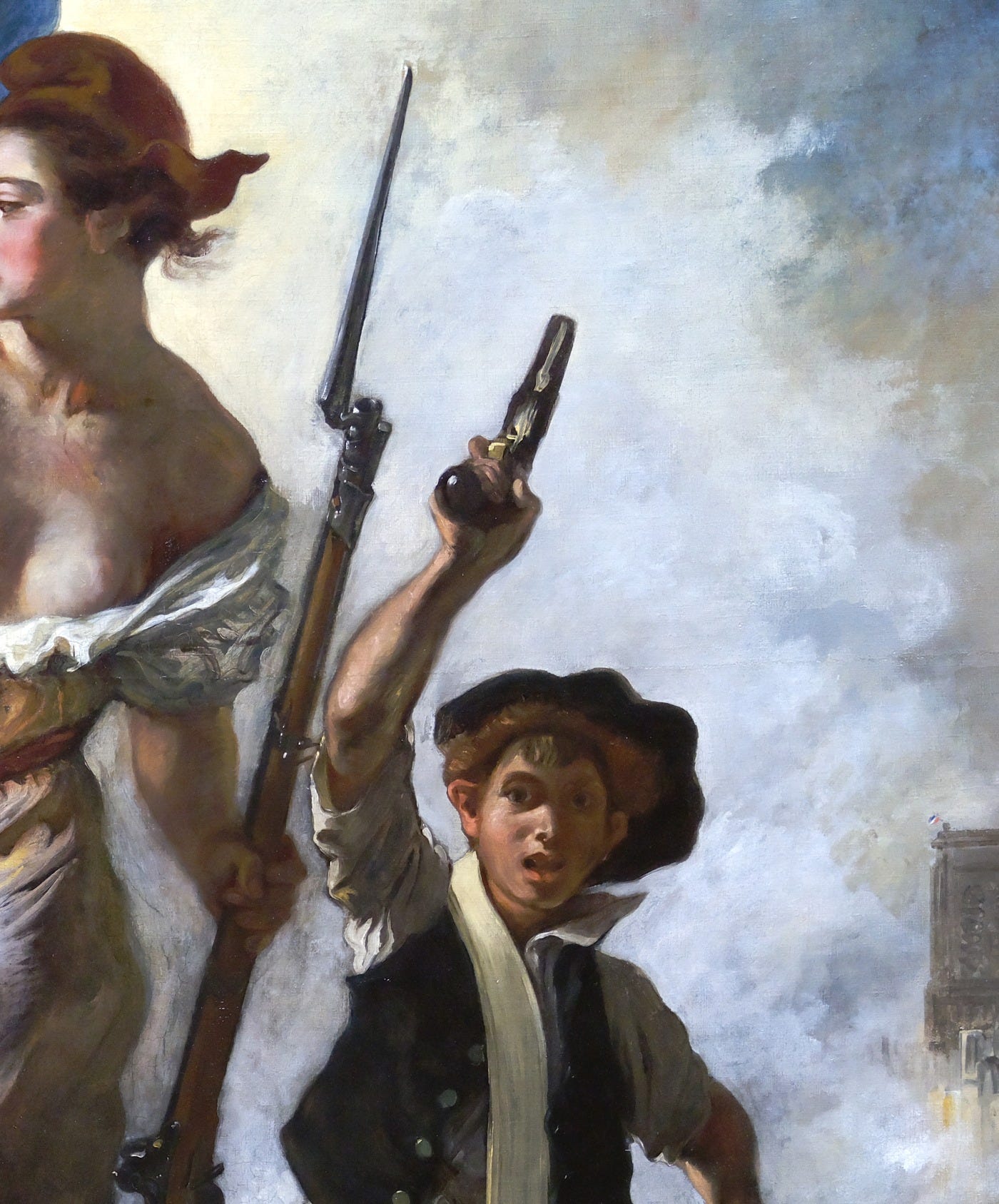
A woman, her chest bare, strides over paving stones and over bodies. Behind her, a crowd armed with muskets and sabers, a man in a top hat, a kid waving two pistols, smoke eating up the sky, and in the distance the two towers of Notre Dame.
At the time, a canvas this size was reserved for kings, for saints, for scenes drawn from the Greek gods. Here, a street riot: ordinary people, corpses in the foreground, a population at the end of its patience, an anger that had been simmering for months. A deliberate provocation.
Delacroix returns to the easel. His brush travels down the woman's left arm, the one nobody looks at, all the way to the hand.
It grips a bayonet musket with a long barrel, held by that barrel, brandished like a club. A soldier's gun, the regulation infantry model, the one from 1816.
Except that this model of musket did not yet exist in 1789.
What Delacroix is painting is not the French Revolution.
What You’ll Discover
Which event this canvas is really about.
Who the man in the top hat is, right beside her.
The hero of a novel this young boy will go on to inspire.
Why this woman’s chest is bare.
What this woman represents.