
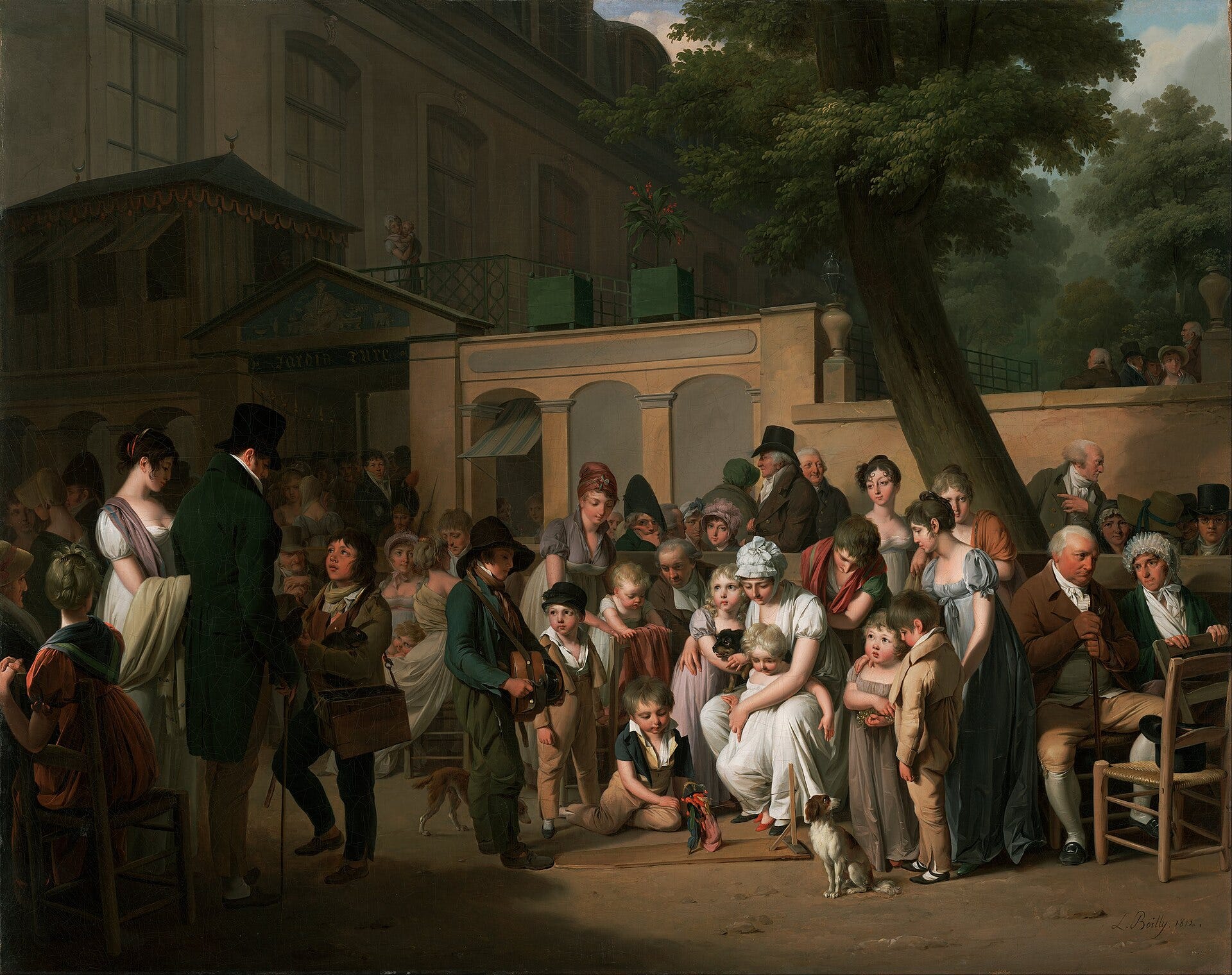
Louis-Léopold Boilly (1761 to 1845) was a French painter of the people of Paris. He is best known for crowded street scenes, like Entrance to the Jardin Turc, a Paris café, and for hundreds of small portraits.
Cool Stories About Art is a newsletter to learn art the fun way.
Join 200,000+ readers and get:
10 new art stories / month
The entire archive of content (140+ articles)
Comment, ask questions, and chat with other readers
Boilly painted for the nobles of the old French monarchy, then through the Revolution, then under Napoleon and the kings who came after him. In 1794, the pictures that had made him popular turned him into a suspect.
Louis-Léopold Boilly was born in 1761 in La Bassée, a small town near Lille, in the north of France. His father, a woodcarver who also sold a little art, gave the boy his first lessons.
In 1778, Boilly went to study with the painter Dominique Doncre in Arras, a nearby city. There he learned to paint illusions, flat pictures of objects that look real enough to touch.
Once settled in Paris, in 1785, Boilly painted small love scenes for rich and noble clients, slightly daring, in the manner of Fragonard and Boucher, two painters adored by the French aristocracy.
In 1791, two years into the French Revolution, the new National Assembly took the Salon, the great official art exhibition in Paris, away from the royal Academy of painters and opened it to all artists. Boilly showed his work there and made his name.
By 1794, the Revolution had entered the Terror, when the government hunted down suspected enemies. On April 22, a painter named Jean-Baptiste Wicar stood up before the Popular and Republican Society of the Arts, a club of artists loyal to the Revolution.
Wicar denounced obscene pictures that "soil the walls of the Republic" and wanted them burned at the foot of the Tree of Liberty, a tree planted as a symbol of the Revolution. Among the painters of those pictures, Wicar named Boilly, for his love scenes.
The Society of the Arts decided to draw up a list of the guilty works for the police and for the Committee of Public Safety, the committee that ran the Terror. That spring, a suspect denounced to the Committee could be sent to prison, and many prisoners went to the guillotine.
How did Louis-Léopold Boilly get out of danger in the spring of 1794?
In the rest of the story
What the Society of the Arts decided about Boilly a few weeks later.
Why his painting of a hero of the Revolution was never finished.
The French word Boilly gave as a title, still used in English today.
Who Boilly hid at the edge of his painting of a Paris café.