
Luca della Robbia (around 1400 to 1482) was a sculptor from Florence, Italy. He carved the Cantoria, a marble gallery for singers now in Florence's cathedral museum, then became famous for sculptures in baked clay covered with a shiny white and blue glaze.
Cool Stories About Art is a newsletter to learn art the fun way.
Join 200,000+ readers and get:
10 new art stories / month
The entire archive of content (140+ articles)
Comment, ask questions, and chat with other readers
By his mid-thirties, Luca della Robbia stood among the best marble sculptors in Florence. Then he turned most of his work toward a far cheaper material, ordinary clay. The recipe of his glaze became a family secret, kept for about a hundred years.
Luca was born in Florence around 1400 and grew up with a brother named Marco. Florence was then a republic, a city that governed itself, grown rich on wool and banking.
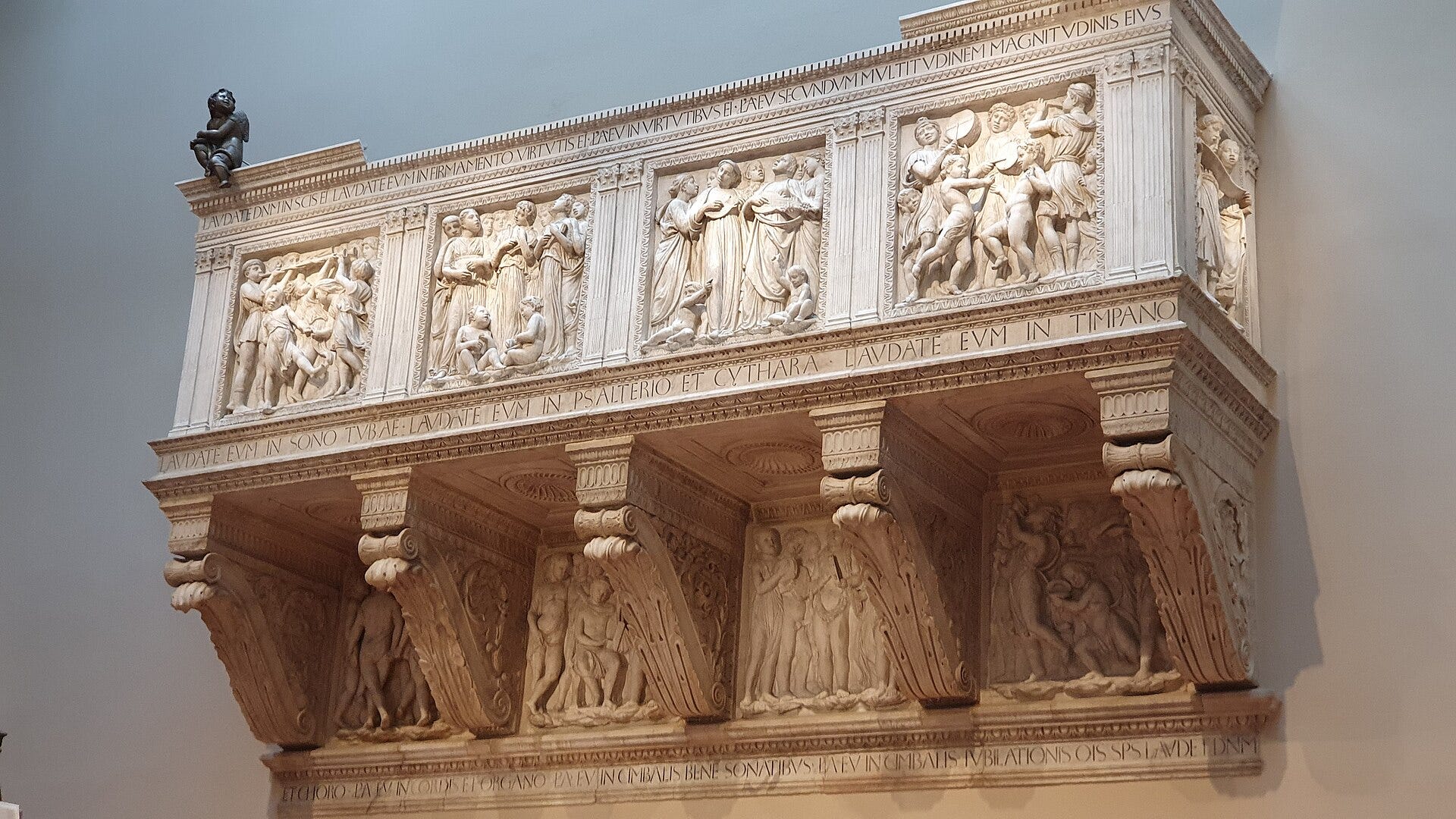
Luca was about thirty when the great cathedral of his city gave him his first recorded commission. In 1431, the Opera del Duomo, the office that ran the building and decoration of Florence Cathedral, ordered a cantoria from him.
A cantoria is a marble balcony for the singers and the organ, set high above a door near the main altar. Before the carving began, Luca joined the guild of stone and wood carvers, the trade association every sculptor in Florence had to belong to.
Luca's Cantoria is made of ten marble panels in which children and young people sing, dance and play music. Along the balcony runs, in Latin, Psalm 150, the last psalm of the Bible, which calls on everything that breathes to praise God with music.
For a twin balcony above the door on the other side of the altar, the cathedral turned to Donatello, the most famous sculptor in Florence. Donatello's contract said he could not be paid more than Luca, a newcomer with no earlier work on record.
In 1436, Leon Battista Alberti, a scholar and architect, opened the Italian version of his book On Painting with the names of the Florentine artists he admired most. Luca stood on that short list beside Donatello and Filippo Brunelleschi, the architect of the cathedral's great dome.
Why would a marble sculptor on Alberti's short list turn to clay, and who would he trust with the secret of its glaze?
In the rest of the story
Why Luca's first great work in glazed clay used only two colors.
How Luca's colors have lasted more than five centuries in the rain.
Which boy learned the family secret, and what Luca's will left him.
Who really made many of the works people call "Della Robbia."