Lucas Cranach the Elder: The Complete Story
Lucas Cranach the Elder was the Renaissance's first media mogul: court painter, print publisher, pharmacist, wine seller and mayor. Born in 1472, he painted Martin Luther's face so often that the Reformation, visually, is a Cranach production.
He signed with a winged serpent, ran painting like a factory, and died the richest artist in Germany. Here is business and belief in one workshop.
Lucas Cranach the Elder at a glance:
1472: born Lucas Maler in Kronach, Franconia; he later takes his hometown's name.
1505: hired as court painter to Frederick the Wise in Wittenberg, a post he holds under three successive electors.
1520: buys the Wittenberg pharmacy, with its monopoly on medicines, sweet wine and wax; the painting was never the only business.
1525: witnesses Luther's wedding to Katharina von Bora, and stands godfather to their first son a year later.
1553: dies at 81 in Weimar, having followed his captive prince into exile.
Court painter at Wittenberg, 1505
After a wild early period in Vienna, Cranach was called in 1505 to Wittenberg as court painter to the Electors of Saxony, and kept the post for nearly half a century under three successive rulers. The court gave him a salary, a coat of arms, the winged serpent he used as a trademark signature, and a base from which he built an empire: a printing house, a pharmacy monopoly, property across the town, and terms as burgomaster from 1537.
Luther's image maker
Wittenberg's other famous resident was Martin Luther, and the two were genuinely close: witnesses at each other's weddings, godfathers to each other's children.
Cranach painted and printed Luther at every stage, monk, Junker Jorg in disguise, husband, doctor of the church, and his workshop's woodcuts carried the Reformation's message across Europe faster than sermons could.
The Reformation had theologians; its face came from one studio.
More incredible painter stories
If Lucas Cranach the Elder pulled you in, you will love these too:
The myth: mass production means minor art
Because the workshop repeated its Venuses, Lucretias and Luthers by the dozen, Cranach gets docked for industry. That is reading him backwards.
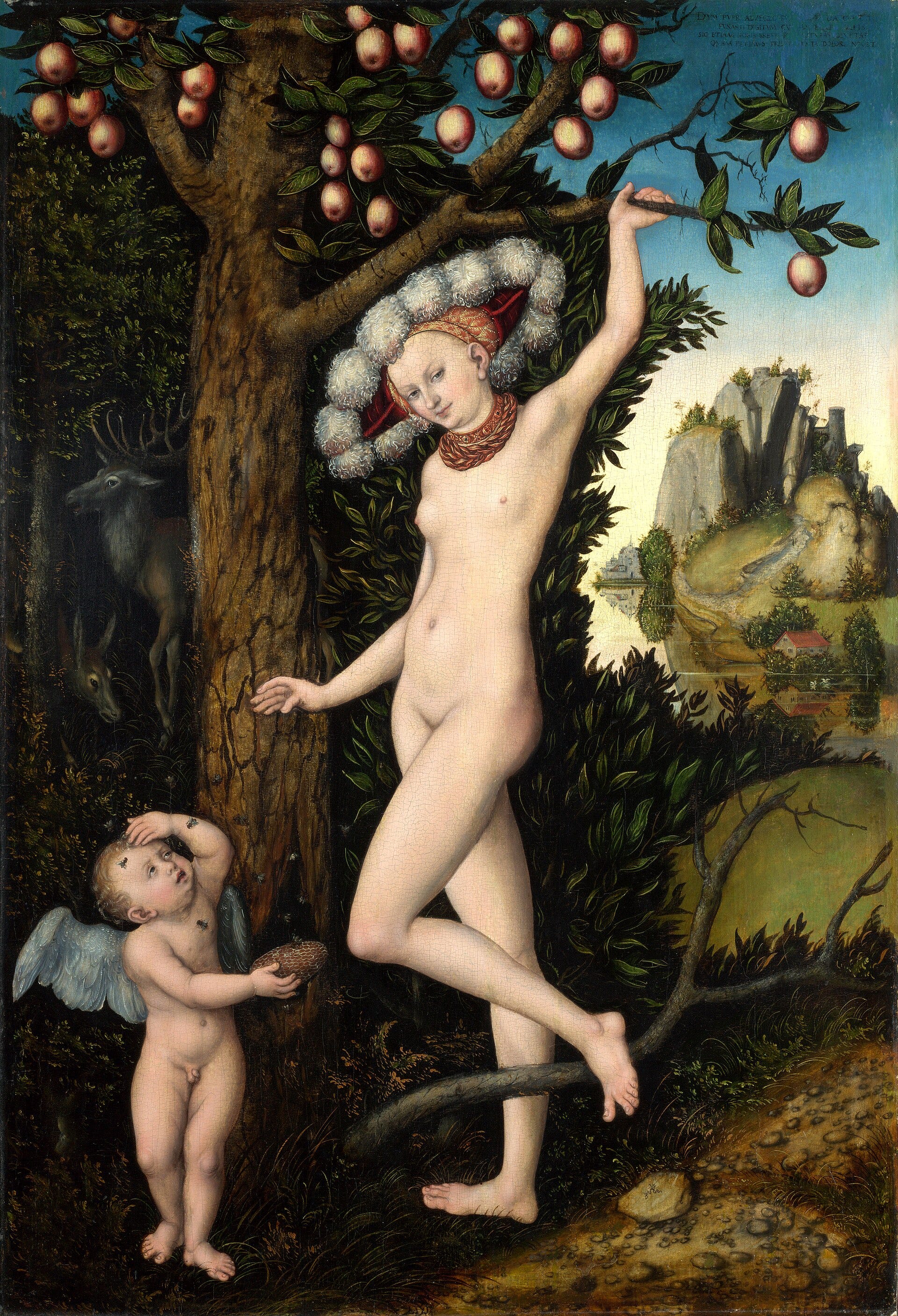
The repetition was the point: he invented the recognisable brand image in painting, a serpent signed product of consistent quality, and his slim, sly nudes on black grounds are as distinct a product as anything in art.
Picasso collected him; the moderns saw a colleague.
Loyal to the end
When Elector John Frederick was captured by the emperor in 1547, Cranach, an old man, followed his prince into custody at Augsburg and Innsbruck rather than stay comfortable at home.
Released with him, he died at Weimar in 1553, at 81, in the house of his daughter. His son Lucas the Younger kept the serpent flying and the workshop running for another generation.
Where to see Cranach
Weimar and Wittenberg keep his story on site; the Uffizi, the Louvre, the Prado and the Gemaldegalerie in Berlin hold the famous panels; and his Adam and Eve pairs are scattered across the world's museums like a signature repeated.
The pharmacist, printer and mayor
Painting was one Cranach business among several. In Wittenberg he owned the town pharmacy, ran a printing press that turned out Luther's tracts, sold wine, and traded property.
Tax rolls list him among the richest men in town, and from 1537 he served terms as Bürgermeister, the mayor of Wittenberg.
The image maker of the Reformation was also, quite literally, the town's druggist, printer and landlord. It helps explain the workshop's industrial calm.
Venus in a see-through veil
The same workshop that printed Protestant propaganda painted dozens of Venuses, Lucretias and nymphs wearing little more than a fashionable hat or a transparent veil.
His nudes ignore the Italian recipe. Where Titian's bodies are warm and heavy, Cranach's are slim, pale and long-legged, closer to Gothic ivory than Roman marble.
The Saxon courts ordered them by the dozen, and nobody at the time seems to have found Luther and Venus a contradiction. Patronage rarely reads manifestos.
Painting the enemy too
While branding the Reformation, Cranach kept painting its opponents. Cardinal Albrecht of Brandenburg, whose indulgence campaign provoked the 95 theses, sat for him repeatedly, once in the guise of Saint Jerome at his desk.
The workshop's door, like its ledger, did not take sides.
The personal loyalties ran deeper than the politics: the friendship with Luther held from the wedding of 1525 to the end of both their lives.
The Lucas Cranach the Elder questions that keep coming up
What is he known for? Portraits of Luther, slim mythological nudes, and the most productive workshop in Germany.
What is the serpent? His trademark signature, a winged serpent, granted with his arms in 1508.
Was he really Luther's friend? Yes: wedding witnesses and godparents to each other's children.
When did he die? At Weimar in 1553, aged 81, after following his captive prince into exile.
How many paintings did the workshop make? Around 5,000 surviving works carry the serpent signature, an output no other Renaissance workshop matches. Specialists use panel dating and the serpent's wings to sort out hands.
What about Lucas Cranach the Younger? He took over the workshop in 1550 and kept the serpent flying for another three decades. Telling father from son remains a specialist's sport.
More secrets to unlock
Grief, recorded in a logo
The trademark tells its own grief: after his painter son Hans died suddenly in 1537, the winged serpent in the workshop's signature changed, its raised bird wings dropped to a lying position from then on. Art historians still use the wings to date the panels: grief, recorded in a logo.