Lucian Freud: The Complete Story
Lucian Freud was the painter who made flesh the whole subject of art again. Born in Berlin in 1922, grandson of Sigmund, he spent seventy years in London rooms staring at people until the paint itself seemed to breathe and sag.
He asked thousands of hours from his sitters and gave back the least flattering, most alive portraits of his century. Here is the slow machine behind them.
Lucian Freud at a glance:
1922: born in Berlin, grandson of Sigmund; the family flees to London in 1933.
1939: at Dartington and other schools he prefers horses to lessons, sometimes sleeping in the stables.
1954: represents Britain at the Venice Biennale with Bacon and Nicholson, still painting with sable precision.
2008: Benefits Supervisor Sleeping sells for 33.6 million dollars, then a world record for a living artist.
2011: dies in London at 88, a last portrait still unfinished on the easel.
Berlin to London, 1933
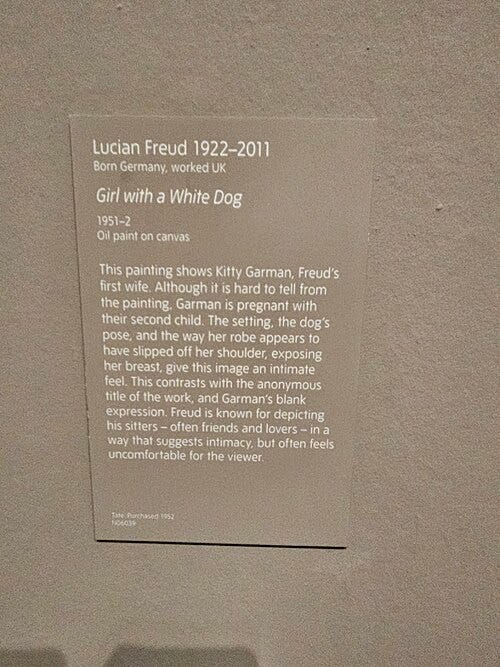
The Freuds left Berlin for London in 1933, when Lucian was ten, ahead of what was coming; grandfather Sigmund followed in 1938. Naturalised British in 1939, the wild, hawkish young man drew and painted with a miniaturist's precision: Girl with a White Dog, painted in 1950 and 1951 and now in the Tate, shows the early manner, smooth, wide eyed and unnerving.
The switch to hog hair
In the late 1950s he traded sable brushes for stiff hog hair, stood up at the easel, and let the paint thicken. From then on flesh was built, not described: he mixed Cremnitz white heavy with lead for skin, scraped and reworked for months, and a single portrait could demand a year of sittings, day sessions for daylight people, night sessions for the others.
More incredible painter stories
If Lucian Freud pulled you in, you will love these too:
The myth: cruelty
Because the bodies are unidealised, Freud was accused of painting people cruelly. His answer was consistent: I want paint to work as flesh does, and the sitters kept coming back, for years, some for decades.
The nakedness was attention, not attack; what looks harsh in reproduction reads, in front of the canvas, as time spent. Nobody gives a person a thousand hours out of contempt.
Leigh Bowery, Big Sue, and the record
The 1990s brought his largest bodies and boldest pictures: the performance artist Leigh Bowery, monumental on a red velvet chair, and Sue Tilley, the benefits supervisor, asleep on a sofa. Benefits Supervisor Sleeping, painted in 1995, sold at Christie's in May 2008 for 33.6 million dollars, at the time the highest auction price ever paid for a work by a living artist.
The last decade
He painted to the end, dying in London in July 2011 at 88, with an unfinished portrait of his assistant David Dawson's whippet still on the easel. The National Portrait Gallery's retrospective, planned with him, opened months later to record queues, and the private man who never explained anything left 14 acknowledged children and no memoir.
Where to see Lucian Freud
Tate Britain holds Girl with a White Dog and key later works; the National Portrait Gallery and the Royal Collection keep the portraits, and the great naked portraits circulate between London, New York and private walls that rarely lend.
Sitting for Freud, a part-time job
A Freud portrait cost the sitter months of evenings, sometimes years. He worked standing, in shifts, day sitters and night sitters running in parallel on different canvases.
Photographs were no substitute: if a sitter quit for good, the painting was abandoned in whatever state it had reached.
Dinner afterward was part of the arrangement, and several sitters said the conversation was the real payment.
The animals
The tenderest Freuds are often the animals: his whippets Pluto and Eli curled against sitters, painted with exactly the attention he gave human skin.
He had loved horses since his schooldays and went back to painting them in his last decades, setting up his easel in a London stable.
Asked what his subject was, he said the people in his life and the things around them that mattered. Dogs counted; so did the mounting pile of paint rags in the corner.
The gambler
For decades Freud gambled heavily, on horses above all, losing sums that would have bought his own paintings back.
The debts ran through dangerous Soho company in the 1960s, with stories linking him to the Krays' circle; some accounts were settled in pictures, a terrible trade for him and a splendid one for the bookmakers.
He claimed being cleaned out felt like freedom, and that the gambling lost its point once he could afford to lose. None of the recklessness reached the canvases, which are all patience.
The Lucian Freud questions that keep coming up
What is he known for? Thickly painted, unidealised portraits and naked portraits requiring epic sittings.
Was he related to Sigmund Freud? His grandson; the family fled Berlin for London in 1933.
What is his record price? Benefits Supervisor Sleeping sold for 33.6 million dollars in 2008.
When did he die? In July 2011, in London, at 88, mid painting.
How many children did he have? At least fourteen acknowledged, by several mothers; the full tally is disputed and he never clarified it. Several of them sat for him.
Did he paint celebrities? Rarely, and on his terms: Kate Moss pregnant, Hockney in exchange for sittings, the Queen on a canvas smaller than a sheet of paper. Requests from the famous were mostly refused.
More secrets to unlock
The smallest royal portrait in the collection
His portrait of Queen Elizabeth II, finished in 2001 after nineteen months of sittings, measures about 23 by 15 centimetres, smaller than a sheet of paper, and he gave it to her as a gift. The press called it a travesty and a masterstroke in the same week; it entered the Royal Collection either way, the smallest and most argued over royal portrait in it.