Lucio Fontana: The Complete Story

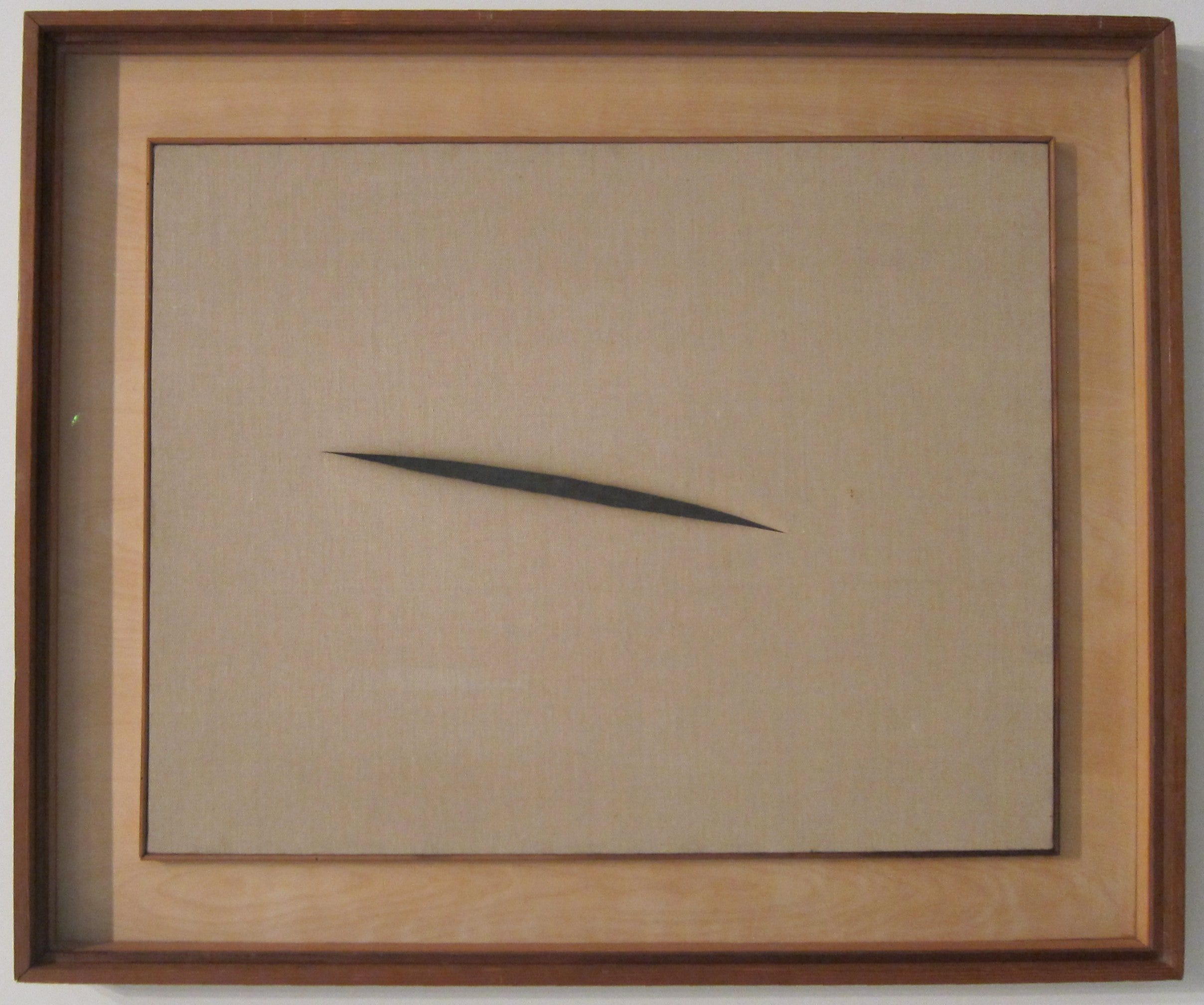
A plain canvas, painted a single colour, with one clean slash cut straight through it. At first it looks like vandalism. In fact it is one of the most influential gestures in modern art, and Lucio Fontana made the cut on purpose, again and again, to open the flat picture onto real space.

Spatial Concept 'Waiting', cut canvas by Lucio Fontana, Tate
Spatial Concept 'Waiting', cut canvas by Lucio Fontana, Tate Modern

He was an Italian Argentine artist, founder of a movement he called Spatialism, famous for slashing and puncturing his canvases.


Over 110,000 art lovers read this every week. Join them, free.


For readers who want the full story

Three that changed how I look at a picture:


The cut

Fontana most famous works are his Cuts, single canvases sliced with a sharp blade so the slit opens into the darkness behind.

The gesture turned a flat surface into a window onto real space, pushing abstract art past the picture and into the third dimension.

Spatialism

Casa Atelier Lucio Fontana (Comabbio)

He founded Spatialism, a movement that argued art should embrace space, movement and even new technology, not just paint on a flat plane.

His pierced and slashed works, which he called Spatial Concepts, were the proof, treating the canvas itself as an object to be opened rather than a surface to be decorated, far beyond traditional oil painting.

Holes and light

Before the slashes came the holes. Fontana punctured canvases with rows of small perforations, letting light and shadow do the work.

He also made glowing environments with neon and black light, decades before such ideas became common, imagining art as a total experience of space.

Sculptor first

Fontana trained as a sculptor and worked in ceramics for years, which is why he thought about the canvas as a three dimensional thing.

Born in Argentina to Italian parents, he spent his career mostly in Milan, and helped shape the postwar Italian art scene that followed.

Common questions about Lucio Fontana

What is he known for?

Slashed and punctured canvases and the movement Spatialism.

Why did he cut the canvas?

To open the flat picture onto real space behind it.

Was he a sculptor?

Yes, he trained in sculpture and ceramics first.

When did he die?

In 1968.

Why one cut changed so much

Fontana proved that a single decisive gesture could carry as much meaning as a crowded canvas, and that the space behind a picture mattered too.

His Cuts now sell for many millions and hang in the great museums, the rare case of an artist who became famous for what he took away rather than what he put on.


Over 110,000 art lovers read this every week. Join them, free.


He approached each cut with great care, often reworking the back of the canvas with black gauze so the slit would read as true depth rather than a tear.

His ideas about space, light and technology fed directly into later installation and environmental art, so a movement he named in Milan still echoes through galleries that fill whole rooms with light today.

His reputation has only grown since his death, with the slashed canvases becoming icons of postwar art and the subject of constant scholarly debate about exactly what the gesture means.

Collectors prize the Cuts above almost any other Italian art of the period, and a single well known example can fetch a sum that would once have seemed impossible for a canvas with a hole in it.

His ideas helped open the door to installation and light art, so the rooms full of neon and projection that fill museums today trace part of their lineage to his small, deliberate cuts.

His ceramic sculptures and glowing neon arabesques, less famous than the Cuts, are now studied as some of the boldest experiments of postwar Italy.


Two stories a week, a hundred secrets unlocked. Start free.