
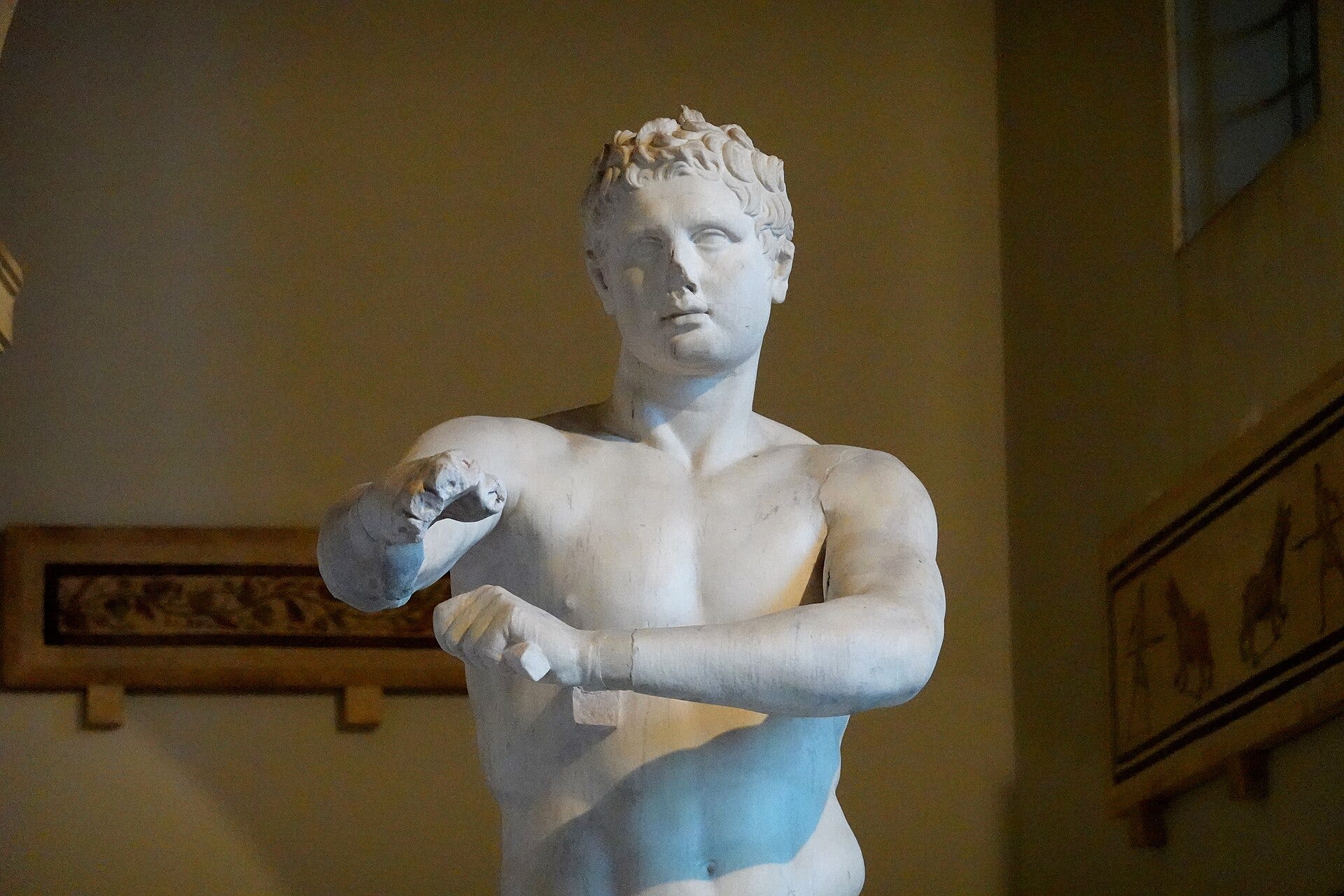
Lysippos (active about 370 to 300 BC), also spelled Lysippus, was a Greek sculptor who worked in bronze. He portrayed Alexander the Great and made the Apoxyomenos, an athlete scraping his arm clean, known today from a Roman marble copy at the Vatican Museums.
Cool Stories About Art is a newsletter to learn art the fun way.
Join 200,000+ readers and get:
10 new art stories / month
The entire archive of content (140+ articles)
Comment, ask questions, and chat with other readers
According to ancient writers, Alexander the Great would let no other sculptor portray him in bronze. Long after both men were dead, Rome conquered the Greek world, and its generals and emperors carried his statues off as prizes. Yet not one of his bronze statues is known to survive.
Lysippos started out as a metalworker in Sicyon, a Greek city of the Peloponnese, the large peninsula of southern Greece. Sicyon was known for its painters and its bronze workshops, yet the young man never studied under a master.
Pliny the Elder, a Roman who wrote a vast encyclopedia four centuries later, tells how the metalworker became a sculptor. A painter of Sicyon, Eupompos, was once asked which of the old masters he took as his model.
Eupompos pointed to a crowd of people and said that "it was Nature herself, not an artist, whom one ought to imitate." An artist, in other words, should learn from living people, not from older works of art. The answer gave the young metalworker the idea of making statues himself.
For a metalworker, the step was a short one: a bronze statue is made by pouring melted metal into a mold. Greek cities ordered such statues of their gods, and of the winners of the great games, like those of Olympia, held in honor of Zeus, the king of the gods.
The former metalworker made both kinds, from a bronze Zeus for the marketplace of Sicyon to statues of winners for Olympia. He also portrayed Alexander, the son of King Philip II of Macedonia, a kingdom in the north of Greece, from the time the prince was a boy.
Alexander became king at twenty, in 336 BC, and went on to conquer the Persian Empire, from today's Turkey to the edge of India. By Pliny's count, Lysippos made some 1,500 works, more than any other Greek sculptor.
How could 1,500 bronzes that Alexander and the rulers of Rome wanted so badly all disappear?
In the rest of the story
How anyone ever managed to count the statues of Lysippos.
Why a Roman emperor had to give a statue back to the crowd.
What a man who saw crusaders loot Constantinople wrote about a bronze giant.
Where a bronze athlete linked to Lysippos lay hidden until 1996.