Madame X by Sargent: The Scandal and the Fallen Strap

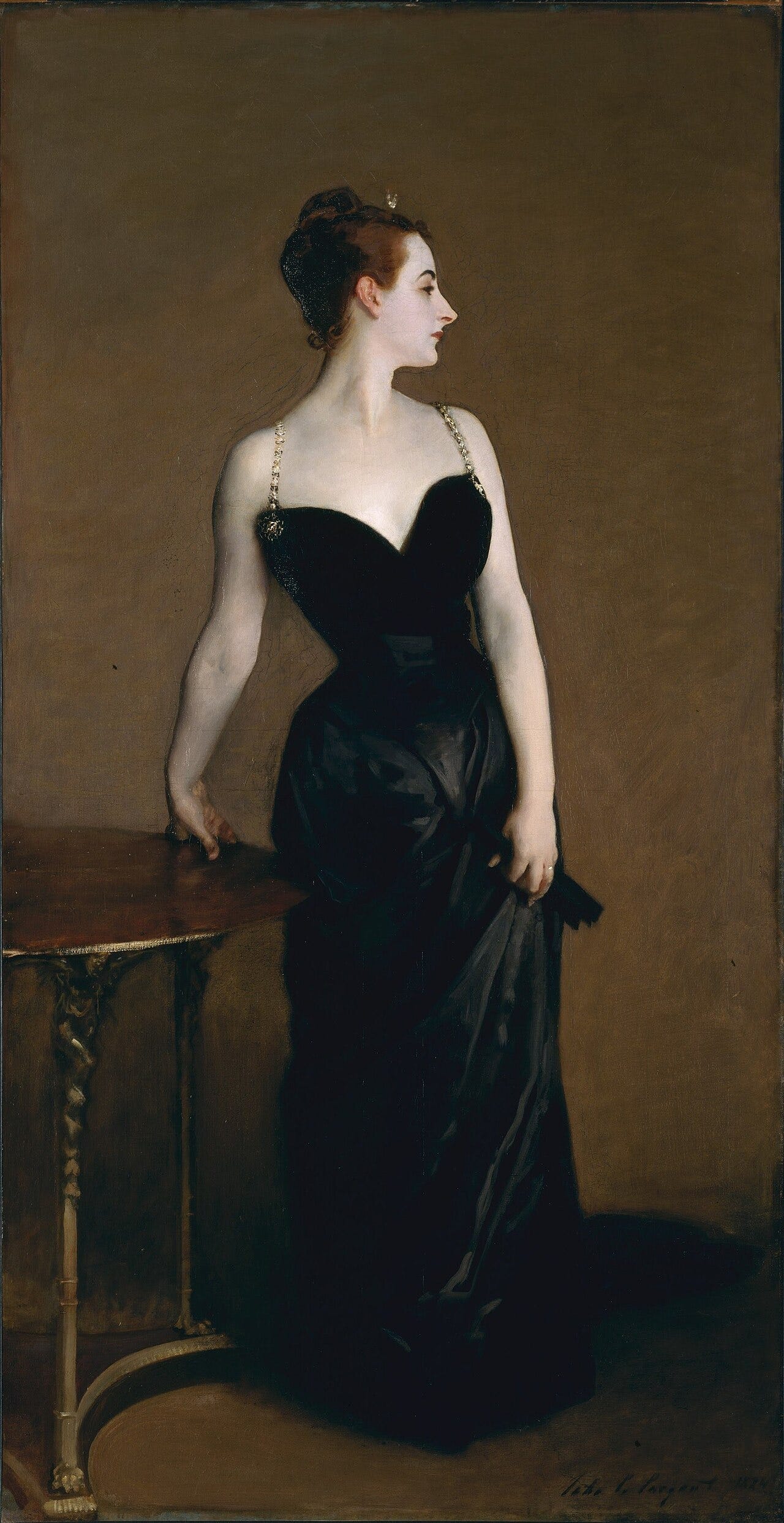
Madame X is an 1884 portrait by John Singer Sargent, in the Metropolitan Museum of Art in New York. It shows a pale society beauty in a black dress.

When Sargent first exhibited it with one jeweled strap slipping off her shoulder, the scandal was so severe that it drove the sitter into hiding and the painter out of Paris.

Society woman in a black gown, head in profile, pale skin
John Singer Sargent, Madame X, 1884

This is the Sargent painting, not the Madonna album. Here is who she really was, why a fallen strap ended two reputations, and the change Sargent made to try to save it.


Learn art the fun way. Free stories every week, no boring lectures.


The woman behind the X

Her name was Virginie Amelie Avegno Gautreau. She was born in Louisiana, moved to Paris after the American Civil War, and married a wealthy French banker.

In the Paris of the 1880s she was famous for her looks and for the gossip about her love affairs, a professional beauty whose face was known in every salon.

Sargent, an ambitious young American painter, wanted her. This was not a commission: he pursued her for months, convinced that painting the most talked about woman in Paris would make his name at the Salon.

He made some thirty studies before he found the pose.

The pose, and the skin that is not natural

She stands with her body turned to us and her head sharply in profile, one hand gripping the table, the other twisting her gown. It is haughty and cold and completely controlled.

Her skin is the strange part. That chalk pale, faintly lavender complexion was not invention. Gautreau powdered herself with rice powder and was rumored to take small doses to lighten her skin, cultivating exactly this unnatural pallor as her signature.

Sargent painted it faithfully, right down to the reddened ear, and touched the portrait with sly classical hints, the little mermaids on the table leg, the crescent moon of the goddess Diana in her hair.

One strap, and a room full of laughter

When Madame X hung at the Salon of 1884, Sargent had painted the right shoulder strap of her gown fallen down her arm, as if it had just slipped.

To modern eyes it is nothing. To 1884 Paris it read as a woman half undressed, an aristocrat shown as available, and the room turned on it.

The critics mocked it, the crowds laughed, and Gautreau's mother reportedly begged Sargent to withdraw the picture, saying her daughter was ruined.

He refused to take it down, but afterward he repainted the strap, lifting it back onto her shoulder where it sits today. The damage was done.

Gautreau withdrew from the glare she had once courted, and Sargent, his Paris career in ruins, packed up and moved to London.


Join 130,000 readers who get the secrets behind the paintings. Free.


Why it is called Madame X

Sargent never titled it with her name. He exhibited it as Portrait of Madame Gautreau, then later, trying to spare her, as Madame X, a mask that fooled nobody, since all of Paris knew whose shoulder it was.

The letter X was meant as discretion, a curtain drawn over a real woman's disgrace. It has ended up doing the opposite: the anonymity makes her a type, the unnamed dangerous beauty, and it is a large part of why the picture still fascinates.

We are looking at a real scandal wearing a blank name.

At the Met, and Sargent's own verdict

Madame X is in the Metropolitan Museum of Art in New York. Sargent kept it in his own studio for over thirty years, and when he finally sold it to the Met in 1916, for a modest sum, he asked that the sitter's name be hidden, and wrote that he supposed it was the best thing he had ever done.

I think he was right. A second, unfinished version survives in the Tate in London. It carries no market price now, one of the most visited portraits in New York.

The pallor that may have been poison

That chalk white, faintly lavender skin was Gautreau's trademark, and she worked at it. She powdered herself heavily, tinted the powder with a violet cast, and was rumored to take small doses of arsenic, then a fashionable and dangerous way to pale the complexion.

Sargent painted the effect exactly, down to the reddened ear, refusing to warm her into something healthier.

It is part of why the portrait unsettled people even before the strap. She does not look like a living woman flushed with blood. She looks lacquered, deliberately artificial, a beauty who has made herself into an object, which is the very thing the picture is quietly about.

What became of Virginie Gautreau

The scandal did not destroy her, but it marked her. She withdrew from the glare she had courted, and yet she went on being painted: Gustave Courtois showed her a few years later, in 1891, again with a strap slipping from her shoulder, and Antonio de La Gandara painted her too.

She spent her later years guarding a beauty that was fading and died in 1915, a year before Sargent finally sold the portrait that had once ruined her season.


Madame X, quick answers

  • Why was Madame X controversial? Sargent first showed it with a jeweled strap fallen off the shoulder, read in 1884 as a respectable woman shown half undressed. The Salon mocked it and the sitter was humiliated.

  • Who is the woman in Madame X? Virginie Amelie Avegno Gautreau, an American born Paris society figure married to a French banker, known for her looks and her pale powdered skin.

  • What happened to Madame Gautreau? The scandal damaged her reputation and she withdrew from public life. Sargent repainted the fallen strap and left Paris for London.

  • Who painted it and when? John Singer Sargent, in 1884.

  • Where is Madame X now? The Metropolitan Museum of Art in New York.


If this painting pulled you in, you will love these too:


The best thing he ever did

The scandal that nearly ended Sargent in 1884 turned out to be the making of him. In London he became the most sought after portrait painter in the world, and by the time he sold Madame X he was rich and famous.

He had come to see the disaster as his finest work, and he was right: the picture the Salon laughed at is now the one painting of his that everyone knows.

Virginie Gautreau died in 1915, a year before it entered the Met, and never lived to see the humiliation become a triumph.

You can see Madame X in person at the Metropolitan Museum. For more by the artist, browse the Tate collection.

What people ask about Madame X


Two new stories a week, 130+ secrets unlocked. Start free.