
Maps and globes in painting are never decoration. Vermeer painted the same wall map at least three times, Holbein hid a broken world in a portrait, and one Dutch map is so accurate that historians date the painting by it. Twelve canvases where geography carries the meaning.
Set your compass
One painter used the same map as a prop in at least three different pictures.
One globe in a famous portrait is deliberately turned to show a country in revolt.
One map hangs behind a soldier flirting with a girl, and it changes the whole scene.
In one painting the earth itself has been reduced to a soap bubble.
Learn art the fun way
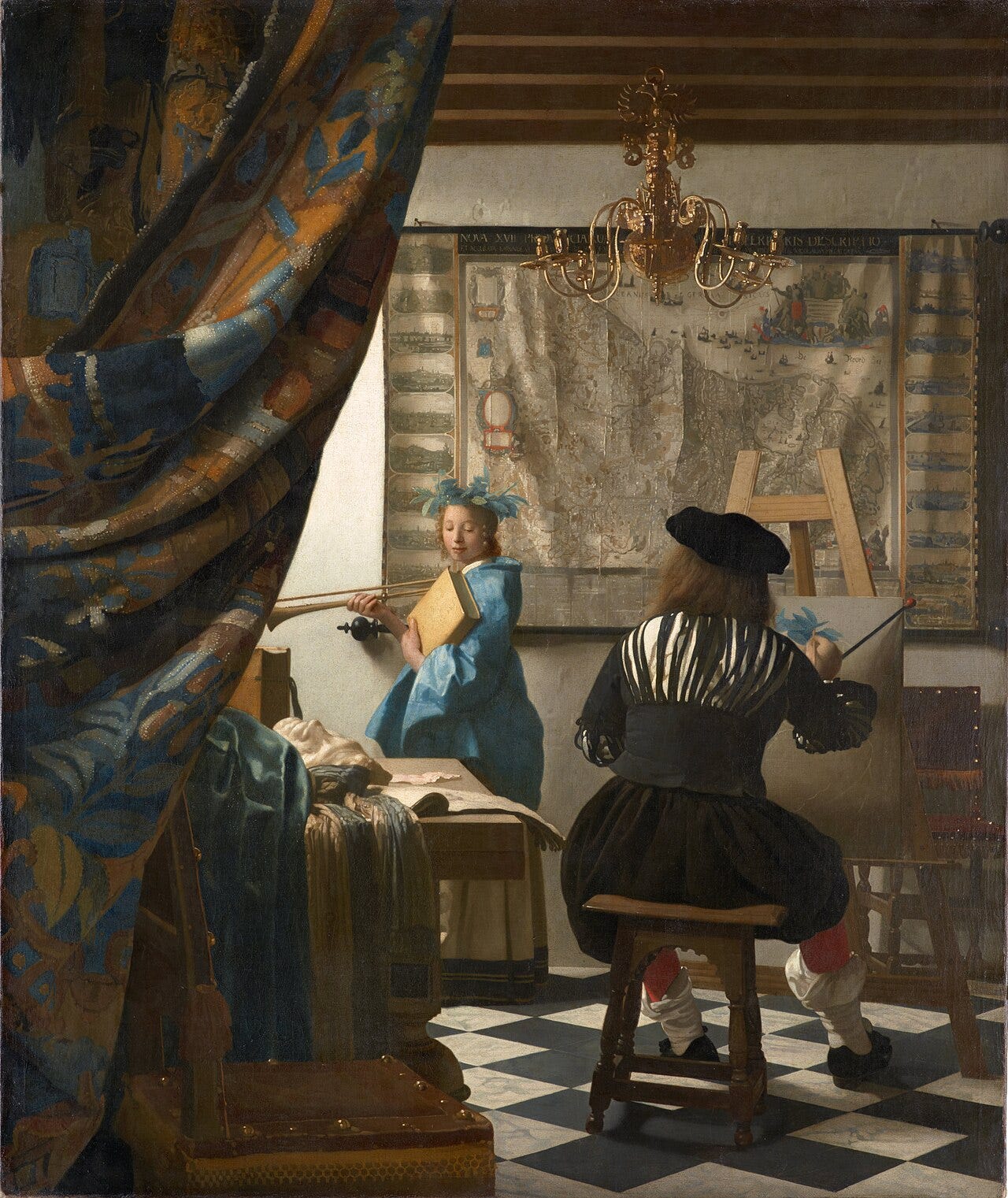
1 | The Art of Painting, Johannes Vermeer (about 1666)
A huge map of the Netherlands fills the back wall, printed before the country split in two. Vermeer painted the old united map decades after it was out of date.
Historians read it as nostalgia for a Netherlands that no longer existed. The map appears in other Vermeers too: he I cover that in Vermeer.
2 | Holbein’s globes, terrestrial and celestial (1533)
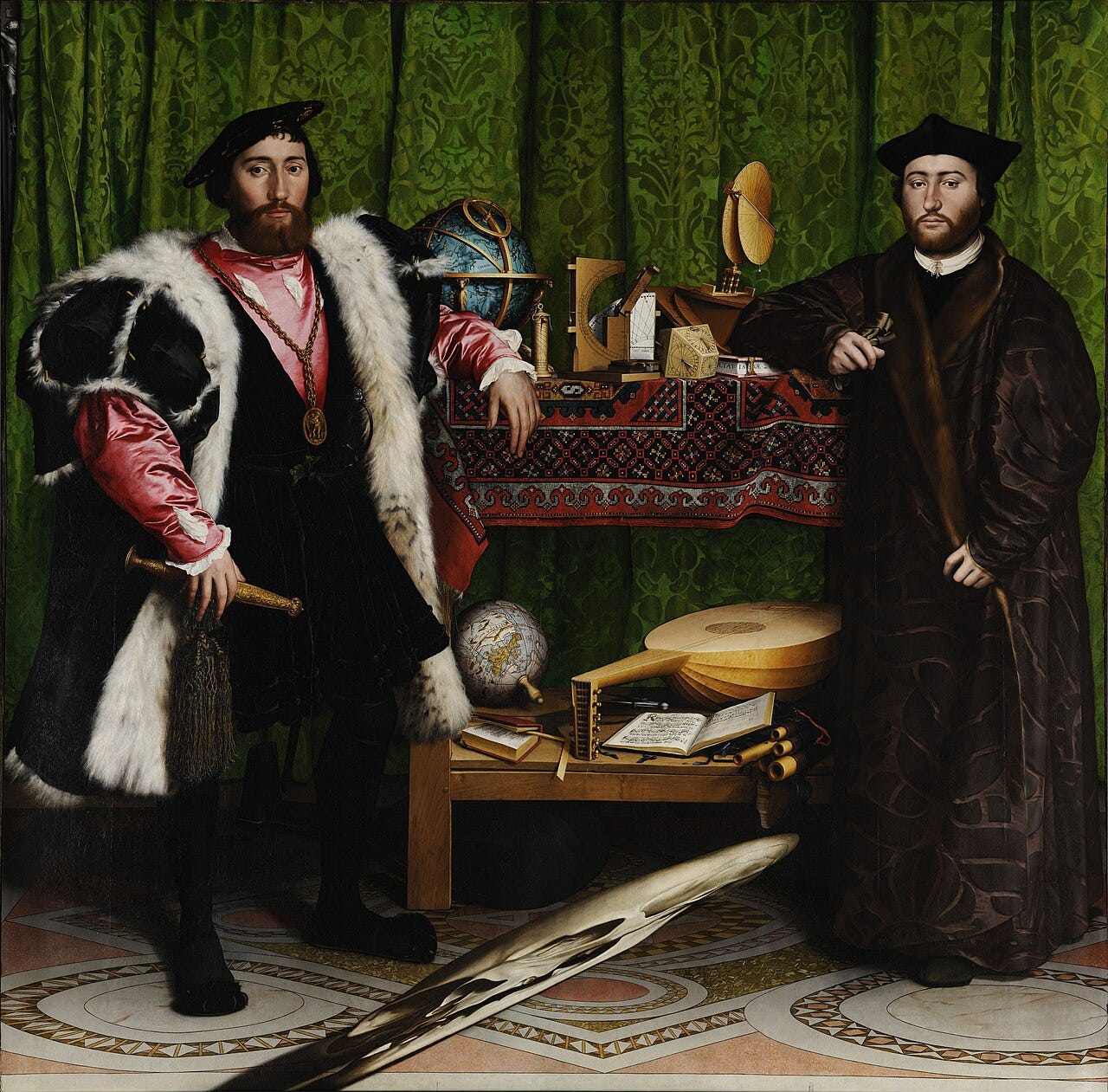
Two diplomats stand beside a shelf of instruments: a celestial globe, a terrestrial globe, sundials, a lute with a broken string.
The terrestrial globe is turned to show Europe fracturing over religion, and the broken string means discord. I go through every object in The Ambassadors and its secret detail.
3 | Officer and Laughing Girl, Johannes Vermeer (about 1658)
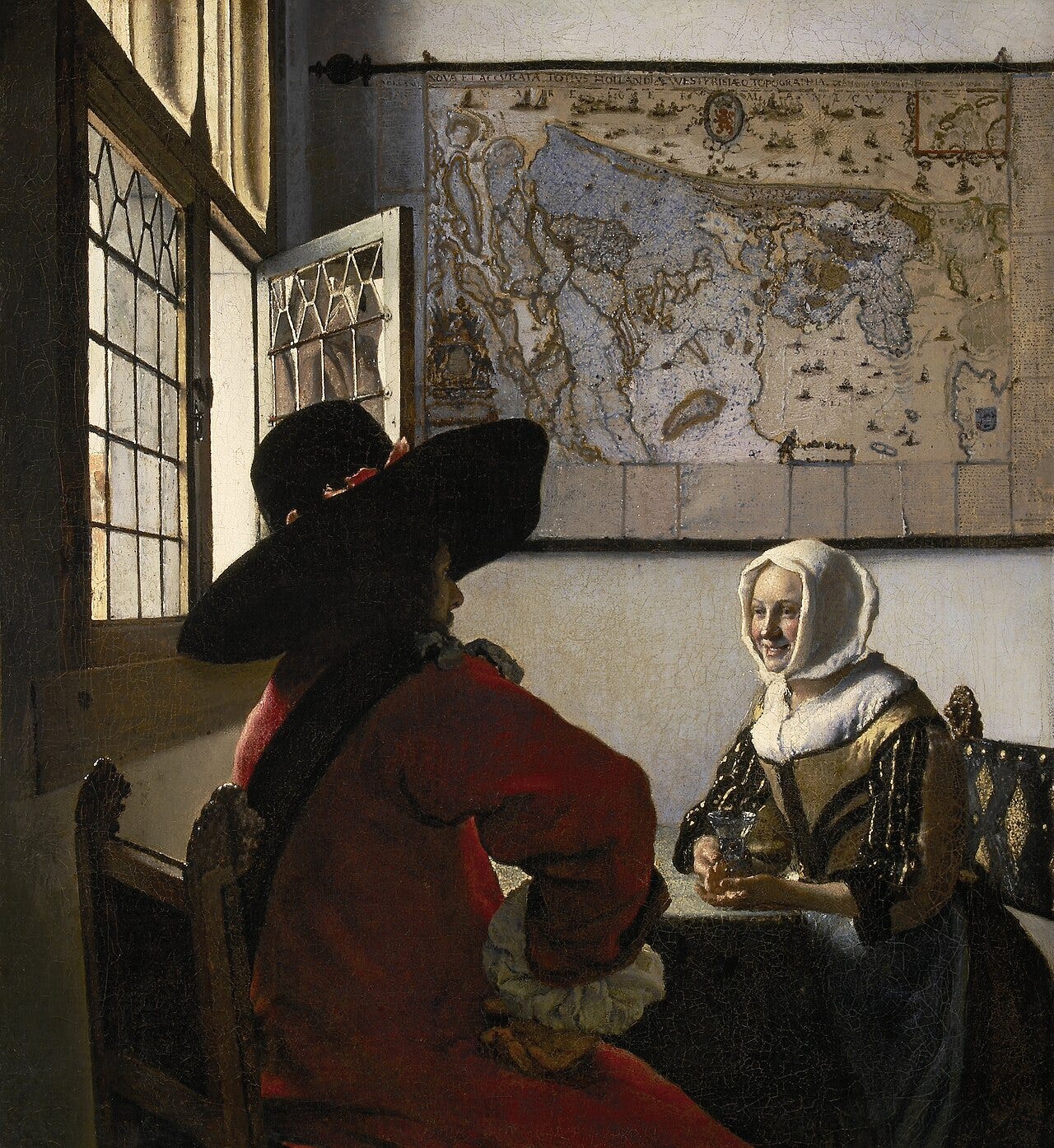
A soldier in a red coat leans in, a girl laughs, and behind them hangs that same wall map of Holland, orange and blue.
The map is not background: it tells you he is a man who travels and she is a woman who stays. The Frick in New York keeps it.
4 | The Armada Portrait of Elizabeth I (about 1588)
Elizabeth rests her fingertips on a globe, directly on the Americas, while behind her the Spanish fleet wrecks in a storm.
A hand on a globe was the clearest claim to empire available in 1588. The full royal propaganda machine is in famous paintings of kings and queens.
5 | The Geographer, Johannes Vermeer (1669)
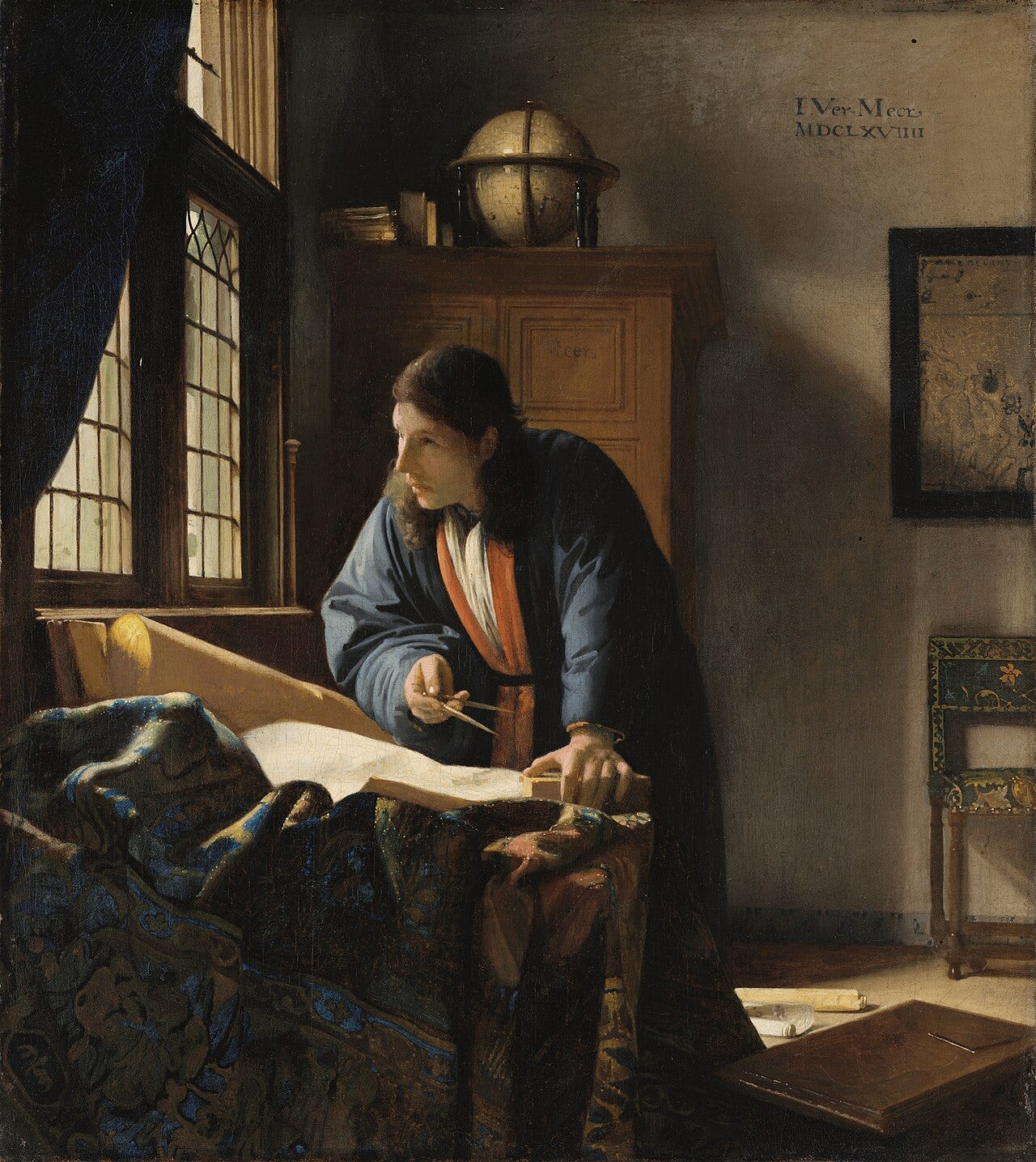
A man in a robe leans over a chart with dividers in his hand, mid thought, looking toward the window. A globe sits on the cupboard behind him.
The globe is a real one, made by Hondius in 1618, identifiable down to the model. Delft was a town of instrument makers, and Vermeer painted their world exactly.
6 | The Allegory of Sight, Jan Brueghel and Rubens (1617)
A room stuffed with telescopes, paintings, globes and optical instruments: a portrait of looking itself, made for the Habsburg governors of the Netherlands.
Globes here are trophies of knowledge. The Prado hangs it beside its four sister senses.
Jan Brueghel the Elder and Rubens painted it around 1617 for the Archdukes in Brussels, cramming a room with telescopes, paintings and instruments. It is a picture about looking that contains dozens of other pictures.
7 | Vanitas with a Globe, Dutch school (17th century)
Skull, hourglass, extinguished candle, and a globe among them. Once the earth joins a vanitas table, it stops meaning power and starts meaning smallness.
The whole grammar of these objects is in what is vanitas.
A terrestrial globe in a vanitas means worldly ambition, and it is usually placed next to a skull to settle the argument. Dutch painters had access to the best globes in Europe, made in Amsterdam by Blaeu.
8 | Homo Bulla, Hendrick Goltzius (1594)
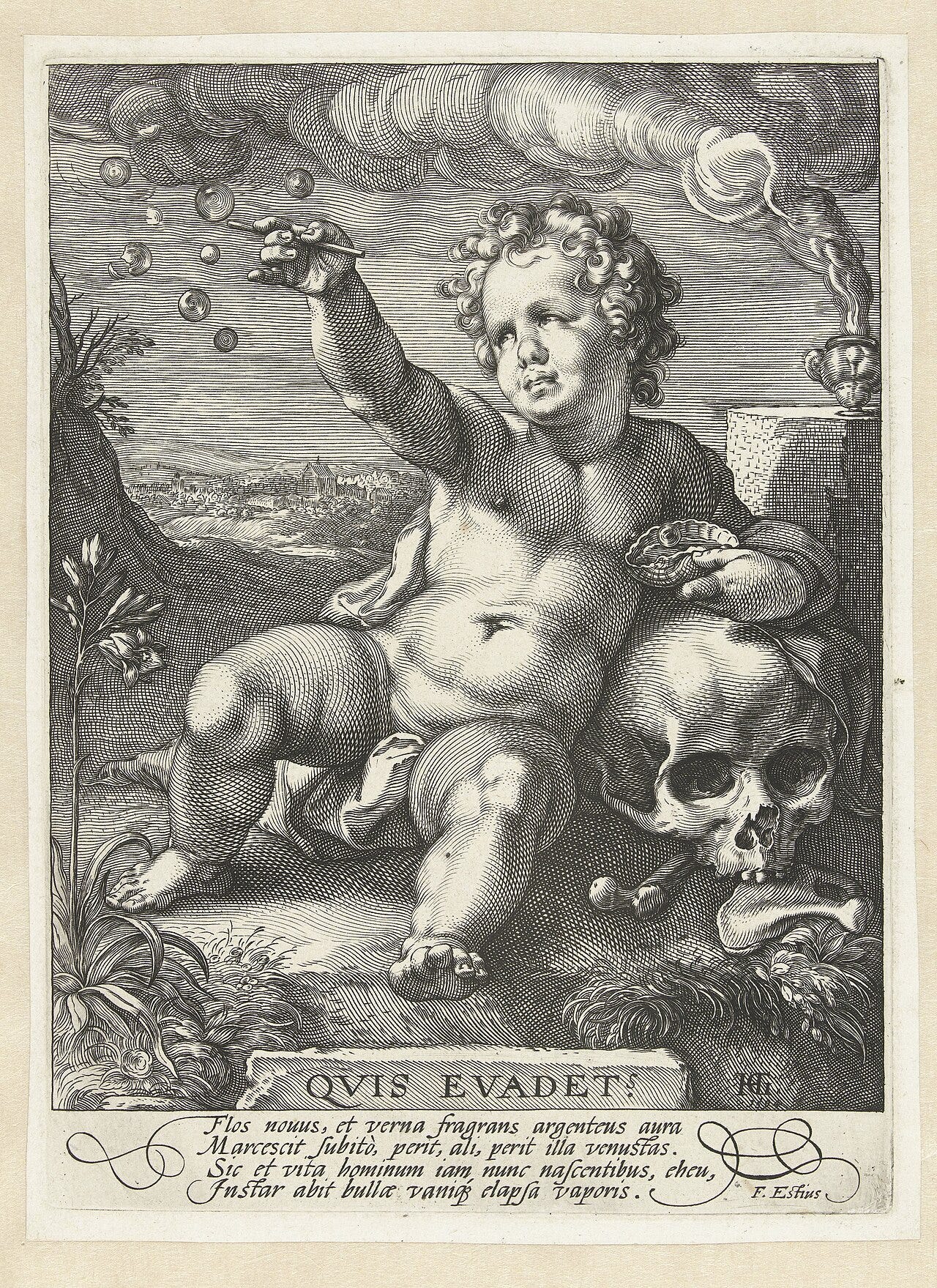
A child leans on a skull and blows soap bubbles under the motto: man is a bubble. The globe of the world becomes a sphere of soap that bursts.
It is the cheapest globe in art history and the most devastating.
The phrase means man is a bubble, from the Roman writer Varro. Goltzius engraved a putto blowing bubbles beside a skull in 1594, and the motif runs through Dutch painting for a century.
9 | The Arnolfini Portrait, Jan van Eyck (1434)
No map, but the most famous convex mirror in painting, curving an entire room into a sphere: a private world with two extra witnesses reflected in it.
Van Eyck signed the wall above it. I unpack the whole room in the Arnolfini Portrait, and the painter More of it in Jan van Eyck.
10 | The Astronomer, Johannes Vermeer (1668)
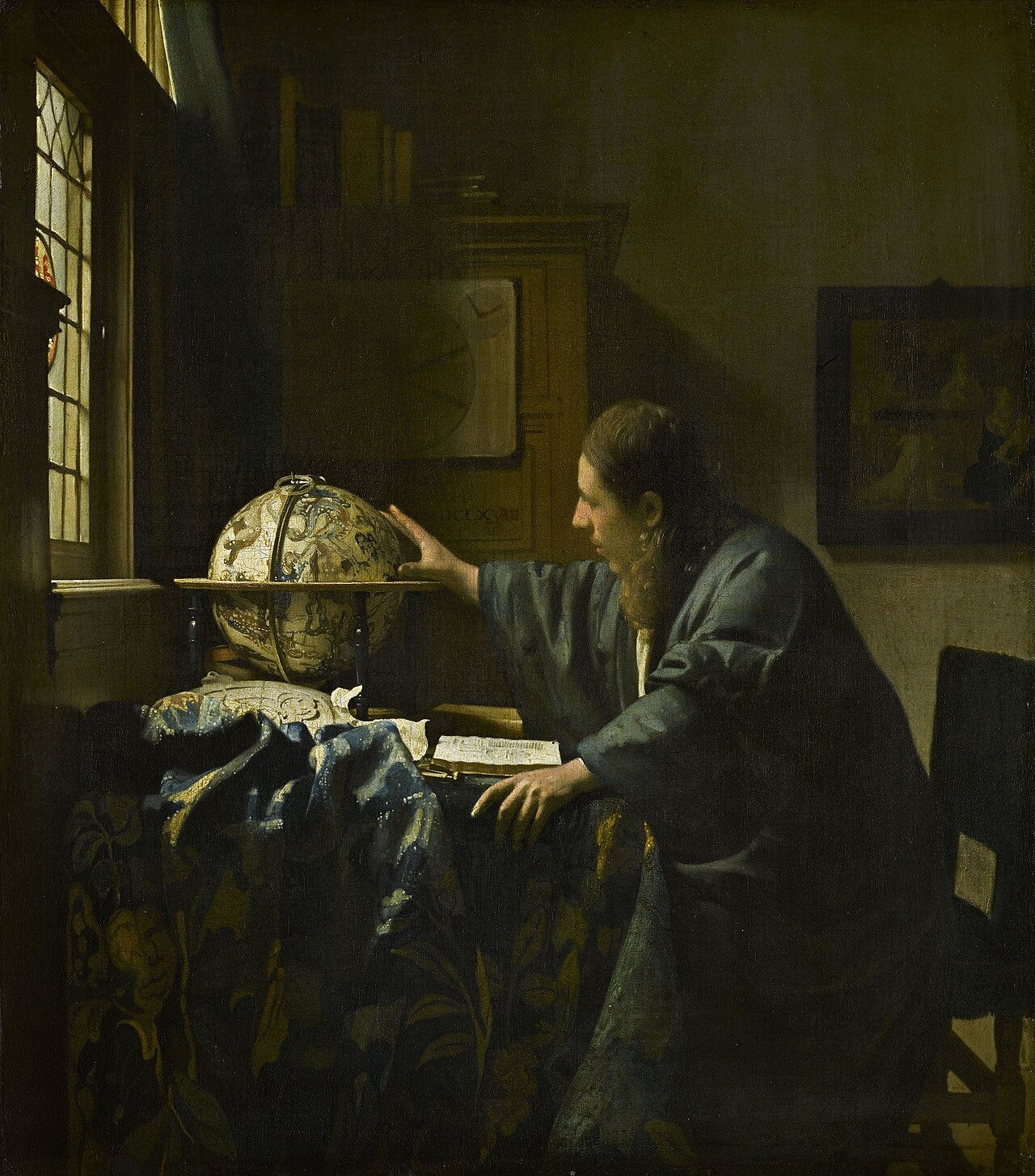
The companion piece to The Geographer: a scholar reaches toward a celestial globe, his hand almost touching the stars printed on it.
The Nazis seized this painting from the Rothschild collection in 1940; it hangs in the Louvre today, a small stamp still on its back.
11 | View of Delft, Johannes Vermeer (about 1660)
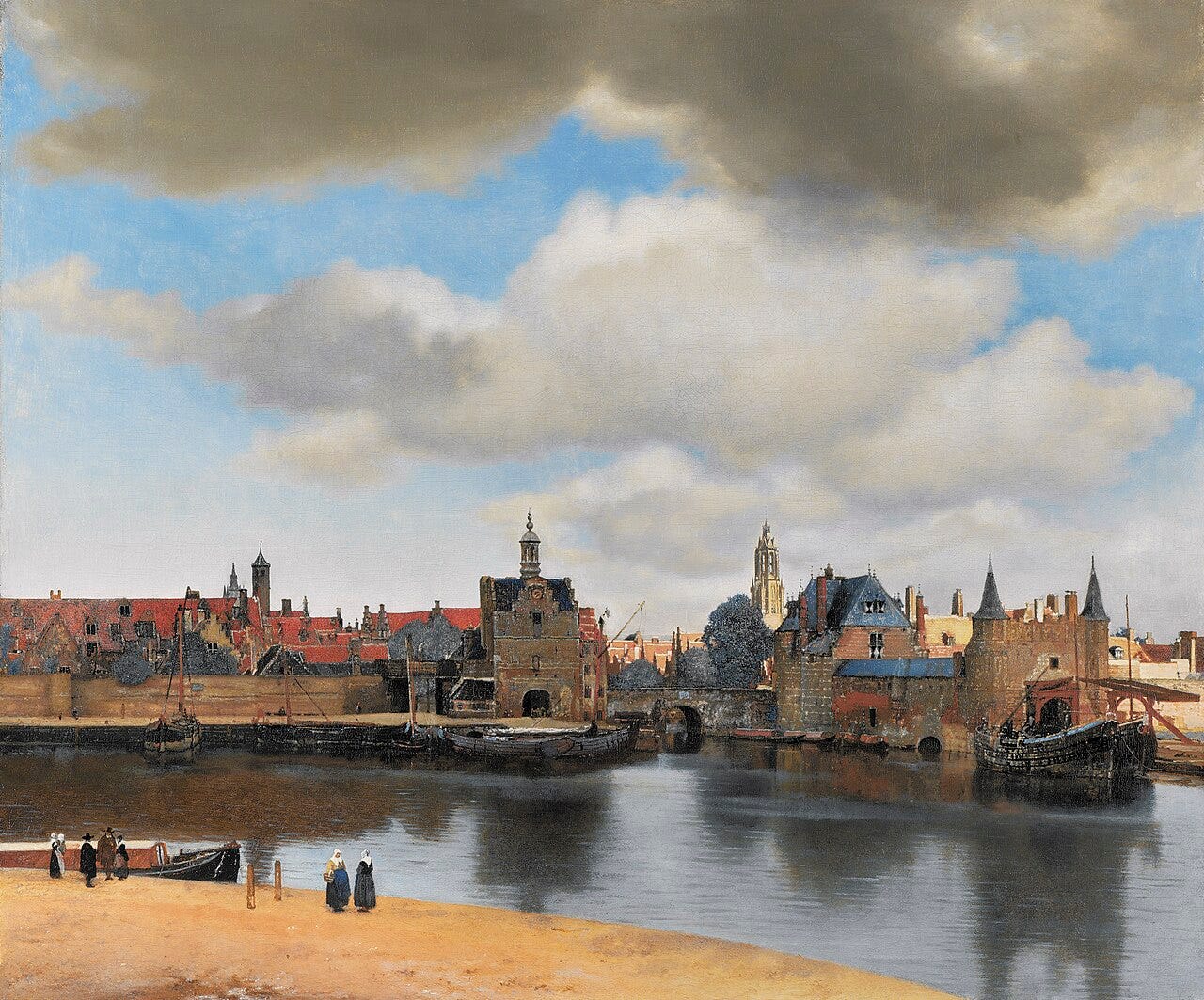
A city portrait so exact that researchers have matched the towers, the light and even the hour: about seven in the morning, looking north.
Painting as cartography. Marcel Proust called it the most beautiful painting in the world and put it in his novel.
Vermeer painted it around 1660 to 1661 from a spot south of the city, and the buildings can still be identified. Proust called it the most beautiful painting in the world and collapsed at an exhibition of it in 1921.
12 | The Bucintoro Returning to the Molo, Canaletto (about 1730)
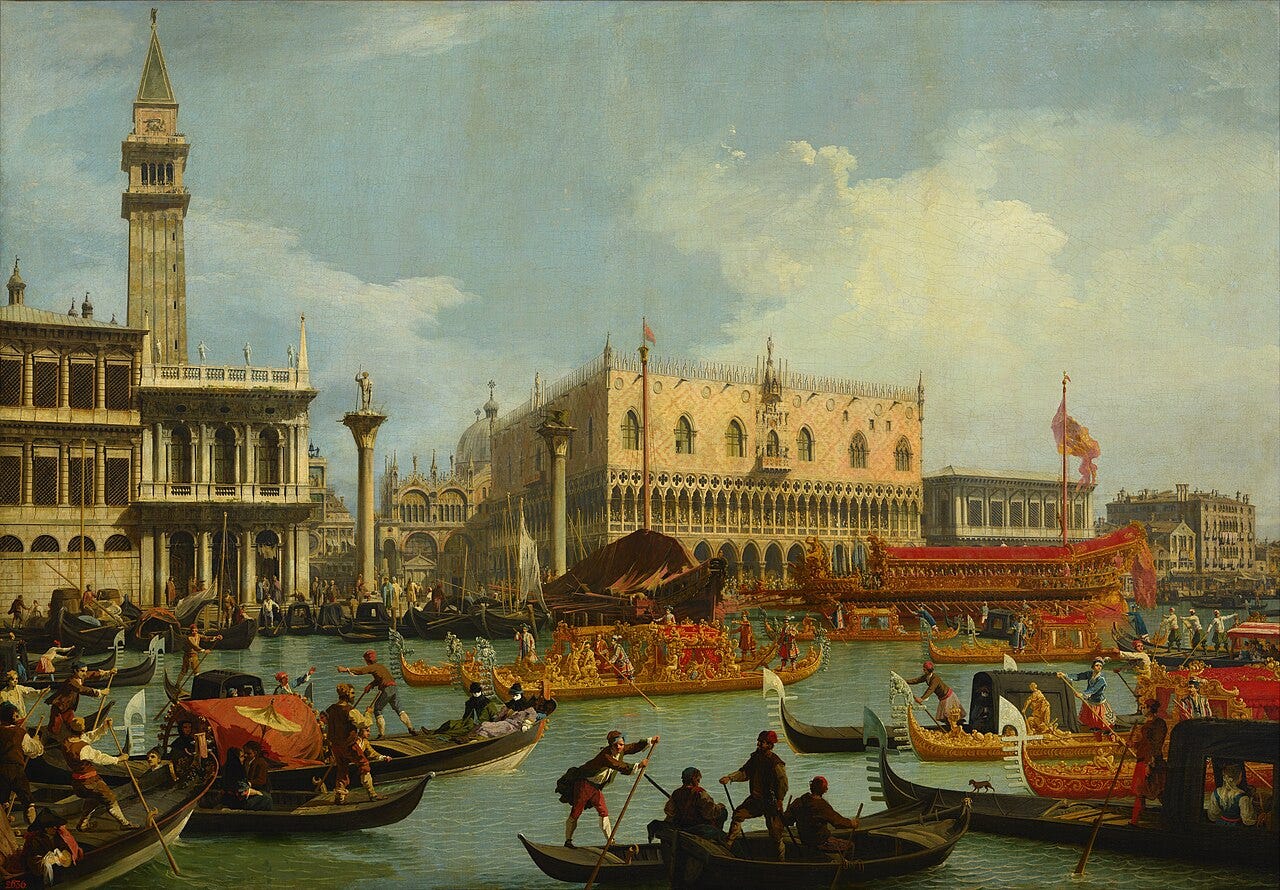
Canaletto sold Venice to English tourists as a perfect map of itself: every column, boat and shadow in place, the city viewable from a chair in London.
He used a camera obscura to get the geometry right. The industrial scale view painter The full account is in Canaletto.
The Rijksmuseum holds the Dutch cartography that hangs on these walls, and the Rijksmuseum has the Holbein.
Reading the maps: what people ask
Why do so many Dutch paintings contain maps? The Dutch Republic ran on trade and printed the best maps in Europe. A wall map showed wealth, curiosity and reach.
Is Vermeer’s map real? Yes. It matches a published wall map by Claes Jansz Visscher, which lets historians date the painting and read its politics.
What does the globe mean in The Ambassadors? It marks the world splitting over the Reformation, with the lute’s broken string repeating the message.
Are the globes in Vermeer identifiable? The celestial and terrestrial globes match models by Hondius, made in 1600 and 1618.
Where do these actually hang? Vienna for The Art of Painting, the Louvre for The Astronomer, the Frick for the Officer, the Rijksmuseum in London for The Ambassadors.
One last detail: Vermeer’s Geographer and Astronomer are the only two men he ever painted alone at work, and X rays show the same model posed for both. One man, two ways of measuring the world.
Several of these maps were painted in monochrome before the color went on, a technique with its own name: grisaille.
This subject is one thread in a wider theme. See how it fits into Objects and Symbols in Painting.