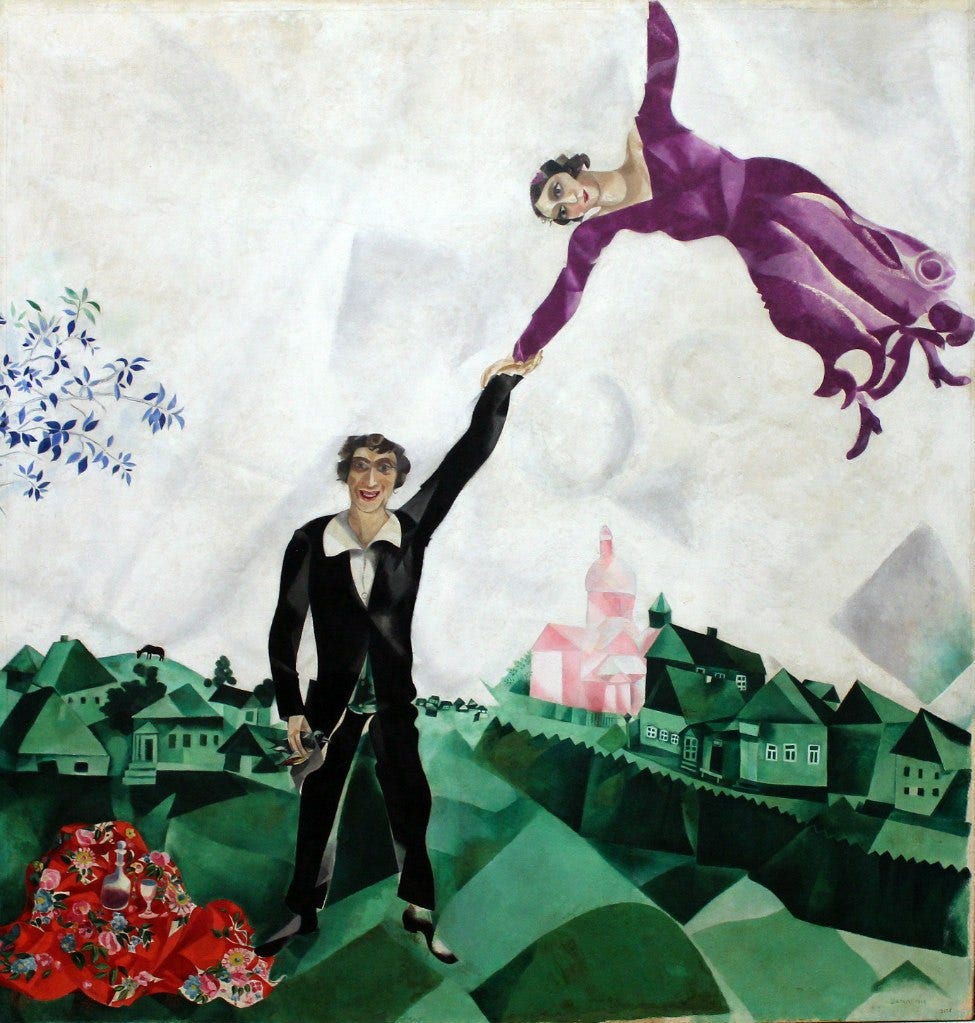
Marc Chagall: The Complete Story

Marc Chagall ran an art school in revolutionary Russia and lost it to Malevich, escaped the Nazis with the clothes he stood in, and at 77 painted the ceiling of the Paris Opera. He outlived every ism he was filed under and died at 97, still working.

The flying cows are not naivete. They are Vitebsk, remembered in Yiddish, painted in French. Here is the century-long story.

Marc Chagall at a glance:

  • 1887: born Moishe Shagal in Vitebsk, eldest of nine in a herring merchant's family.

  • 1911: reaches Paris and a studio at La Ruche, where the poets Cendrars and Apollinaire become his first interpreters.

  • 1920: paints the murals of Moscow's State Jewish Theater in seven weeks, then leaves Russia for good in 1922.

  • 1944: Bella dies suddenly in exile in New York; he does not touch a brush for months.

  • 1985: dies at 97 in Saint-Paul-de-Vence, the last living witness of the Paris avant-garde of 1911.

Montréal Cote St Luc avenue Marc Chagall 2022 08 09

Vitebsk, the town he never left

Chagall was born Moishe Segal in Vitebsk, in the Russian Empire, on July 7, 1887, eldest of nine children of a herring warehouse worker. The wooden houses, fiddlers, and rooftops of that Hasidic town furnished his imagery for the next ninety years, whatever country he actually lived in.

Paris, 1911: La Ruche and the poets

Arriving in Paris in 1911, he took a studio in La Ruche among the poorest immigrant artists and painted I and the Village within the year.

Apollinaire and Cendrars adopted him; Cubism he took apart and reassembled into something entirely his own.

Trapped in Russia by the 1914 war, he married Bella Rosenfeld in 1915, and after the revolution became art commissar of Vitebsk, founding a school so open-minded he invited Malevich, who promptly took it over.

Chagall left in 1920, a modernist purged by modernists.


Hooked on Chagall? Get more art secrets and stories in your inbox, free.


More incredible painter stories

If Marc Chagall pulled you in, you will love these too:


Exile, Bella, and the war

Paris again from 1923, then flight in 1941, when Varian Fry's rescue network got the family to New York just ahead of the deportations.

Bella died suddenly of an infection in September 1944, and Chagall did not touch a brush for months.

The crucifixions he painted around the war, above all White Crucifixion of 1938, put a Jewish Jesus in a prayer shawl at the center of Europe's catastrophe, and Pope Francis has named it his favorite painting.

The myth of the naive dreamer

Because the lovers float, Chagall gets called a folk artist who wandered into modernism.

The record shows the opposite: a trained painter who argued theory with Malevich, taught, ran a school, mastered stained glass in his seventies, and worked in ballet, opera, ceramics, and mosaic.

Picasso, not a generous man, said that when Matisse died Chagall would be the only painter left who understood what color really is.


130,000 readers learn art the fun way here. Join them, free.


Glass, ceilings, and where to see him

The late Chagall is public art: the twelve Jerusalem Windows for the Hadassah hospital synagogue in 1962, the Paris Opera ceiling unveiled in 1964 over Garnier's gilt, painted at 77 on 240 square meters, and the America Windows given to Chicago in 1977.

He died in Saint-Paul-de-Vence on March 28, 1985, at 97. The Musee Chagall in Nice, MoMA, and the Art Institute of Chicago hold the core.

The theater walls of Moscow

In 1920 Moscow's State Jewish Theater handed him bare walls and seven weeks. He painted the whole room: fiddlers, acrobats, and himself carried in on a friend's shoulder.

When the theater was liquidated in 1949 the canvases went into hiding, under the stage and then in storerooms; on a 1973 visit he signed them again.

They resurfaced to tour the world in the 1990s: the missing link between Vitebsk and everything after, kept alive in the dark.

America, and Aleko

Exile put him on stage. The ballet Aleko opened in Mexico City in 1942 with his sets and costumes, executed with local pigments and seamstresses while he learned Spanish curses.

The Firebird followed in 1945, designed in the year of grief after Bella's death: an aviary of costumes museums still exhibit.

The Metropolitan Opera murals and the Paris ceiling of the 1960s grew straight from those wartime stages.

The Bible, printed and painted

Vollard commissioned a printed Bible in 1930; Chagall traveled to Palestine to prepare, etched through the decade, and the war froze the plates. The 105 prints finally appeared in 1956.

From the same current came the Message Biblique, seventeen large canvases he gave France in 1966; Malraux built a museum for them in Nice.

He called the Bible the greatest source of poetry there is, and spent forty years paying the compliment back.

The Marc Chagall questions that keep coming up

  • Why do Chagall's figures fly? They come from Yiddish idioms and Vitebsk memory, where joy lifts people off the ground. He painted the phrase, not the physics.

  • Did Chagall paint the Paris Opera ceiling? Yes, unveiled in September 1964 on Malraux's commission. It was installed over the original 1875 ceiling, which is intact underneath.

  • What religion was Chagall? He was raised Hasidic Jewish in Vitebsk, and Jewish life remained his central subject, including the wartime crucifixions that framed Jesus as a persecuted Jew.

  • Where can I see Chagall? The Musee National Marc Chagall in Nice, the Opera Garnier ceiling in Paris, the America Windows in Chicago, and the Jerusalem Windows at Hadassah.

  • How much does a Chagall cost? Les Amoureux, from 1928, brought 28.5 million dollars in 2017, his record. Prints are plentiful and affordable; so are fakes, which keeps the Comité Chagall busy.

  • Did he ever go back to Russia? Once, in 1973, at the Soviet ministry's invitation: he signed the hidden theater murals and saw his sisters, but refused to visit Vitebsk. Some returns cost too much.


More secrets to unlock


The vote he lost, the century he won

The school Chagall founded in Vitebsk in 1919 admitted anyone, which is how Malevich walked in and voted him out. Sixty years later the man who lost that vote had ceilings in Paris, windows in Jerusalem, and 97 years of the century in his hands.


Learn art the fun way. Get the next story in your inbox, free.


(Castres) Hommage à Chagall Pablo Gargallo Musée Goya