Marie Antoinette and 11 More Great Royal Portraits

Royal portraits were the propaganda of their age, from Rigaud's towering Louis the Fourteenth to Vigee Le Brun's scandalous Marie Antoinette in her underclothes, Titian's emperor on horseback and David's Napoleon on a rearing horse.

Every one was built, above all, to be believed.

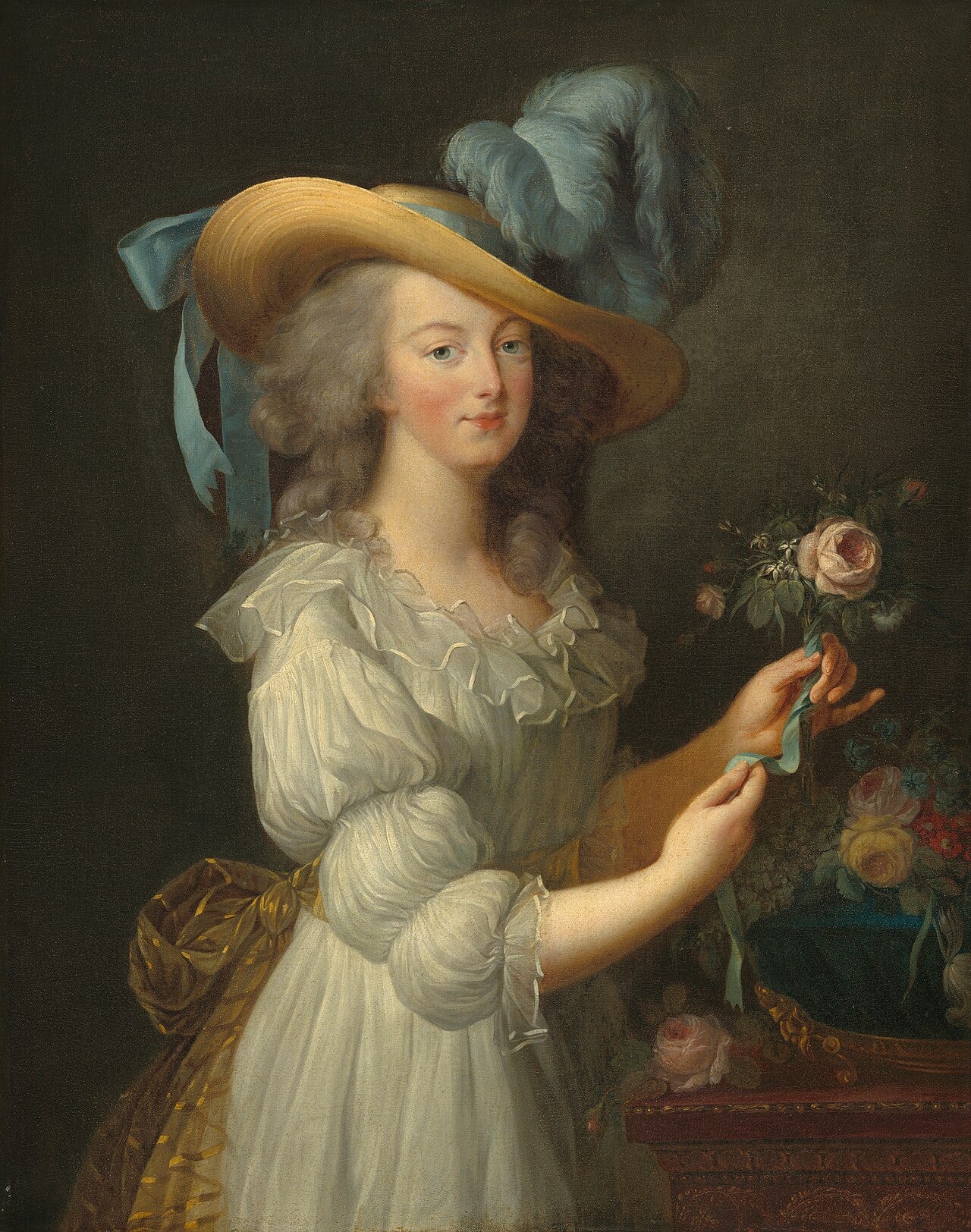
Marie Antoinette in a white muslin dress and straw hat
Elisabeth Vigee Le Brun, Marie Antoinette in a Chemise, 1783.

A crown could not be everywhere at once, so the portrait went instead, hung in embassies and palaces to stand in for the ruler. That made these paintings weapons, each one arguing that the sitter was strong, holy, beautiful or simply meant to rule.

I have gathered twelve, with Marie Antoinette at both ends, because her story shows better than any what these images could do, and what they could not save you from.

What a royal portrait is really selling:

  • Power. Padded shoulders, a raised hand, a horse mid rear. The body is arranged to loom over you.

  • Bloodline. Ermine, crowns and family groups all insist the sitter was born to the throne.

  • Virtue. A devoted mother, a calm general, a pious king. The image answers whatever the public is whispering.

  • Taste. Silk, jewels and the finest painter alive were themselves proof of a court's wealth and reach.


Learn art the fun way. Free stories every week, no boring lectures.


What comes after this page

If you like knowing what is actually going on inside a picture, start with these three:


1. Elisabeth Vigee Le Brun, Marie Antoinette in a Chemise (1783)

The queen of France stands in a soft white muslin dress and a straw hat, holding a rose, looking as though she has wandered out of a garden rather than a palace.

Vigee Le Brun, one of the great women painters the story keeps forgetting, meant it as charming. It caused a scandal.

The problem was the cloth. The dress was imported cotton, not French silk, which looked unpatriotic while Lyon's weavers went hungry, and worse, it looked like underwear, the queen shown as if caught in her nightgown.

She had to pull it from the Salon. Vigee Le Brun quickly painted a more proper version with a rose, but the damage held, and yet the same simple gown swept France as a fashion, nicknamed the chemise of the queen.

2. Elisabeth Vigee Le Brun, Marie Antoinette and Her Children (1787)

Marie Antoinette in red velvet with her three children
Elisabeth Vigee Le Brun, Marie Antoinette and Her Children, 1787, Palace of Versailles.

Four years later the queen sits stiff and regal in red velvet, three children around her, one boy lifting the cloth on an empty cradle. This was a rescue mission in paint, made to fight the hatred building around her.

The public had turned vicious. They called her Madame Deficit and passed around filthy cartoons, so the court commissioned a grand image of Marie Antoinette as a devoted, ordinary mother, wrapped in French luxury this time.

The empty cradle is real grief. A baby daughter had just died as the picture was finished, and the painters left the crib bare, but no portrait could turn the tide, and within six years the monarchy was gone.

3. Hyacinthe Rigaud, Louis the Fourteenth (1701)

Louis XIV in ermine robes showing his legs, Rigaud
Hyacinthe Rigaud, Louis the Fourteenth, 1701, the Louvre, Paris.

The Sun King throws back a mountain of ermine to show off a pair of elegant legs in white stockings and red heeled shoes, one hand on a scepter, wig piled to the sky.

Rigaud painted the ultimate image of absolute power, and it set the template for royal portraits for a century.

Louis was sixty three and proud of it. He had been a dancer in his youth, and he wanted those legs shown, a king who ruled France for seventy two years posing like a man half his age.

He liked it too much to give it away. The portrait was meant for his grandson, the new king of Spain, but Louis kept it and sent a copy instead, and the original still hangs in the Louvre.

4. Hans Holbein the Younger, Henry the Eighth (about 1537)

Henry VIII standing wide with hands on hips, in gold
Hans Holbein the Younger, Portrait of Henry the Eighth, about 1537.

Feet planted wide, shoulders padded huge, fists on his hips, Henry stares straight out and dares you to look away. Holbein built the definitive image of the Tudor king, a wall of power and menace in cloth of gold.

The grandest of them all is lost. Holbein painted Henry into a giant mural at Whitehall Palace that burned in 1698, and we only know that overwhelming frontal pose from copies made before the fire.

It was pure image making. Henry was aging and unwell by then, but Holbein gives him the body of a champion, and that invented figure is still the Henry the Eighth everyone pictures today.


Join 130,000 readers who get the secrets behind the paintings. Free.


5. Titian, Charles the Fifth at Muhlberg (1548)

Emperor Charles V in armor on horseback at dawn
Titian, Charles the Fifth at the Battle of Muhlberg, 1548, the Prado, Madrid.

An emperor in dark armor rides out alone at dawn, lance in hand, against a burning sky. Titian painted Charles the Fifth just after a great victory, and set the template for the grand equestrian portrait that every later ruler would copy.

The calm is a fiction. Charles suffered badly from gout and could barely sit a horse by then, yet Titian shows him upright and effortless, the master of half the world in the saddle.

It set the pose for centuries. From this one picture flows a whole line of kings on horseback, the ruler literally raised above everyone, riding toward you out of the light.

6. Anthony van Dyck, Charles the First at the Hunt (about 1635)

Charles I standing elegantly beside his horse, van Dyck
Anthony van Dyck, Charles the First at the Hunt, about 1635, the Louvre, Paris.

The king of England pauses on a walk, hand on hip, a servant holding his horse, looking down at us with easy grace. Van Dyck made Charles the First the most elegant monarch in Europe, and largely on the canvas rather than in life.

The flattery was deliberate. Charles was a short and shy man with a stammer, and van Dyck angled him against the sky, made him tall and serene, and gave England an image of a king born to command.

The picture outran the reality. Fourteen years after this, the same king was tried by his own parliament and beheaded, and van Dyck's cool, confident portraits now look like the dream of a doomed court.


130,000 people read this every week. Joining them costs nothing.


7. Diego Velazquez, The Infanta Margarita in Blue (1659)

A young Habsburg princess in a silver blue gown
Diego Velazquez, The Infanta Margarita Teresa in a Blue Dress, 1659, Kunsthistorisches Museum, Vienna.

A small Habsburg princess stands buried in an enormous silver blue gown, her pale face grave under a mound of curled hair. Velazquez painted the Infanta Margarita over and over as she grew, in some of the tenderest royal portraits ever made.

These were betrothal updates. The pictures were shipped to Vienna, where the girl was promised in marriage to her own uncle, so the court could watch its future empress grow up from a distance.

The blood shows in the face. Generations of Habsburg cousins marrying cousins had left the family with a heavy jaw and fragile health, and Margarita, married at fifteen, would be dead by twenty one.

8. Peter Paul Rubens, The Disembarkation of Marie de Medici at Marseilles (1623 to 1625)

A queen arriving by ship amid sea gods, Rubens
Peter Paul Rubens, The Landing of Marie de Medici at Marseilles, 1623 to 1625, the Louvre.

A French queen steps off a ship while sea gods churn the water below and a winged Fame trumpets overhead, the whole arrival turned into a myth.

Rubens painted the landing of Marie de Medici as if a goddess had come ashore, and the three sea nymphs twisting in the water below are among the finest nudes he ever made.

It was spin on a giant scale. This is one of twenty four huge canvases Rubens made to retell the queen mother's messy, quarrelsome life as a glorious epic, tactfully skipping her exile and her feuds with her son.

Flattery this heavy needs cover. Rubens loaded the cycle with gods and allegories precisely so he could praise a difficult patron without lying outright about the awkward facts.

9. Jacques Louis David, Napoleon Crossing the Alps (1801)

Napoleon on a rearing white horse in the mountains
Jacques Louis David, Napoleon Crossing the Alps, 1801.

Napoleon rears up on a wild white horse, cloak snapping in the wind, one arm flung toward the mountain pass, a general turned force of nature. David painted the perfect image of the coming emperor, calm on a fiery steed.

The truth was humbler. Napoleon actually crossed the Alps a few days behind his army, on a sure footed mule, led by a local guide, in mild weather, which is not quite the storm David gives us.

Napoleon knew exactly what he wanted. He told David not to bother with a likeness of a calm sitter, but to show him serene on a rearing horse, because greatness, he understood, is something you paint into being.

10. Franz Xaver Winterhalter, Empress Elisabeth of Austria (1865)

Empress Sisi in white with diamond stars in her hair
Franz Xaver Winterhalter, Empress Elisabeth of Austria, 1865.

The empress sweeps across the canvas in a white gown scattered with diamond stars, more of them glittering in her famous floor length hair. Winterhalter painted Sisi of Austria as a fairy tale, the most admired beauty of her age.

One man painted all their crowns. Winterhalter was the portrait machine of nineteenth century royalty, moving from court to court to flatter queens and empresses across Europe, which is why so many of them look alike.

Behind the glitter was a prisoner. Sisi hated court life, starved and exercised herself thin to keep this image, and was stabbed to death by an anarchist decades later, still guarding the beauty this picture sold.

11. Pierre Paul Prud'hon, The Empress Josephine (1805)
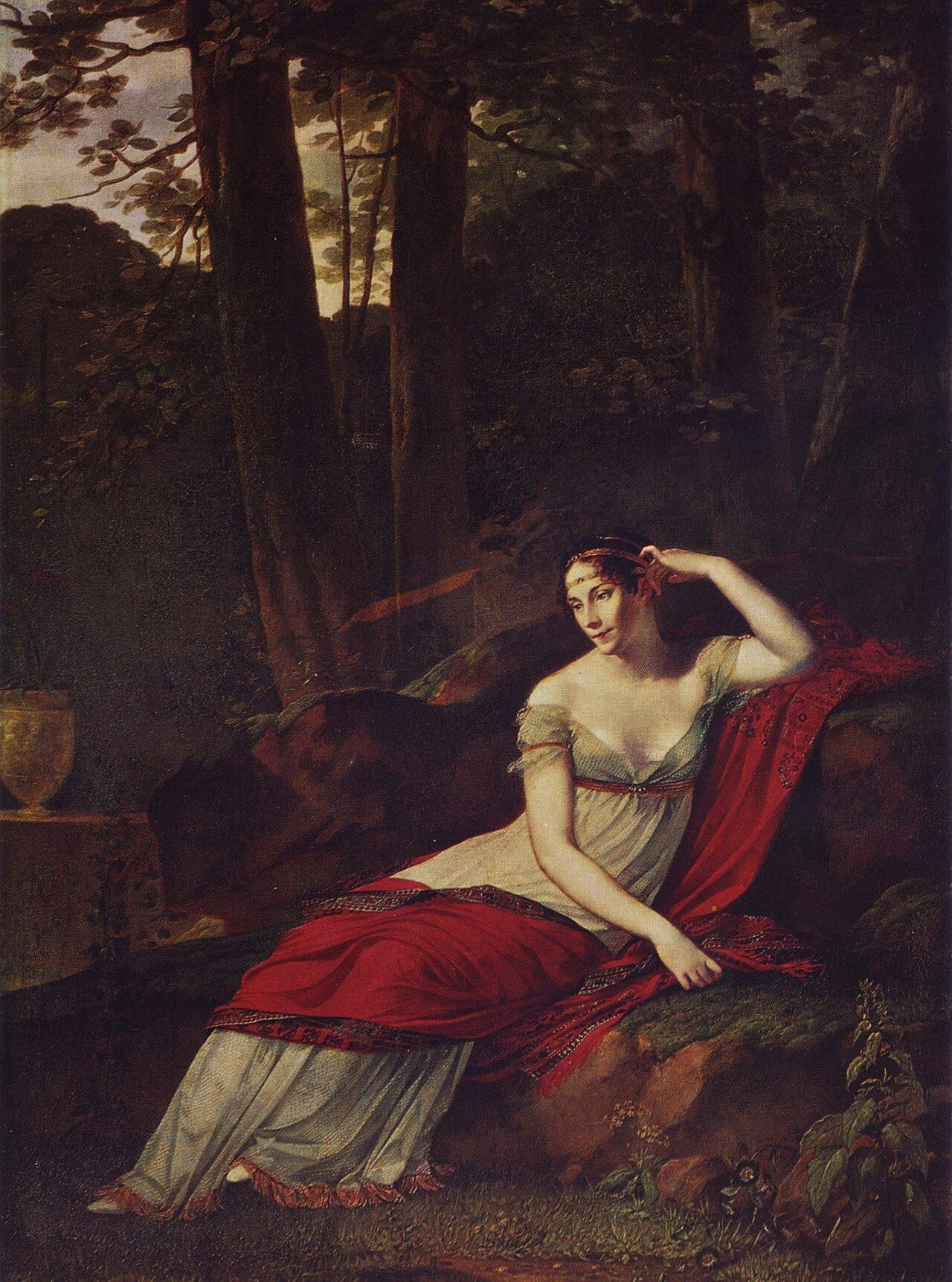
Josephine reclining alone in a shadowy wood
Pierre Paul Prud'hon, The Empress Josephine, 1805, the Louvre, Paris.

Napoleon's wife sits alone in a shadowy wood, leaning on one arm, her white dress slipping, her look soft and far away. Prud'hon painted the Empress Josephine not as a ruler but as a dreaming, melancholy woman.

The mood turned out to be a warning. Josephine looks pensive here, and within a few years Napoleon divorced her because she had given him no heir, trading affection for a younger bride and a dynasty.

It is a quieter kind of royal portrait. There is no throne and no crown, only a beautiful, uncertain woman in the park at Malmaison, the country house she loved, and the whole thing feels closer to a private confession than a piece of state.


Two new stories a week, 130+ secrets unlocked. Start free.


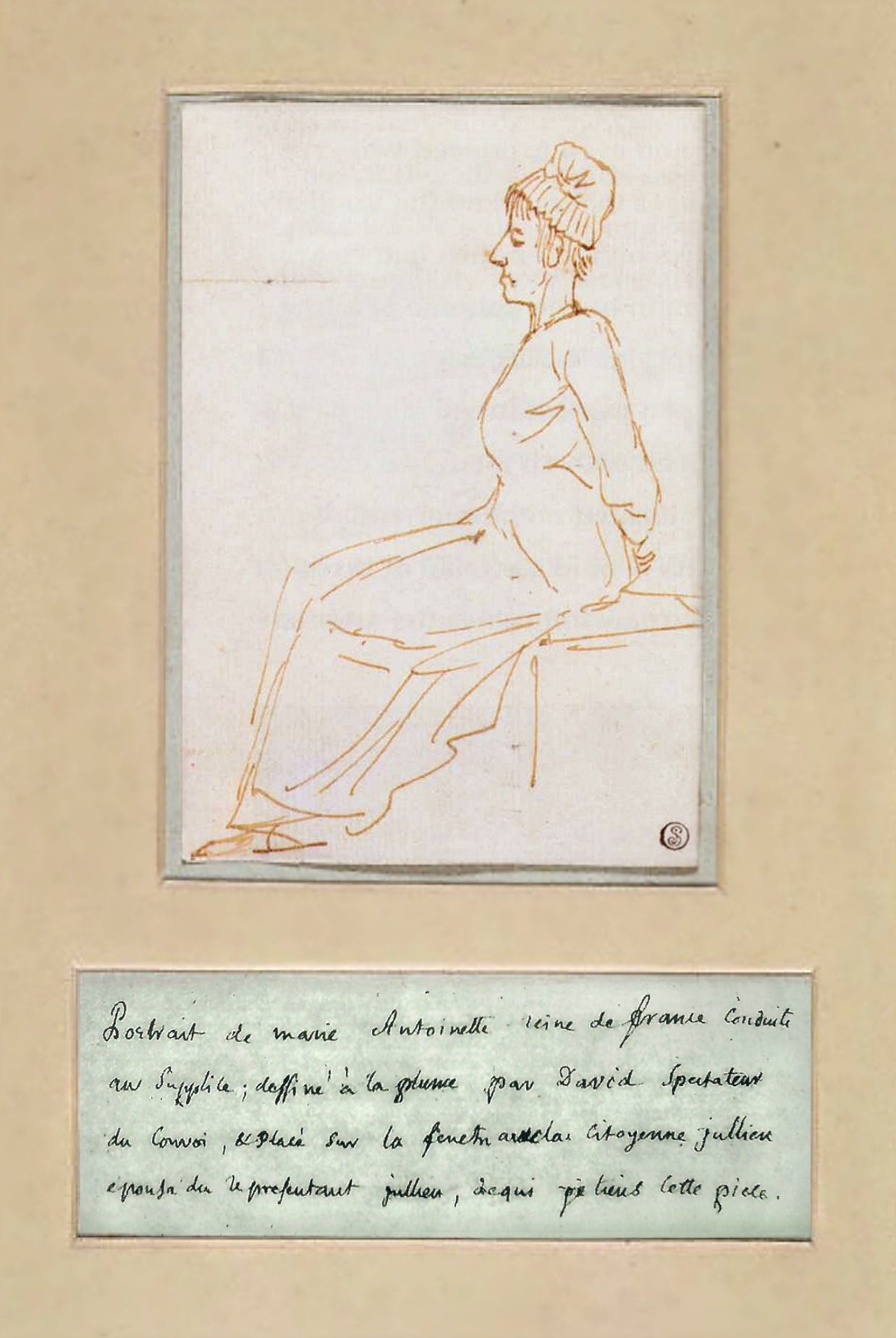
12. Jacques Louis David, Marie Antoinette on the Way to the Guillotine (1793)

A shorn Marie Antoinette bound in a cart, David sketch
Jacques Louis David, Marie Antoinette Being Taken to Her Execution, 1793, the Louvre.

An older woman sits bolt upright in a cart, hands tied behind her, hair hacked short, chin lifted. In a few quick strokes of pen and ink, David caught Marie Antoinette on the morning of her execution, passing under his window.

There is no flattery left. The painter who would soon glorify Napoleon drew the fallen queen with brutal plainness, a small, defiant figure stripped of every silk and jewel her portraits had once piled on.

It is the other end of her story. Ten years earlier she had scandalized France simply by posing in a plain white dress, and now the plainness is total, a queen reduced to a handful of honest lines on her way to the blade.

Where to meet the crowns

  • Rigaud, Louis the Fourteenth, and Prud'hon, Josephine: the Louvre, Paris.

  • Vigee Le Brun, Marie Antoinette and Her Children: the Palace of Versailles.

  • Titian, Charles the Fifth at Muhlberg: the Prado, Madrid.

  • Van Dyck, Charles the First at the Hunt: the Louvre, Paris.

  • Velazquez, The Infanta Margarita: the Kunsthistorisches Museum, Vienna.

Go deeper into the painted crown

A royal portrait is the art of persuasion at its most expensive. These go further:


Questions people ask about royal portraits

  • Why was Marie Antoinette's portrait a scandal? Her 1783 portrait showed her in a simple cotton muslin dress that looked like underwear and snubbed the French silk industry, seen as unqueenly and unpatriotic.

  • Who painted Marie Antoinette the most? Elisabeth Vigee Le Brun, her favorite painter, who made around thirty portraits of the queen and fled France when the Revolution came.

  • Why are kings painted on horseback? The equestrian portrait, launched by Titian's Charles the Fifth, raises the ruler above everyone and links him to ancient images of victorious emperors.

  • Did royal portraits show people as they really looked? Rarely. Painters routinely made kings taller, healthier and calmer than they were, since the job was to project power, not record a face.

  • What happened to Marie Antoinette? She was executed by guillotine in October 1793, a scene David sketched from life as her cart passed, ten years after her chemise portrait shocked Paris.

The face that could not save her

Set the two Marie Antoinettes side by side and you see the whole power and the whole limit of these paintings. A portrait could make a gouty emperor ride like a god, a short king stand tall, a difficult queen mother arrive like Venus.

It could dress a young woman in diamonds and sell her as a fairy tale. What it could not do was hold back a revolution. In 1783 Marie Antoinette shocked France by posing in a plain white dress, and in 1793 she rode to the scaffold in one.

Vigee Le Brun had given her the first white dress, and its glory. David caught the second, on the way to the blade.