
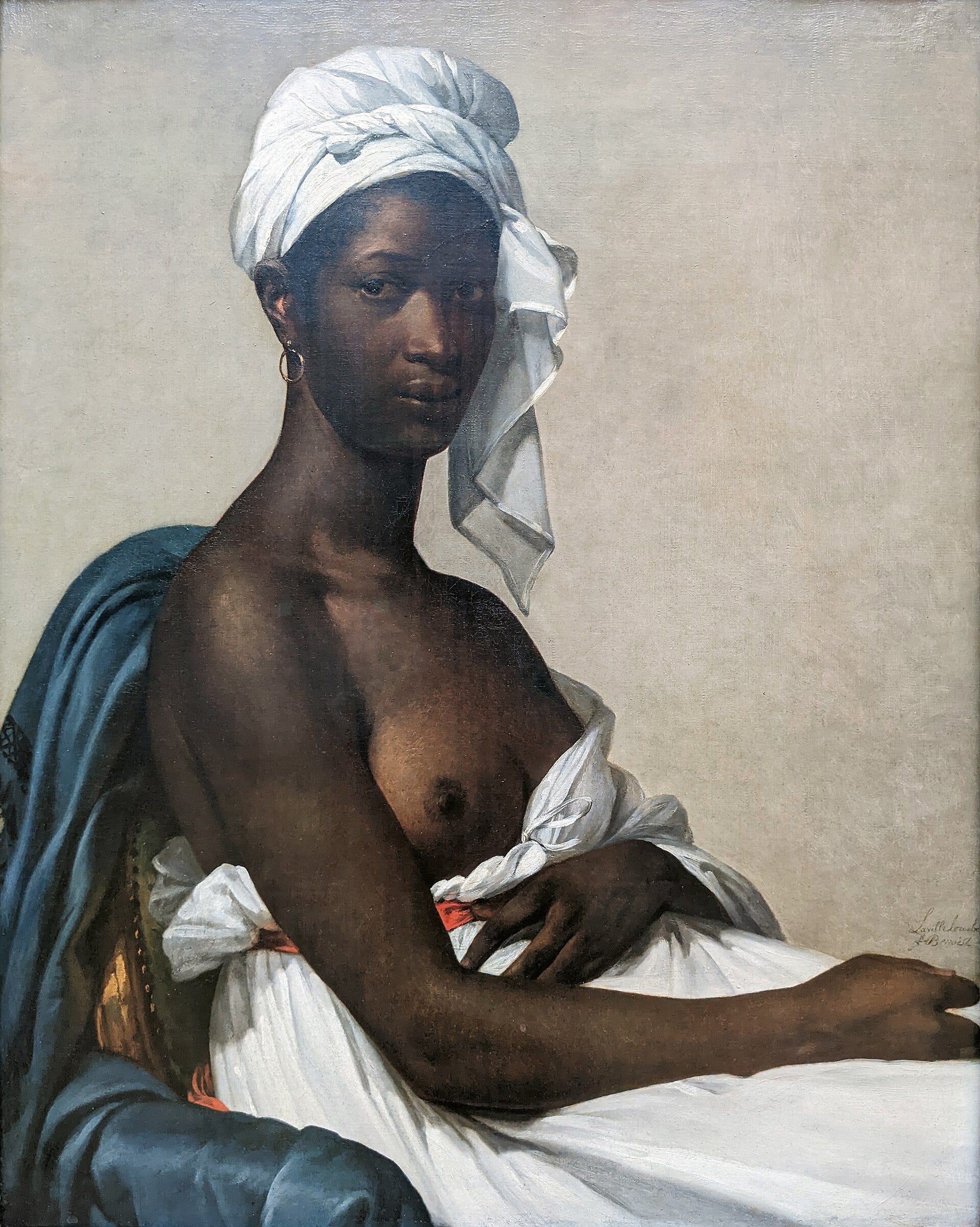
Marie-Guillemine Benoist (1768 to 1826) was a French painter of the time of the French Revolution and Napoleon. She is best known for Portrait of Madeleine, painted in 1800 and now at the Louvre in Paris.
Cool Stories About Art is a newsletter to learn art the fun way.
Join 200,000+ readers and get:
10 new art stories / month
The entire archive of content (140+ articles)
Comment, ask questions, and chat with other readers
In 1803, the government of France asked Marie-Guillemine Benoist to paint Napoleon Bonaparte, then the ruler of the country. The next year, she won a gold medal at the Salon, the great official exhibition of painting in Paris. In 1814, at the height of her fame, she gave up showing her paintings in public for good.
Marie-Guillemine Benoist was born in Paris on December 18, 1768. Benoist is her married name: her family name was Laville-Leroulx. Her father was an official in the government of Louis XVI, the king of France, and he had no dowry to give her.
A dowry was the money a bride brought to her husband when she married. Her father counted on his daughter's talent to replace it: a good painter could earn her own money.
So in 1781, at about twelve, Marie-Guillemine entered the studio of Élisabeth Vigée Le Brun, the favorite portrait painter of Queen Marie-Antoinette. Her sister, Marie-Élisabeth, who also painted, came with her.
In 1786, Marie-Guillemine moved on to Jacques-Louis David, the most admired painter in France. He worked at the Louvre, then a palace of the king and not yet a museum. A royal rule forbade young women to train there, yet David took three women into his studio, and Marie-Guillemine was one of them.
With David, she learned history painting, the most prestigious kind of art. History paintings told stories, with scenes taken from the Bible, from ancient myths and from history.
A history painter made a name at the Salon, which was held at the Louvre itself. In 1786, only members of the Royal Academy of Painting and Sculpture, the official society of the king's artists, could show their work there, and Marie-Guillemine, at seventeen, was not one of them.
Why would a painter barred from the Salon at seventeen give it up for good after winning its gold medal?
In the rest of the story
What a critic of 1791 wrote about women after seeing her work.
Why her husband had to flee France the year they married.
Where the young woman in her most famous portrait came from.
Which of her paintings no one saw in public for two centuries.