
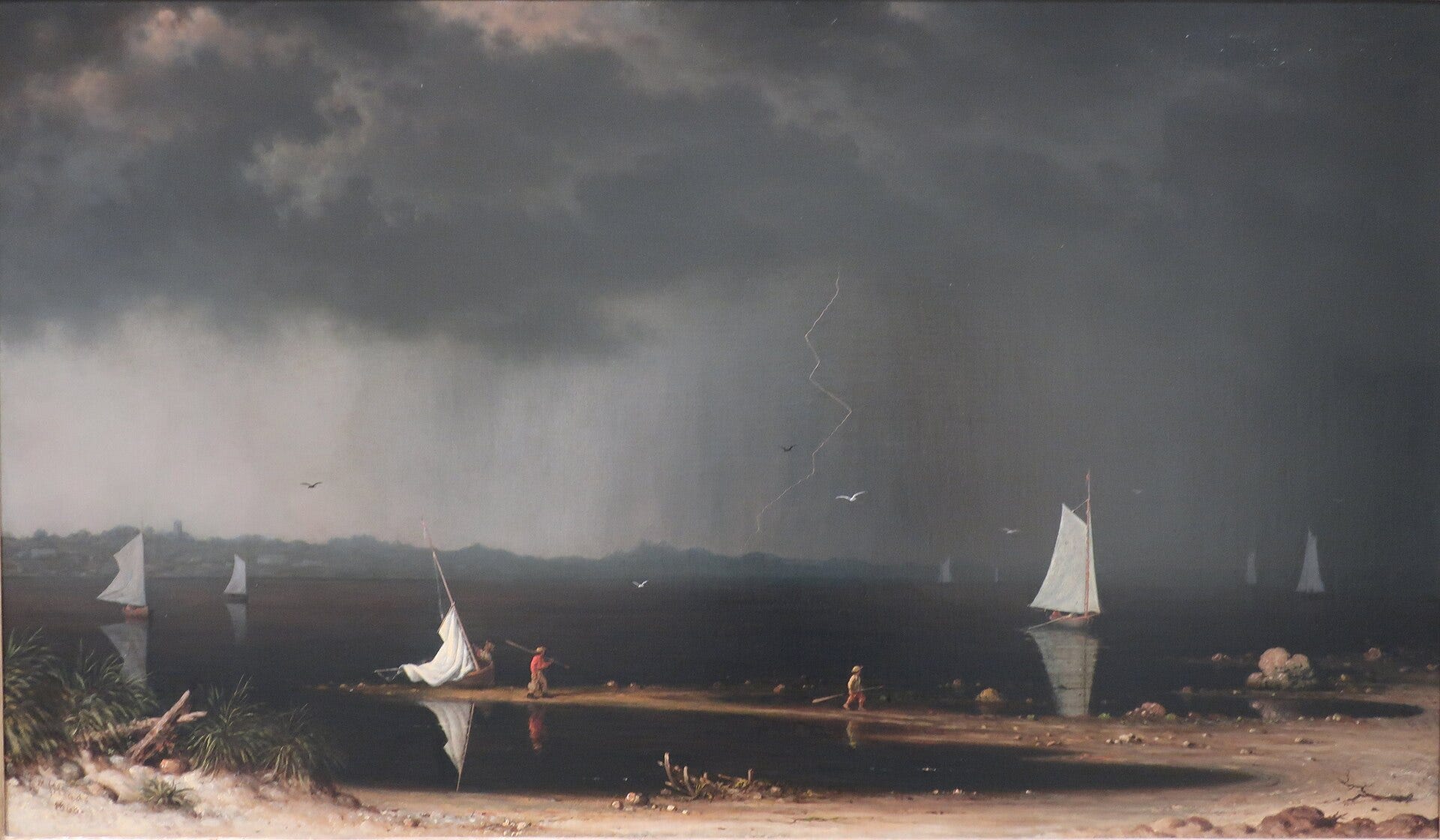
For years, a painting of magnolias laid on velvet covered a hole in the wall of a house in Indiana. The magnolias were by Martin Johnson Heade (1819 to 1904), an American painter of salt marshes, thunderstorms and hummingbirds. His Thunder Storm on Narragansett Bay, a black sky over a calm bay, hangs at the Amon Carter Museum in Fort Worth, Texas.
Cool Stories About Art is a newsletter to learn art the fun way.
Join 200,000+ readers and get:
10 new art stories / month
The entire archive of content (140+ articles)
Comment, ask questions, and chat with other readers
For most of his life, Martin Johnson Heade kept apart from the art world of New York and never joined its artists' clubs. After his death in 1904, his paintings were forgotten for about forty years. Today the Museum of Fine Arts in Boston alone owns about thirty of them.
Heade was born on August 11, 1819, in Lumberville, a village on the Delaware River, in Pennsylvania. His family ran the general store, which also served as the village post office.
The family spelled its name Heed. The painter added the "a" himself, while his relatives kept the old spelling.
In nearby Newtown lived Edward Hicks, a painter who had never been to art school. Hicks painted one Bible scene again and again, The Peaceable Kingdom, where lions and lambs live in peace. In the late 1830s, Heade took his first painting lessons from Hicks.
Portraits became Heade's trade. In 1841, one of his portraits went on show at the Pennsylvania Academy of the Fine Arts, a leading art academy in Philadelphia.
Two years later, another of his portraits hung in New York at the National Academy of Design, the society of New York artists, whose yearly exhibition could make or break a young painter's career.
Yet Heade did not stay in New York. He went from town to town in search of sitters, the people who paid to have their portrait painted, and he rarely stayed more than a year or two in one place.
In the late 1850s, after meeting landscape painters at work in the White Mountains of New Hampshire, Heade began to paint landscapes himself. In 1859, close to forty, he settled in New York, among the most famous landscape painters in America.
But the city never fully took him in. Over the next ten years, Heade painted several thunderstorms, a rare subject in American landscape painting of his time, and in his last years the New York critics forgot him.
How did a painter forgotten for forty years end up in the great museums of his country?
In the rest of the story
What an emperor gave the hummingbird painter after seeing twelve of his pictures.
Which oil tycoon gave the painter a studio at his grand hotel.
Where a lost storm painting turned up, long after his death.
What one of his paintings was really doing in a house in Indiana.