
Martin Schongauer was a painter and engraver, born around 1450 in Colmar, a German-speaking town in Alsace, now in eastern France. He died in 1491 in Breisach, on the Rhine.
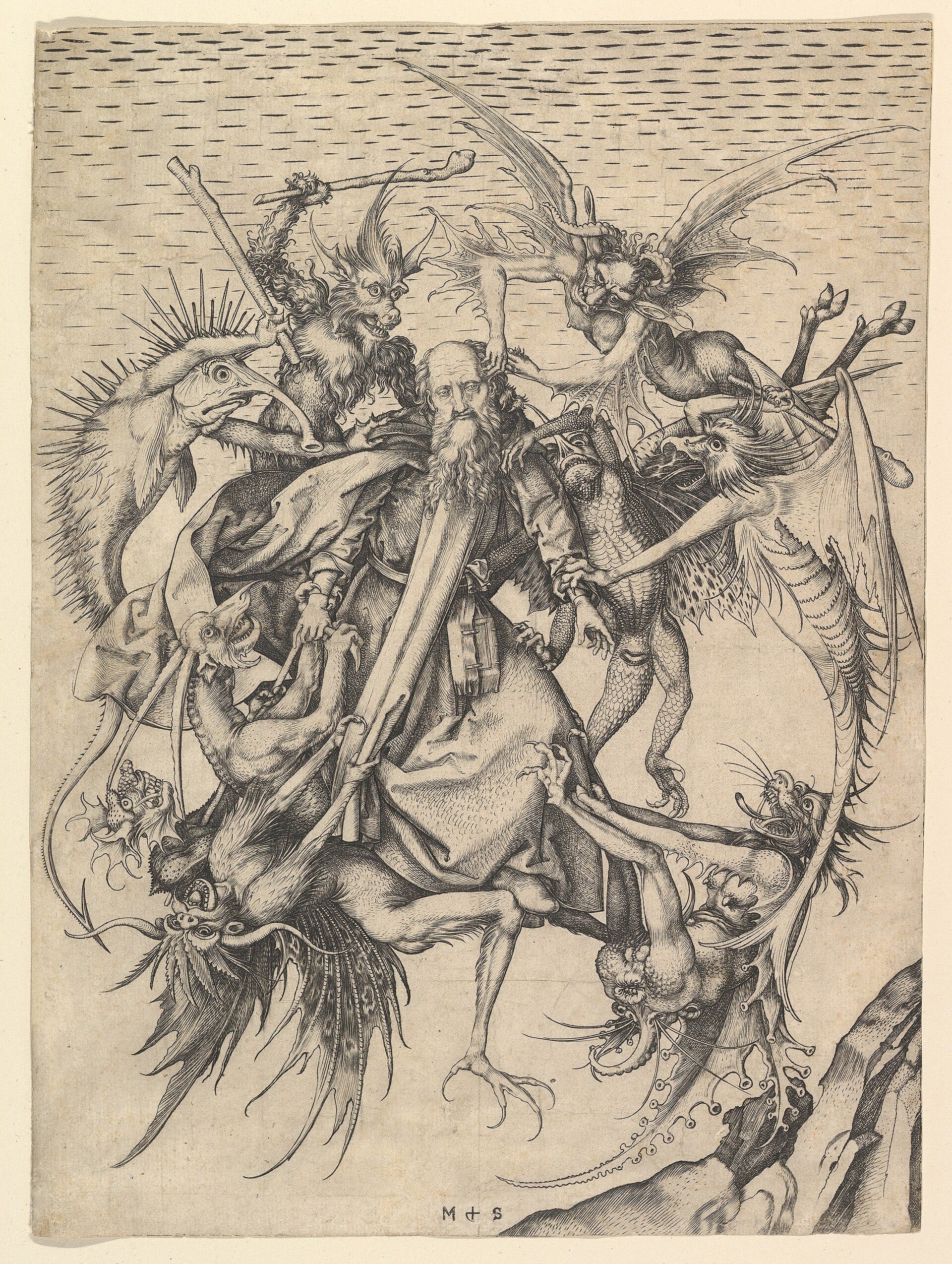
*Schongauer was famous above all for his engravings, pictures cut into copper plates and printed on paper, which were sold and copied across Europe. His best-known painting is The Madonna of the Rose Bower, from 1473.*
In 1492, the young Albrecht Dürer, who would become the most famous German artist of his time, came to Colmar to meet the master engraver. Dürer learned that Schongauer had died the year before.
Cool Stories About Art is a newsletter to learn art the fun way.
Join 200,000+ readers and get:
10 new art stories / month
The entire archive of content (140+ articles)
Comment, ask questions, and chat with other readers
Martin Schongauer grew up in a family of goldsmiths, craftsmen who made jewels, cups and church objects in gold and silver. His father, Caspar, came from Augsburg, a rich merchant city in southern Germany, and settled in Colmar around 1440.
Augsburg and Colmar then belonged to the same patchwork of German-speaking states, the Holy Roman Empire. Colmar became French only in the 1670s.
Three of Martin's brothers became goldsmiths like their father, and another brother, Ludwig, became a painter.
In a goldsmith's workshop, the main tool is the burin, a small steel rod with a sharp point that is pushed into metal to dig fine lines. Martin probably learned to hold a burin as a boy, in his father's workshop.
Yet Martin did not follow his father's trade. In 1465, he enrolled at the University of Leipzig, in eastern Germany, something very few artists of his time ever did. He left after about a year, and no record says why.
By around 1470, Martin Schongauer was back in Colmar, working as a painter. He also put his father's tool to a new use: with the burin, he cut his own pictures into plates of copper and printed them on paper.
The printed sheets carried his pictures to cities he never visited, and to young artists he never met. One of them was Albrecht Dürer, a goldsmith's son from Nuremberg, in southern Germany.
What could Dürer still learn from a master he would never meet?
In the rest of the story
Who copied half of Martin Schongauer's prints, his initials included.
Which detail Albrecht Dürer borrowed from a Schongauer print, as a tribute.
How Schongauer's largest painting vanished from view for more than a century.
Where Schongauer's best-known painting turned up, seventeen months after thieves took it.