
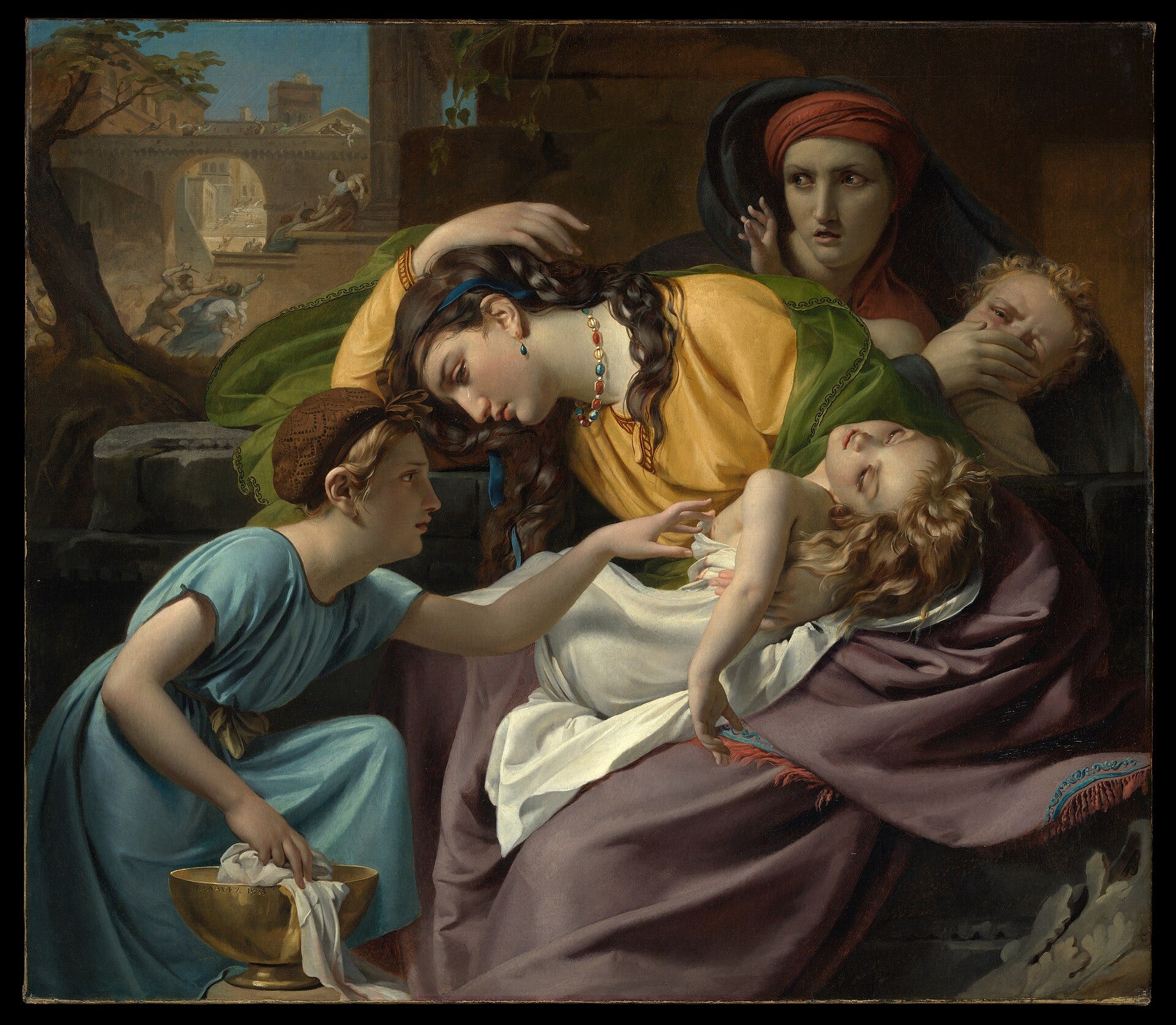
Few subjects put painters in a harder position. A king orders the death of the small boys of a village, and the picture is meant to hang in a church. Every painter who took it on chose what to leave out, and in one snowy village the choice was made by someone else, years after the painter's death, with geese and cheeses.
Cool Stories About Art is a newsletter to learn art the fun way.
Join 200,000+ readers and get:
10 new art stories / month
The entire archive of content (140+ articles)
Comment, ask questions, and chat with other readers
What Each Painter Chose to Show
The story fills three verses of Matthew's Gospel. The wise men tell King Herod that a new king of the Jews has been born, and Herod answers by ordering the death of every boy aged two and under in and around Bethlehem. No other ancient writer mentions it, and many historians doubt it ever happened.
Even if it did, Bethlehem was a village, so a real event would have meant perhaps a dozen children, far from the 144,000 of later tradition. The Church still honored them as the first martyrs, on December 28, and wanted their image.
That left painters with a scene no church could show in full. Each of the twelve works below earned its place by what its painter decided to show instead: a crowd or a single mother, the killing or what came after. Several also slipped a violence from their own time into the Gospel story.
12. William Holman Hunt, The Triumph of the Innocents (1876 to 1887)
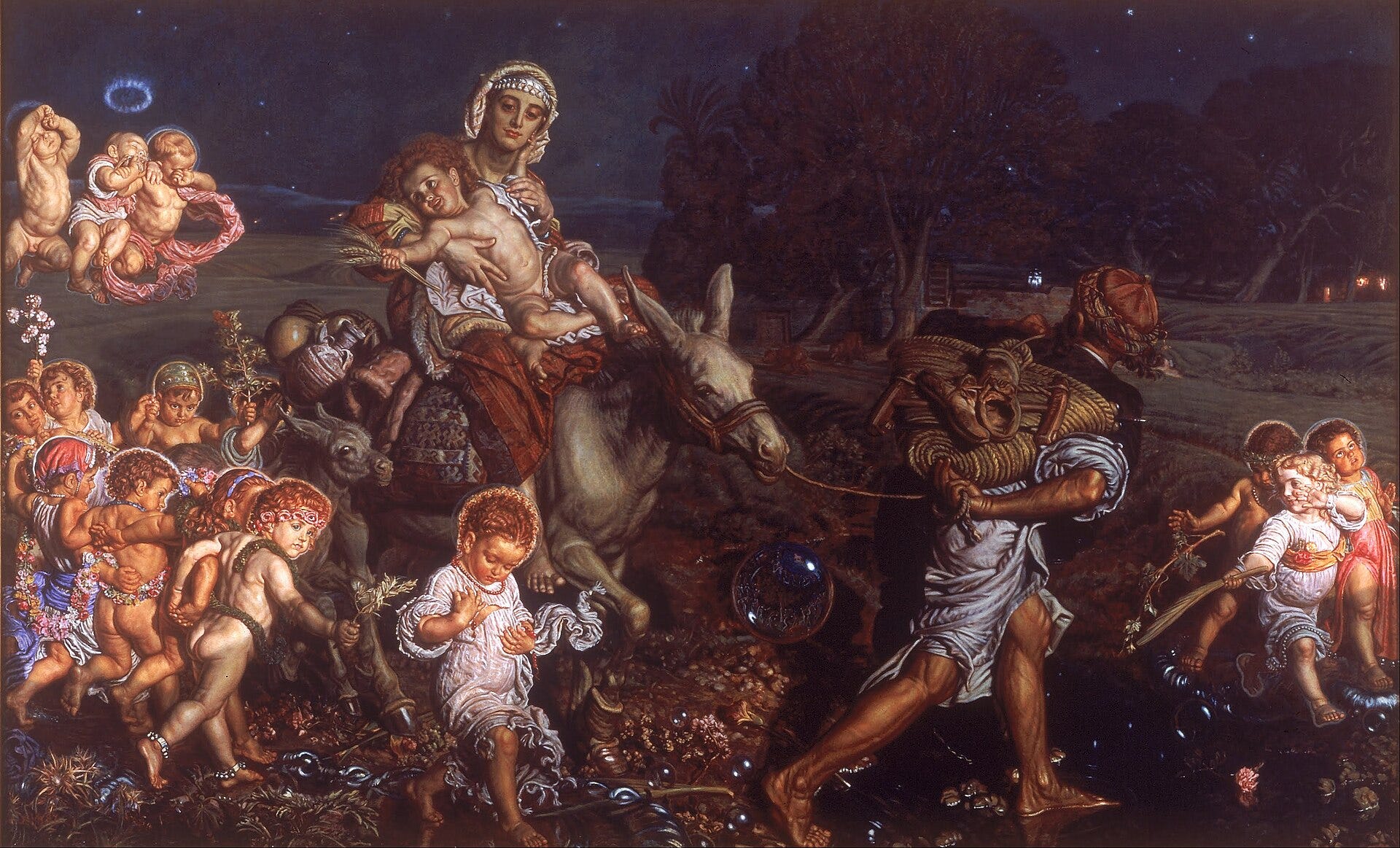
Small children in white walk beside a donkey through a stream at night, flowers in their hair, some of them carrying palm branches. Clear bubbles float above the water in the moonlight. Nobody dies in this picture. William Holman Hunt painted the boys of Bethlehem after the massacre, walking beside the family that escaped it.
That family is the one in Matthew's Gospel. Warned in a dream, Joseph takes Mary and the child into Egypt before the soldiers come. Hunt had helped found the Pre-Raphaelite Brotherhood, whose young English painters wanted every detail drawn from life, and he began this canvas in Jerusalem in 1876, during his third stay in the Holy Land.
Drawing from life meant finding his models there. A woman from Bethlehem posed for the tilted head of the Virgin, although Mary in the end took the features of his wife, Edith. The first large canvas failed. Hunt had painted it on a piece of Syrian linen bought in the bazaar, and he put it aside to begin again on a new one.
The work took him more than seven years, and London saw it only in March 1885. The version in Liverpool, dated 1876 to 1887, is probably the abandoned canvas, which he later took up again and finished.
What holds the picture together are the children, and Hunt refused to turn them into angels. They are the souls of the boys of Bethlehem, crowned with flowers, a few of them still waking as they walk. The largest bubble holds Jacob's ladder, the Tree of Life and the Lamb borrowed from the Ghent Altarpiece of Jan van Eyck. To my mind, no other painter found so gentle a way into this subject.
That gentleness rests on a doubt Hunt kept on purpose. He wanted the viewer unable to tell whether the children are a vision seen by Mary or something real walking at her side. To the poet William Bell Scott, he wrote that he meant them to be "more than a vision to the Virgin."
At a Glance
Artist: William Holman Hunt (1827 to 1910)
Painted: 1876 to 1887
Medium: Oil on canvas
Size: 157.5 × 247.7 cm (62 × 97 1/2 in)
Where to see it: Walker Art Gallery, Liverpool
11. Matteo di Giovanni, Massacre of the Innocents (1482)
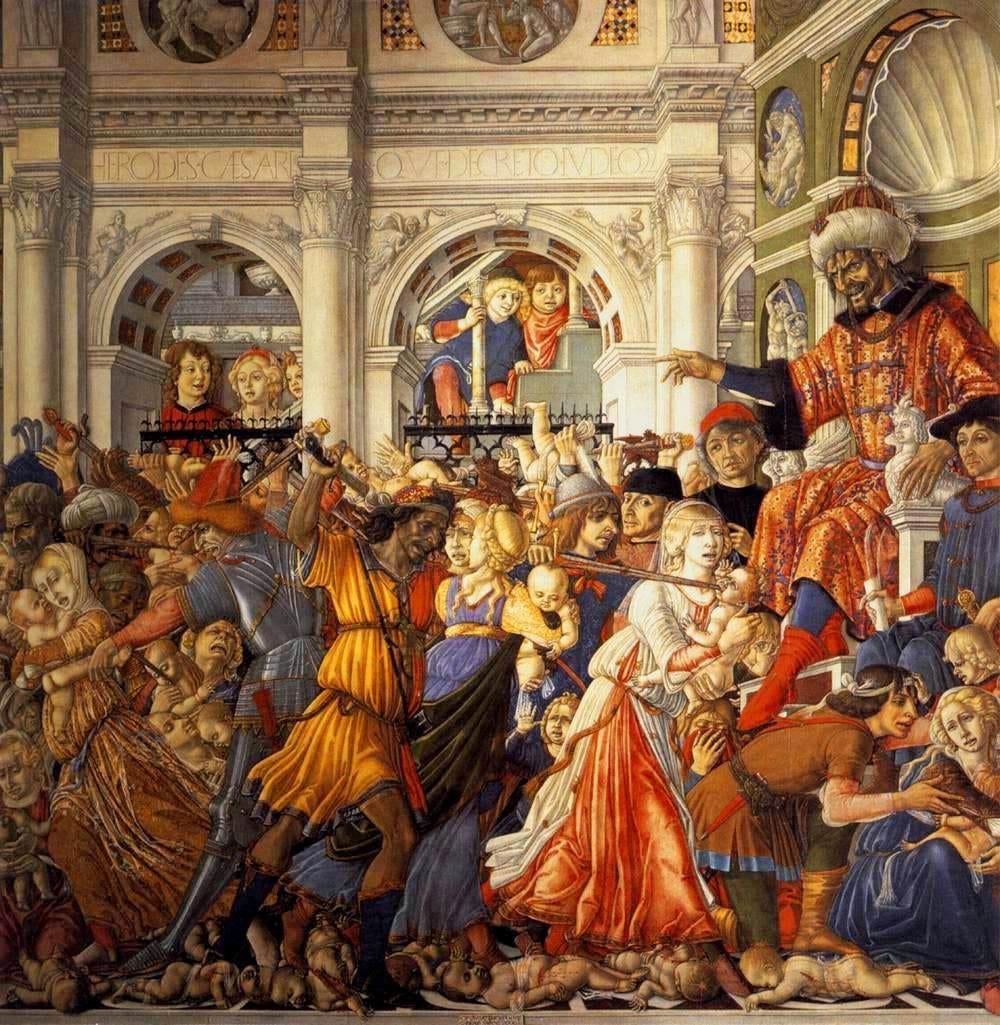
At the top of a crowded panel, King Herod gives his order from a marble throne under a classical loggia, while onlookers lean over the balconies above him. The king wears a turban and a long Eastern robe. In Siena in 1482, those clothes pointed to a disaster at the other end of Italy.