Maurice Utrillo: The Complete Story

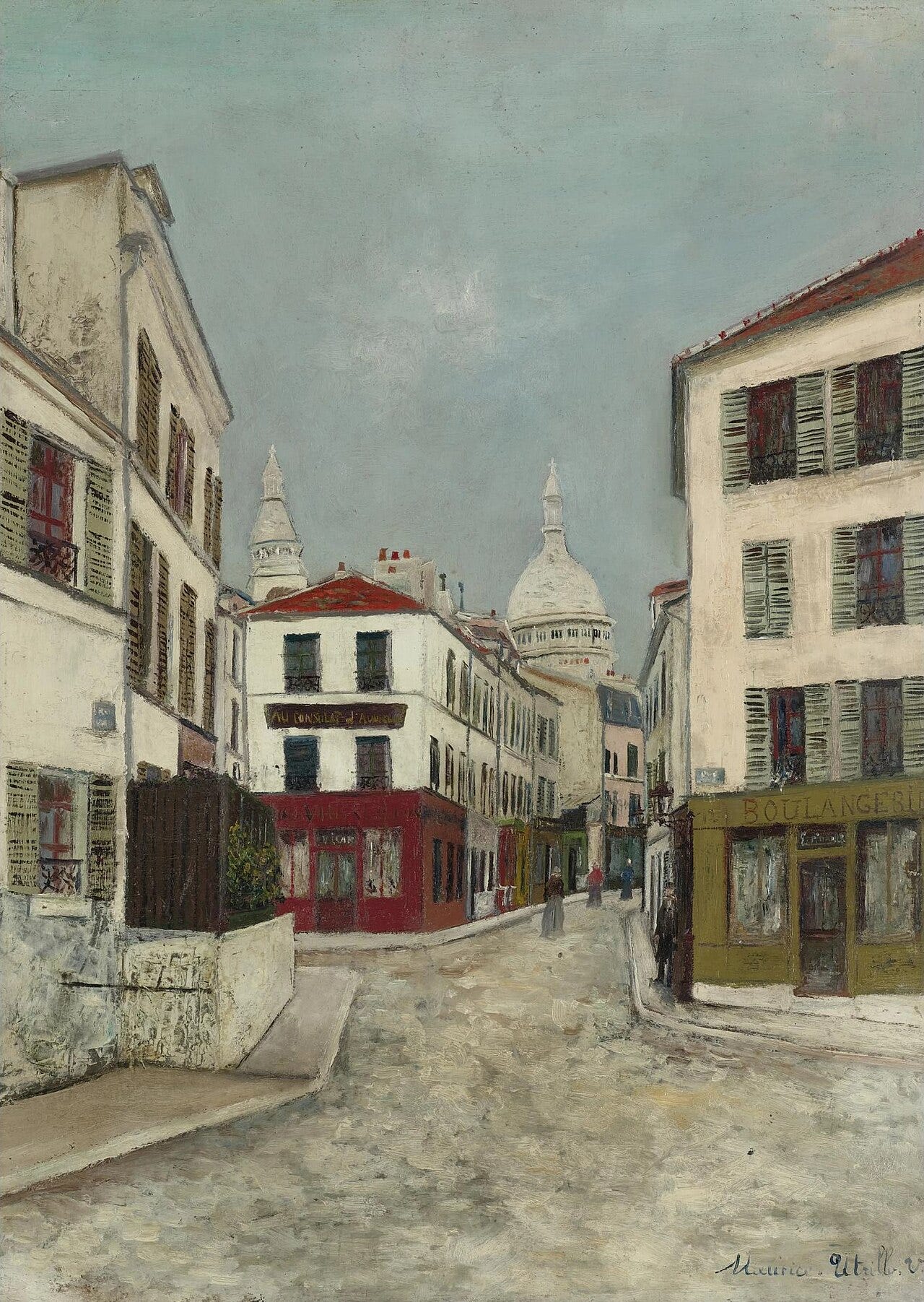
Empty Montmartre streets under a pale sky, white walls, a church, a lamp post, painted with a strange tenderness and not a soul in sight.

Maurice Utrillo painted the same Paris hill over and over, often from postcards, and turned its quiet corners into some of the best loved cityscapes in French art.

Maurice Utrillo, La Rue Norvins, Montmartre, 1910

He was a French painter famous for his street scenes of Montmartre, the troubled son of the artist Suzanne Valadon, whose life was shadowed by addiction.


Join 110,000 readers who learn art the fun way. Free.


Beyond the list

The ones I would send you to next:


The streets of Montmartre

Maurice Utrillo, Eglise de Pont Saint Martin, 1917

Utrillo painted the lanes, churches and cafes of Montmartre with a plain, direct touch, capturing the feel of the old village within Paris.

His quiet landscape painting of the city, usually empty of people, has a loneliness that gives even a sunny wall a touch of melancholy.

The White Period

His most admired works come from his so called White Period, when he mixed plaster and glue into his paint to capture the chalky, crumbling walls of the old streets.

Those textured whites, set against grey skies, are his signature, a post Impressionist vision of the city built from the surfaces of its own buildings.

Born into art

Utrillo was the son of Suzanne Valadon, a former artist model who became a fine painter herself, and he grew up surrounded by the artists of Montmartre.

His mother encouraged him to paint partly as therapy for his troubles, and he turned out to have a real and natural gift.

The shadow of addiction

Utrillo struggled with alcoholism from his teens, and much of his life was spent in and out of treatment.

He often painted from picture postcards rather than the street, partly because of his condition, yet the results lose none of their feeling for the place he loved.

A few questions about Maurice Utrillo

What is he known for?

Quiet street scenes of Montmartre, especially his chalky White Period.

Who was his mother?

The painter Suzanne Valadon.

Did he paint from life?

Often from postcards as well as from the streets themselves.

When did he die?

In 1955.

Why his empty streets still move us

Utrillo turned a troubled life into images of great calm, and his deserted Montmartre lanes feel like memories more than records.

He found fame and even official honours in his lifetime, a rare happy turn for an artist whose story was otherwise so hard, and his white walls still draw visitors to the hill he painted.


Join 110,000 readers who learn art the fun way. Free.


He was one of the few painters to become famous and commercially successful while still alive and still struggling, with collectors competing for his Montmartre views even in his lifetime.

His mother Suzanne Valadon, once a model for Renoir and Degas, taught herself to paint by watching them, so the family produced two remarkable artists from a single hill in Paris.

His White Period works are now the most sought after of his career, and original Montmartre views by his hand sell for high prices at auction, treasured as portraits of a Paris that has largely vanished.

Reproductions of his quiet streets hang in homes around the world, keeping the old village on the hill alive in the imagination of people who have never climbed it.

Official France honoured him with the Legion of Honour, a rare public reward for an artist whose private life had been so hard, and his home city celebrated him as the painter who had given Montmartre its lasting face.

His paintings now hang in major museums in France and abroad, a lasting tribute to the lonely streets he made famous.


Get more art secrets and stories in your inbox, free.