Maxfield Parrish: The Complete Story

Maxfield Parrish was the American artist who painted a glowing dream world and sold it to a whole nation. His luminous skies of deep cobalt, his sunlit maidens on rocky ledges, his fairy tale light all became so popular that one of his prints hung in a huge share of American homes in the 1920s.

He blurred the line between fine art, illustration and advertising, and made a fortune doing it.

Maxfield Parrish, Dinky Bird, 1904

His signature blue is so distinctive it earned its own name.

  • Born: Philadelphia, 1870

  • Known for: Parrish blue, Daybreak, dreamlike neoclassical fantasy

  • Died: Plainfield, New Hampshire, 1966


Hooked on Maxfield Parrish? Get more art secrets and stories in your inbox, free.


If you want more than a list

If you like knowing what is actually going on inside a picture, start with these three:


The blue that carries his name

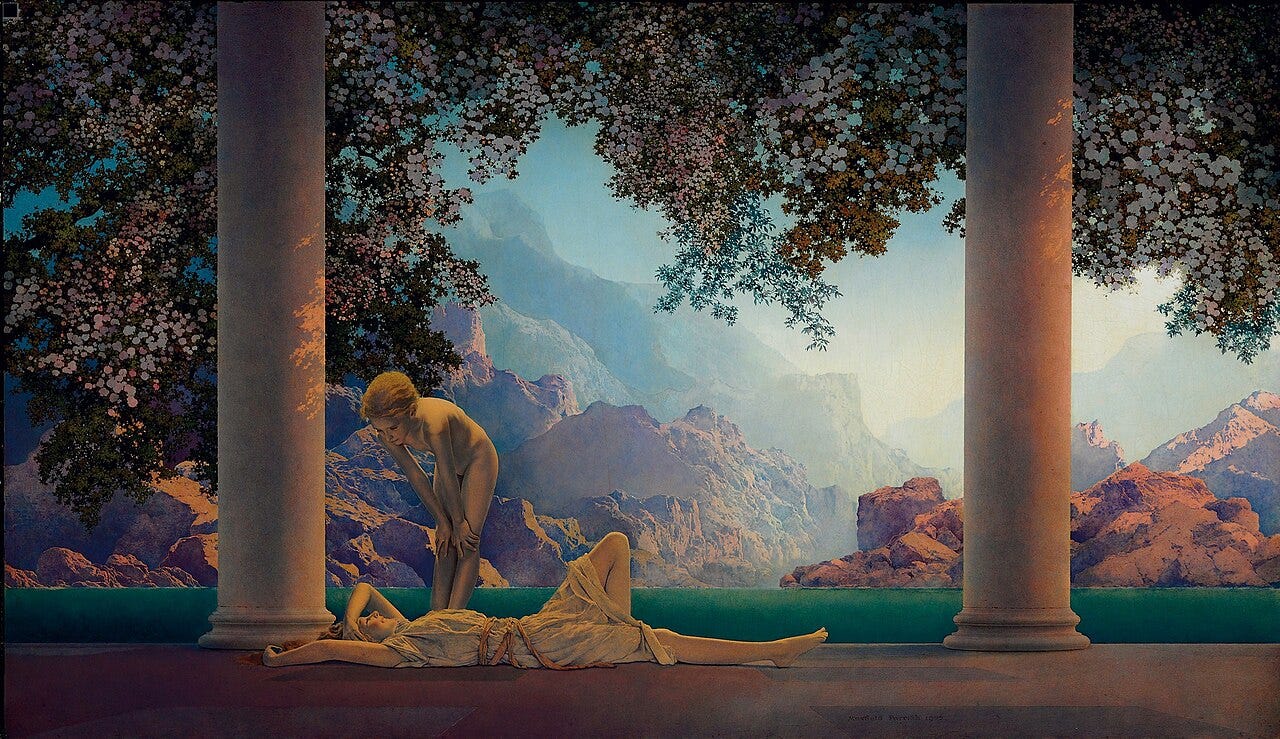
Maxfield Parrish, Daybreak, 1922

Parrish built his pictures from thin transparent glazes laid over a bright white ground, a slow layering that lets light bounce back through the colour.

The skies that result glow with a deep, clean cobalt collectors simply call Parrish blue. See what is oil painting.

The method is closer to stained glass than to ordinary painting. Each veil of colour stays clear, so the finished scene seems lit from somewhere behind the canvas.

The most hung picture in America

Maxfield Parrish, The Lantern Bearers, 1908

In 1922 he painted Daybreak: two figures on a marble terrace under a vast dawn sky and distant blue mountains. Sold as a print, it became one of the most reproduced images of the century, with copies in an astonishing number of American living rooms.

For a time Parrish may have been the most widely seen artist in the country, not in museums but on the walls of ordinary homes.

Art, magazines and money

Parrish refused to treat illustration as lesser work. He painted magazine covers, book pictures and advertisements, for Jell O, for the Edison Mazda light company, with the same care as any gallery canvas. See what is landscape painting.

That commercial reach made him rich and famous while some critics looked down on him. He simply kept painting what people loved, and let the cheques settle the argument.

The quiet turn to landscape

Later in life Parrish grew tired of painting maidens and turned mostly to pure landscape, glowing New England scenes of snow, rocks and trees under his unmistakable skies.

He kept working into his eighties, a craftsman to the end, building each picture slowly from light and glaze in his New Hampshire studio.

What people ask about Maxfield Parrish

What is Maxfield Parrish famous for?

Glowing fantasy scenes, his signature Parrish blue, and the hugely reproduced print Daybreak.

What is Parrish blue?

The deep luminous cobalt he achieved by layering thin transparent glazes over white.

Was he a fine artist or an illustrator?

Both, and proudly so. He gave commercial work the same craft as gallery painting.

When did he die?

In 1966, in New Hampshire, aged 95.

Why the glow still sells

Critics spent decades dismissing Parrish as too sweet and too popular. The public never agreed, and the market has caught up: original Parrish paintings now sell for large sums, and his dreamy blue light remains instantly recognisable a century on.


110,000 readers learn art the fun way here. Join them, free.


One last detail. He often built small models, miniature rocks, drapery and figures, and photographed them to paint from, constructing his fantasy worlds like tiny stage sets before lifting them onto canvas.


Great art stories and secrets, straight to your inbox. Free.