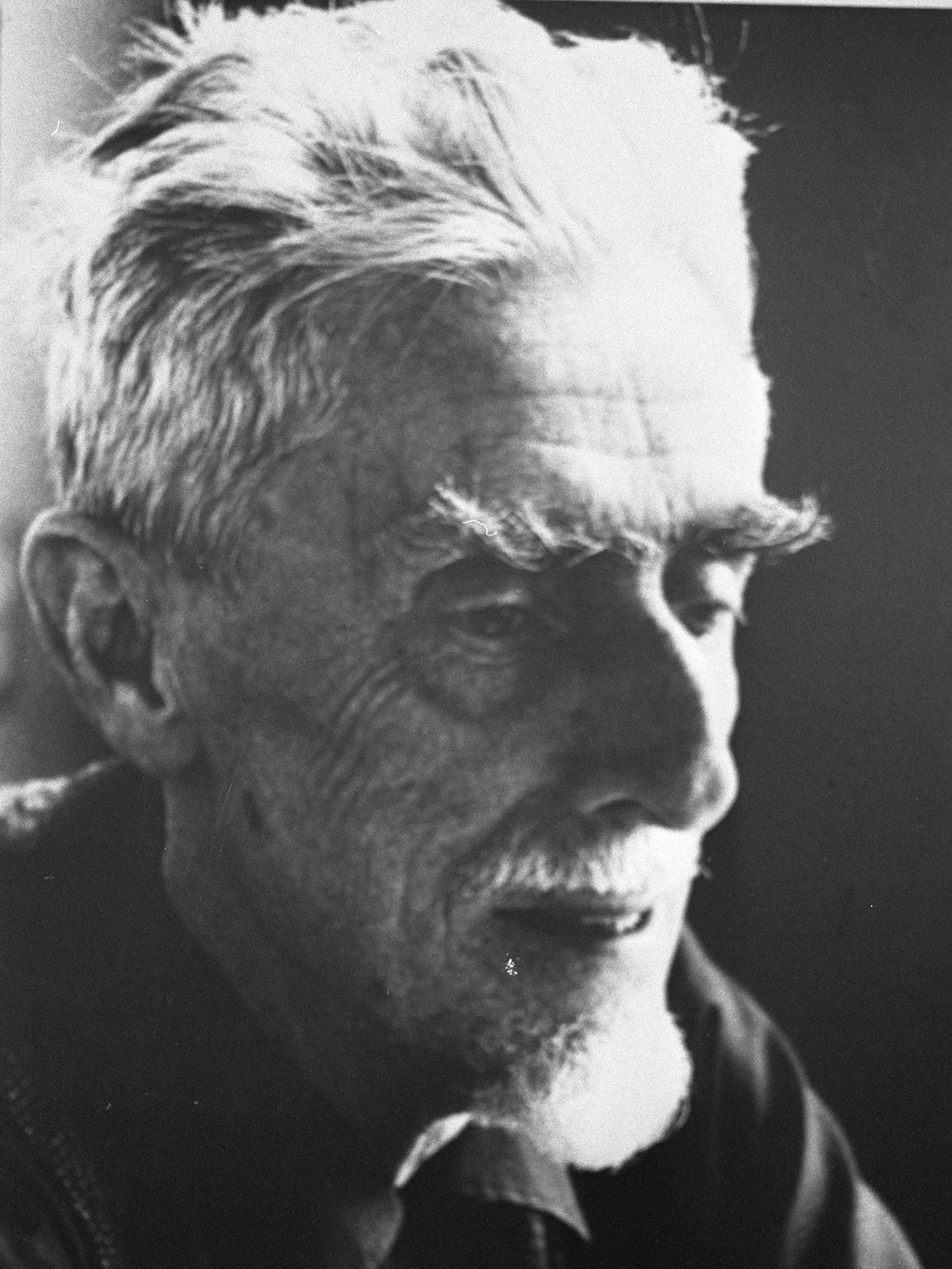
MC Escher: The Complete Story

Monks climb a staircase that loops back on itself forever. Water flows downhill and somehow returns to its own source. Two hands draw each other into being.

Ambigram tessellation Escher

The images belong to MC Escher, the Dutch printmaker who turned mathematics into mind bending art, and who failed at almost everything in school except drawing.

The fine art world dismissed him for decades. Scientists, students and mathematicians adored him, and his impossible worlds became some of the most recognisable images of the twentieth century.


The most mind bending art, free in your inbox.


The ones I would send a friend

If you like knowing what is actually going on inside a picture, start with these three:


The impossible worlds

Escher is famous for buildings that cannot exist. In Relativity, staircases run in every direction with their own gravity; in Ascending and Descending, figures climb a loop of steps forever; in Waterfall, water falls and rises at once.

He built these from precise drawing, exploiting the tricks of perspective so the eye accepts what the mind knows is impossible. Many spread through lithography.

The endless tiling

Ambigram Escher and tessellation background photomontage wit
Ambigram Escher and tessellation background photomontage with reversible hands

His other obsession was tessellation, filling a surface with interlocking shapes that leave no gap, so birds turn into fish and lizards crawl off the page and back onto it.

The idea came from the Moorish tiles of the Alhambra in Spain, which he studied for days, then filled with living creatures. He also worked in woodcut.

Loved by scientists, ignored by critics

The art establishment dismissed Escher as a clever illustrator, too cold and mathematical to be a real artist. He did not mind much, once saying he felt closer to mathematicians than to his fellow painters.

They felt the same. Crystallographers cited his tilings, the mathematician Roger Penrose was inspired by his impossible figures, and his prints became fixtures on student walls and album covers worldwide.

The mathematics he could not do

Here is the twist. Escher had no advanced mathematical training and claimed he never really understood it. He worked by intuition and patient trial, drawing his way into ideas mathematicians would later formalise.

The geometer Coxeter sent him a diagram that helped him capture infinity inside a circle, and Escher reverse engineered the maths from the picture, thinking visually what others could only prove in symbols.

What people ask about MC Escher

What is he known for?

Impossible buildings, optical illusions, and tessellations of interlocking creatures.

Was he a mathematician?

No, he had little formal maths training and worked by visual intuition.

What inspired his tilings?

The Moorish tile patterns of the Alhambra in Spain.

When did he die?

In 1972, in the Netherlands.

Why the staircase never ends

Escher proved an artist could be rejected by the galleries and still become one of the most reproduced image makers alive. His impossible worlds work like puzzles you can never quite solve, which is exactly why people keep coming back to stare.


Read by 110,000 people who love a good art story. Join free.


Before the famous prints he spent years drawing the hill towns and coastlines of Italy. The rise of fascism drove him north, and cut off from real landscapes he turned inward, into the invented, rule bound worlds of pattern and paradox that made him famous.

His images turn up now on book covers, album sleeves, tattoos and maths classroom walls, copied endlessly by a culture that the galleries of his own day told him he did not belong to.

The draughtsman they dismissed became one of the most reproduced artists of the century. Look long enough at one of his staircases and you start to doubt the floor under your own feet.


Learn art the fun way. Free stories, straight to your inbox.