Medusa in Art: 12 Great Depictions of the Gorgon
The most famous images of Medusa in art run from Caravaggio's screaming shield and Rubens' writhing snakes to Cellini's bronze Perseus and a snarling clay Gorgon from ancient Greece.
Across the centuries artists reshaped the Gorgon from a fanged monster into a tragic beauty.
Medusa began as pure terror, a face so hideous it turned men to stone, carved on temples to scare evil away. Then something shifted. Painters started giving her sorrow, and finally beauty, until she became the doomed woman of the Symbolists.
This is that journey, one severed head at a time. I have a soft spot for the versions that make you pity her.
How to read a Medusa:
The moment. Most artists freeze her at the decapitation, mouth open, still half alive.
The snakes. How wildly the hair writhes tells you how monstrous the artist wanted her.
The mirror. Perseus never looks straight at her, and often neither do we.
The face. Watch it drift from fanged beast to grieving woman over the centuries.
The ones I would hand you next
If you like knowing what is actually going on inside a picture, start with these three:
The Arnolfini Portrait, detail by detail, the mirror, the dog, and the question everyone asks
The darker truth about Gauguin, the part of the Tahiti story that never makes the wall label
Vermeer, Woman Holding a Balance, what is actually on those scales
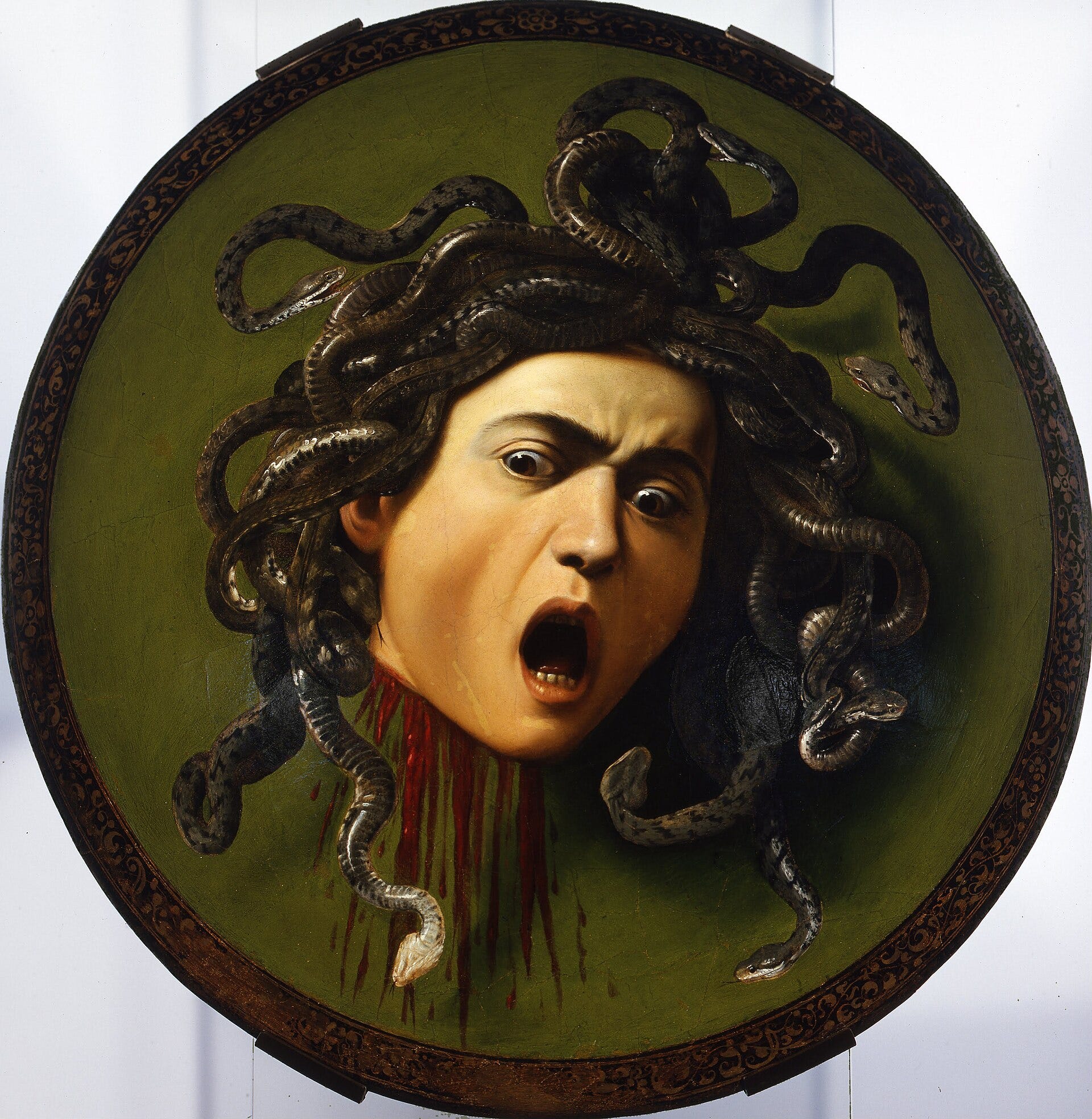
1. Caravaggio, Medusa (1597, the Uffizi)
A round shield hangs in the Uffizi, and on it a severed head screams, snakes hissing from the scalp, blood arcing from the neck. Caravaggio painted his Medusa in 1597 on a convex parade shield of poplar and leather, and it may be the most famous face the Gorgon ever wore.
He gave her his own face. Caravaggio used a self portrait so he could paint terror from the inside, the mouth open at the instant the blade falls.
He built her out of deep shadow and sudden light, the chiaroscuro he made his signature, and I take apart more of his hidden tricks in the Caravaggio code.
It was a gift of power. Cardinal del Monte commissioned the shield for the Medici, and a Medusa painted on it was a compliment, a nod to Athena, whose own shield carried the Gorgon to freeze enemies in place.
There is an earlier version too, from about 1596, in a private collection.
2. An Archaic Greek Gorgon (about 540 BC)
The oldest Medusa here is a lump of painted clay. This gorgoneion, a Gorgon face, was molded onto a roof tile in a Greek colony of southern Italy around 540 BC, tongue out, tusks bared, eyes staring.
That was the whole point. A snarling Gorgon set at the edge of a roof worked as a guard, an apotropaic charm meant to scare evil away from the building below.
Greeks put the same face on shields, armor and doorways. Rows of these grinning tiles once ran along temple roofs across the Greek world.
There is no beauty here and no pity. She is pure monster, the raw material every later artist would slowly refine.
3. The Rondanini Medusa (Roman marble, Munich)
Jump a few centuries and the monster has become a sleeping woman. The Rondanini Medusa in Munich is a Roman marble mask, eyes closed, small wings in the hair, two snakes knotted gently under the chin.
It is a Roman copy of the Gorgon that sat on Athena's shield, and it became known as the beautiful Medusa. Goethe kept a cast of it and wrote about its strange calm, caught between life and death.
This serene face is the seed of everything that follows. The Symbolists fell in love with it three hundred years later.
4. Leonardo's Lost Medusa (a tale from Vasari)
Some Medusas exist only in words. In his Lives, the writer Vasari described a young Leonardo painting a wooden shield with a monster so lifelike that his own father flinched when he saw it.
That shield has never been found, and most historians think the tale is half legend. The Head of Medusa long displayed as Leonardo's in the Uffizi turned out to be Flemish, painted around 1600 by another hand.
It is a neat lesson in how art history works. A good story can outlive the picture it describes, and sometimes replace it entirely.
5. Benvenuto Cellini, Perseus with the Head of Medusa (1554, Florence)
In the Loggia dei Lanzi, open to the street, a bronze Perseus stands over the beheaded body and lifts the dripping head for all of Florence to see. Cosimo the First de' Medici ordered it as a warning to anyone who might cross him.
The casting nearly failed. As the bronze cooled too fast in the mold, a feverish Cellini hurled his own pewter plates and cups into the furnace to keep the metal flowing, a scene he tells with relish in his memoirs.
The whole thing took him nine years.
Look at the back of Perseus' helmet and a face stares out from the design. It is Cellini himself, hidden in his own masterwork.
6. Peter Paul Rubens, The Head of Medusa (about 1617, Vienna)
Rubens lays the head on a cold rock, and the horror is in the details. The blood at the neck turns to coral, and the snakes are alive, breeding, biting, knotting together with a life of their own.
Rubens probably left the reptiles to a specialist, most likely Frans Snyders, who painted animals with unnerving precision. Together they made a picture more like a nature study of nightmares than a myth.
Later owners hung it behind a curtain in Vienna so they could pull it back and watch their guests recoil. The Gorgon still did her job long after the axe.
7. Gian Lorenzo Bernini, Medusa (about 1640s, Rome)
Bernini carves the one moment nobody else dares, the change itself. His marble bust catches Medusa as the snakes first rise from her own scalp, her face twisting in horror at what she is becoming.
This is Medusa as victim, feeling the curse from the inside. Some scholars read the anguished features against Bernini's own stormy private life in those years.
The bust came to the Capitoline as a gift in the 1730s and has stood there ever since. Its link to Bernini rests on style alone, with no document to prove it, so scholars still argue the point.
8. Luca Giordano, Perseus Fighting Phineus (about 1680s, London)

A wedding feast turns into a brawl, and Perseus does the unthinkable. He raises Medusa's severed head, and his attackers freeze into gray statues in mid swing, swords still up.
Giordano seized the cruelest twist in the myth. The head keeps its power after death, a weapon that petrifies anyone who meets its eyes. The National Gallery canvas is a whirl of falling, stiffening bodies.
His nickname says it all. Neapolitans called him Luca fa presto, Luke works fast, and the speed is right there in the brushwork.
9. Antonio Canova, Perseus with the Head of Medusa (about 1800, the Vatican)
Canova cools the whole story down to white marble. His Perseus is a calm neoclassical hero, holding the head out at arm's length, more trophy than horror.
The timing was pointed. When Napoleon carried the Apollo Belvedere off to Paris, the Vatican set Canova's Perseus on the very pedestal it left empty.
Pope Pius the Seventh unveiled it in 1801, and for a while this cool young hero stood in for the most admired statue in Rome.
10. Carlos Schwabe, Medusa (1895)
By the end of the 1800s Medusa had turned tragic. Carlos Schwabe painted her in 1895 as a pale, grieving face inside a circle, the snakes more like a crown of thorns than a threat. It is the Symbolist Medusa at its purest.
A victim cursed for a crime that was done to her, she sits closer to a suffering saint than a beast. Arnold Bocklin had opened this door in 1878, and a generation of painters walked through it.
It is the mirror image of where we began. The face first carved to frighten has become a face that asks for pity.
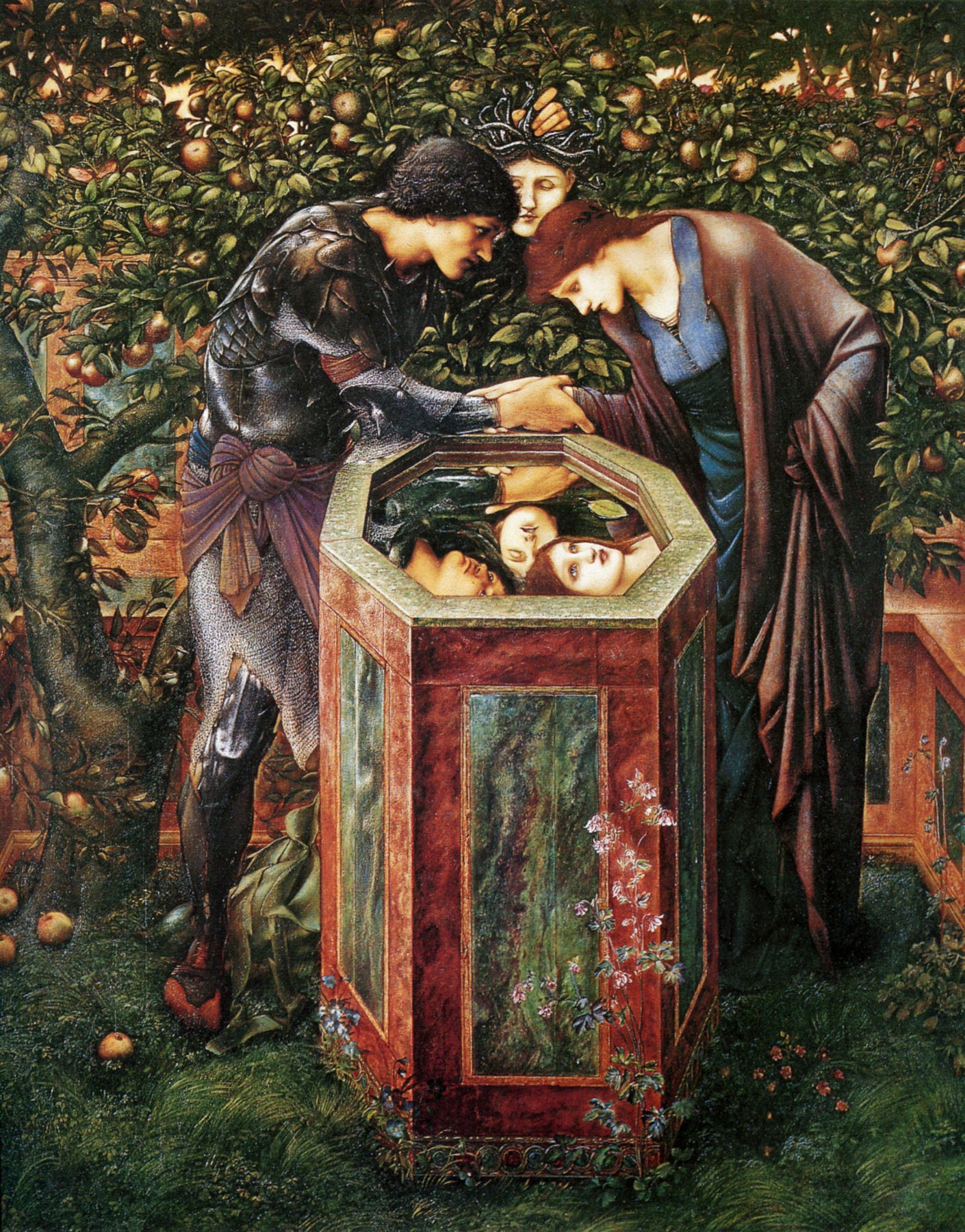
11. Edward Burne Jones, The Baleful Head (1885 to 1887)
Even lovers cannot look at her. Burne Jones shows Perseus holding the head over a well so that Andromeda can see it safely in the reflection, the two of them gazing down into the water.
It belongs to a cycle of ten paintings on the Perseus story, commissioned for the music room of Arthur Balfour, a young politician who would later become Prime Minister.
The idea is quietly clever. In a scene about love, the deadliest thing in the room can only be met at a safe remove, in a mirror.
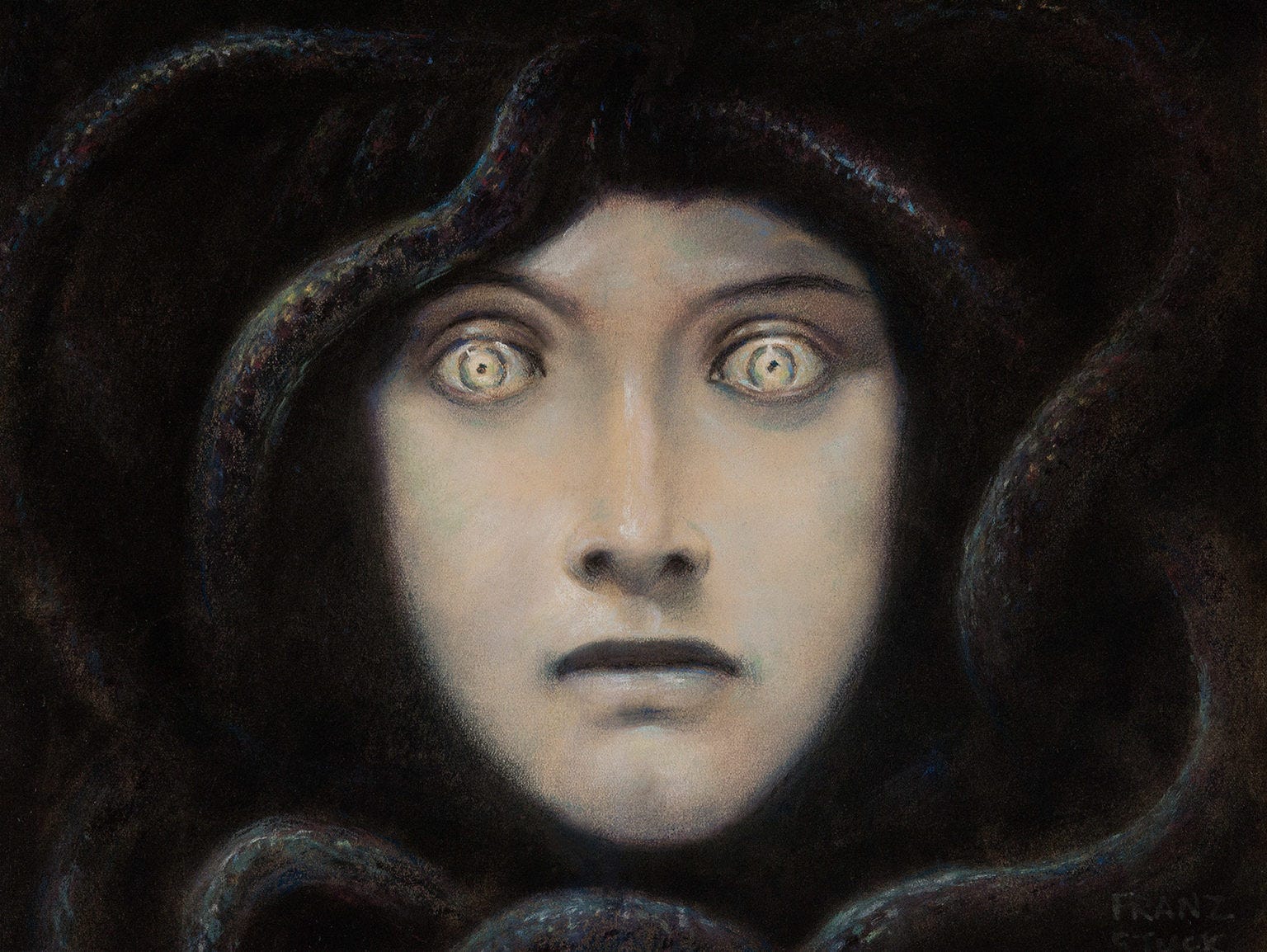
12. Franz von Stuck, Head of Medusa (1892, Nuremberg)
At the end of the century Medusa turns beautiful and dangerous at once. Von Stuck paints a proud woman who glares straight out of the frame, dark snakes coiled through her hair, her eyes locked on yours.
He took his cue from Bocklin but pushed her toward seduction, the Symbolist femme fatale who could ruin a man with a look. It hangs in the Germanisches Nationalmuseum in Nuremberg.
This is the Medusa that stuck. Fashion, jewelry and film would borrow her stare for the next hundred years.
Where to stand before the Gorgon
Caravaggio, Medusa: the Uffizi, Florence.
Cellini, Perseus: the Loggia dei Lanzi, Piazza della Signoria, Florence, out in the open air.
Rubens, Head of Medusa: the Kunsthistorisches Museum, Vienna.
Canova, Perseus: the Vatican Museums, Rome.
Von Stuck, Head of Medusa: the Germanisches Nationalmuseum, Nuremberg.
If the severed head pulls you in, read these next
Medusa was Caravaggio's kind of subject, a horror with a hidden face. Keep going with these:
Inside Monet house at Giverny, room by room, including his own bedroom
The Ambassadors, detail by detail, the object at the bottom that only works from one side
Luncheon of the Boating Party, detail by detail, who everybody at that table actually was
What people ask about Medusa in art
Who painted the most famous Medusa? Caravaggio, around 1597, on a round parade shield now in the Uffizi. He gave the screaming head his own face.
Why is Medusa painted on a shield? In the myth Athena set Medusa's head on her shield to petrify enemies, so painting her on a shield turned the object into a magic weapon.
Did Medusa start out ugly or beautiful? Ugly. The earliest Greek Gorgons are fanged, snarling monsters. The beautiful, tragic Medusa came much later and peaked with the Symbolists.
Whose face did Caravaggio use? His own. The self portrait let him paint fear from the inside, at the moment of death.
Where can I see Cellini's Perseus? Under the Loggia dei Lanzi in the Piazza della Signoria in Florence, standing in the open air for anyone to see.
The face that keeps changing
No monster in art has traveled so far. Medusa starts as a fanged guard on a Greek roof, becomes a serene Roman mask, then a Medici warning in bronze, a Baroque horror behind a curtain, and at last a woman you are meant to desire and fear at once.
Cellini threw his own dinner plates into the furnace to finish Perseus. Caravaggio lent her his face. She has always been a mirror for whatever each age found most frightening, and lately, most alluring.