
Melancholy is a sadness without a clear cause, and for centuries doctors blamed it on the body: too much black bile, the darkest of the four fluids thought to govern health. Scholars claimed the finest minds carried the most of it. Painters inherited that mix of gloom and prestige and drew some of their quietest pictures from it.
Cool Stories About Art is a newsletter to learn art the fun way.
Join 200,000+ readers and get:
10 new art stories / month
The entire archive of content (140+ articles)
Comment, ask questions, and chat with other readers
From Black Bile to Empty Streets
Melancholy is hard to paint because nothing happens in it. There is no injury to show and no event, only a person who has stopped. So artists invented signs for it: a head propped on one hand, tools lying unused, one figure idle while the others work.
What those signs meant changed over time. At first melancholy was a humor of the body, ruled by the planet Saturn. Then it became the mark of the thinker, and later a danger that preachers warned against. By the nineteenth century it had turned into a mood that could settle on an empty room or a deserted street.
Grief and mourning were left out, since they deserve lists of their own. Every work below takes melancholy itself as its subject, from an allegory packed with symbols to an empty city street.
12. Jan Matejko, Stańczyk (1862)
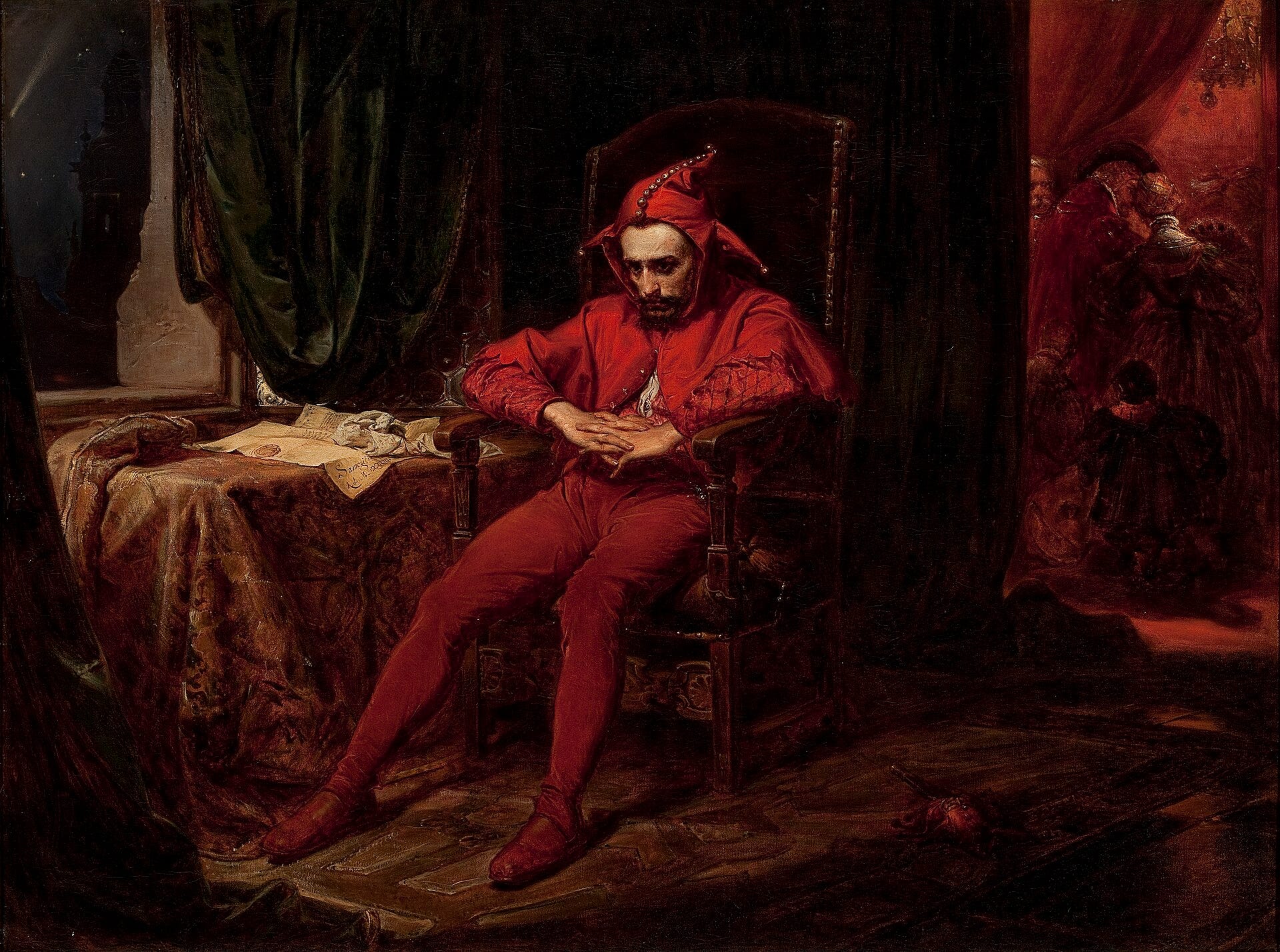
A jester in red sits slumped in an armchair, alone in a dark room. Behind him, through an open doorway, a royal ball goes on in full light. At his feet lies his fool's scepter, the stick topped with a small carved head that jesters carried.
The long title of the painting explains why he is not dancing: Stańczyk During a Ball at the Court of Queen Bona in the Face of the Loss of Smolensk. Stańczyk was a real jester at the Polish court in the sixteenth century. The open letter beside him reports that the city of Smolensk has fallen to Moscow, and nobody else in the palace has read it yet.
The scene is set in the past, but painted with the present in mind. Jan Matejko made it in 1862, at twenty-four, and lent the jester his own face. By then Poland had been divided between Russia, Prussia and Austria for over sixty years and no longer existed as a state. It is hard for me not to see in this picture a comment on Matejko's own time.
Historical accuracy was not the point. Smolensk fell in 1514, and Bona Sforza only married the Polish king in 1518, so the scene could never have taken place as painted. Matejko needed both halves anyway: the court celebrating in the light, and the man hired to amuse it sitting in the dark with the news.
In 2024, Lady Gaga put the canvas on the back of her album Harlequin, and a jester mourning a sixteenth-century city found an audience that had never heard of Smolensk.
At a Glance
Artist: Jan Matejko (1838 to 1893)
Painted: 1862
Medium: Oil on canvas
Size: 88 × 120 cm (34.6 × 47.2 in)
Where to see it: National Museum in Warsaw, Warsaw
11. Nicholas Hilliard, Henry Percy, 9th Earl of Northumberland (about 1590 to 1595)
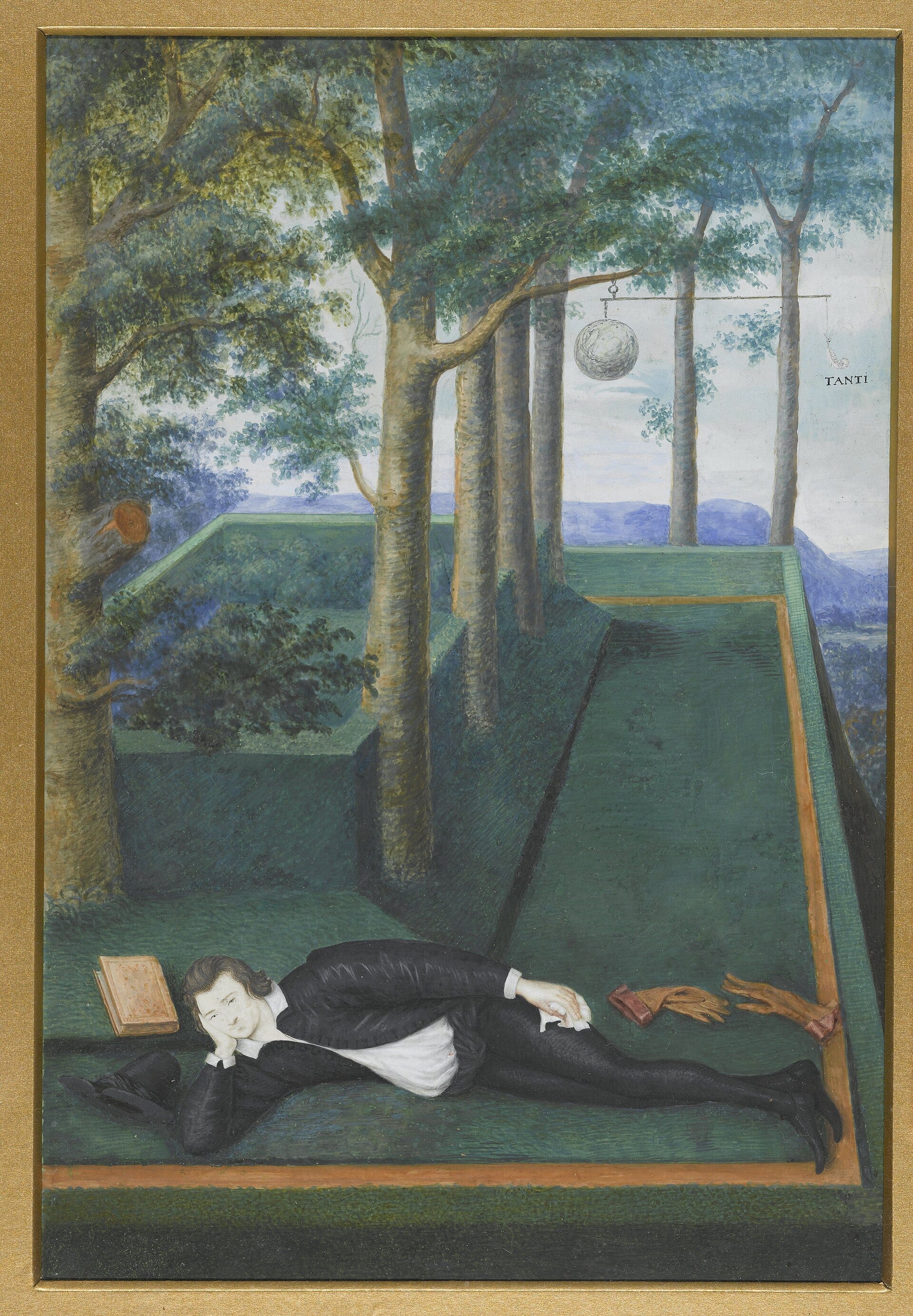
In a small walled garden, a young nobleman lies in the grass, propped on one elbow, his shirt open at the neck and a book at his side. Above his head, a tiny balance hangs from a branch, with a globe in one pan and a feather in the other. Nobody has ever decoded that emblem with certainty. The man himself is easier to name, and the solitude he chose for his portrait would one day be forced on him.