Memento Mori in Painting: 8 Skulls That Warn You

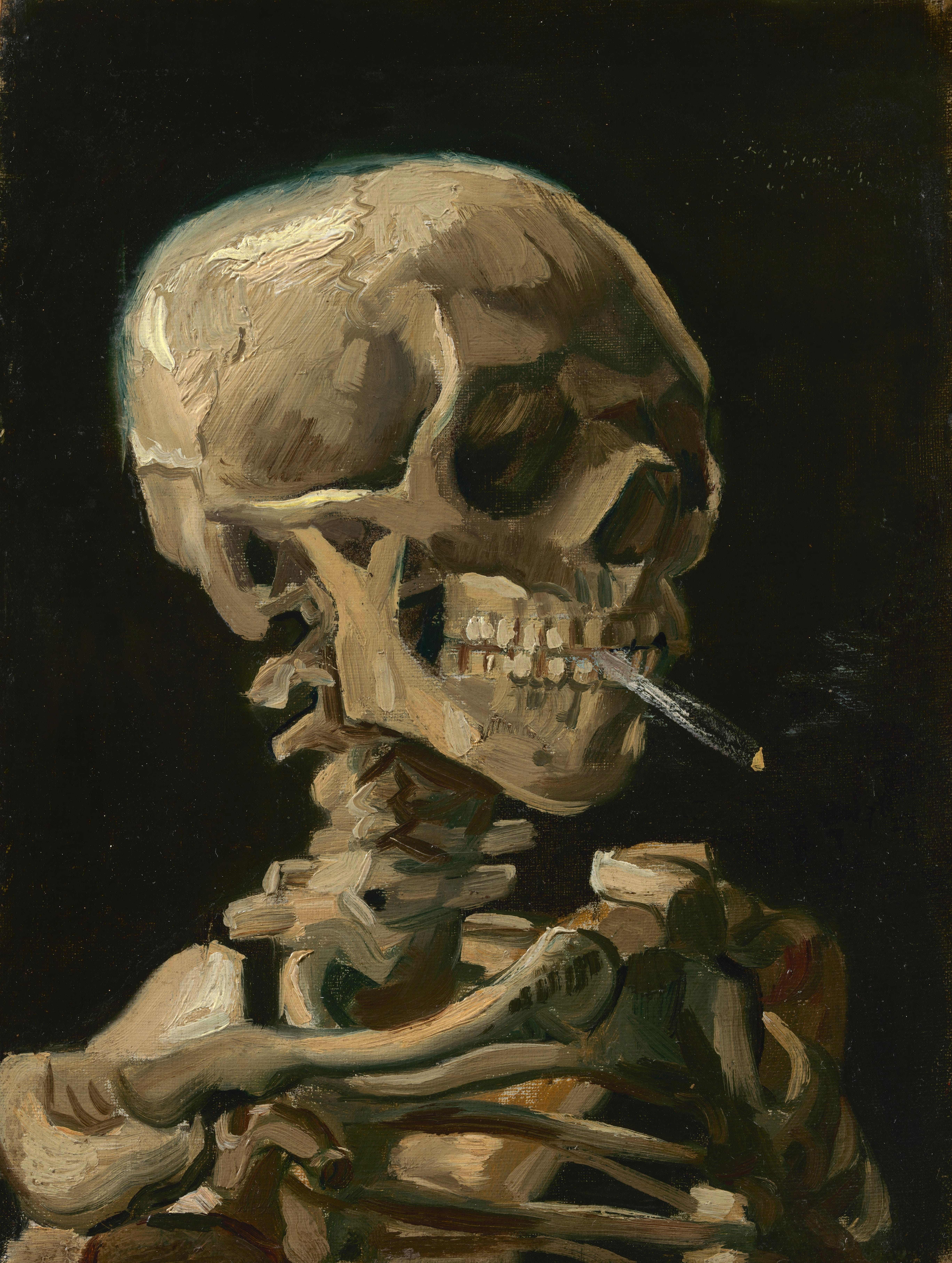
In the winter of 1885, a Dutch art student in Antwerp took a classroom skeleton, painted its skull in oils, and stuck a lit cigarette between its teeth.

Cezanne's four human skulls stacked into a pyramid on a bare canvas
Paul Cezanne, Pyramid of Skulls, about 1901, private collection

The student was Vincent van Gogh, and the joke was aimed at his own teachers. Drawing skeletons was standard anatomy training at the Antwerp academy. Painting them was not, and giving one a smoke was pure insubordination.

That little canvas belongs to one of the longest running traditions in Western art: the memento mori, the painted reminder that you are going to die. What began as a devotional warning became, over four centuries, a student prank, a private obsession, and finally a market spectacle involving 8,601 diamonds.

What is memento mori in art? Memento mori is Latin for "remember you must die." In painting, it refers to symbolic reminders of mortality, most often a human skull, placed in portraits, religious scenes, and still lifes to urge viewers to reflect on the brevity of life.

This idea runs through the whole of the darkest side of art history, but the skull itself, on its own, is where it started.

Here is how the skull traveled, told through eight paintings.

The religious warning

Champaigne's still life of a tulip, a skull and an hourglass on a stone ledge
Philippe de Champaigne, Still Life with a Skull, 1671, Musee de Tesse, Le Mans
Caravaggio's Saint Jerome writing at a desk with a skull resting near his hand
Caravaggio, Saint Jerome Writing, about 1605 to 1606, Galleria Borghese, Rome

In the seventeenth century, the skull on the table was a sermon.

Caravaggio put one right beside the pen. In "Saint Jerome Writing," painted around 1605 to 1606 for Cardinal Scipione Borghese and still in the Galleria Borghese in Rome, the old scholar stretches his writing arm across the desk, and a skull sits near his hand. All that learning, the skull says, ends the same way.

Frans Hals made the warning swagger. His "Young Man holding a Skull (Vanitas)," dated 1626 to 1628 and now at The National Gallery in London, shows a life size young man gripping a skull in one hand while the other gestures outward, as if mid speech. The brushwork is fast and loose, unusually so for the period, which gives the death lecture the energy of a stage performance.

Georges de La Tour turned it inward. In "The Magdalen with the Smoking Flame," painted around 1638 to 1640 and held by the Los Angeles County Museum of Art as a gift of the Ahmanson Foundation, Mary Magdalene sits by candlelight with a skull, books, and a scourge on her lap. No audience, no gesture. Just a woman thinking about the end. A second version of the composition hangs in the Louvre.

Philippe de Champaigne stripped the idea to its bones. His "Still Life with a Skull," painted in 1671 and kept at the Musee de Tesse in Le Mans, France, contains exactly three objects on a bare stone ledge: a tulip, a skull, an hourglass. Life, death, and the time between them. Nothing else in the frame.

The private joke

Two centuries later, the skull stopped preaching and started talking to the painter alone.

Van Gogh's "Head of a Skeleton with a Burning Cigarette," painted in the winter of 1885 to 1886 and now in the Van Gogh Museum in Amsterdam, is the tradition turned into mockery. The cigarette was his private jab at the rigid drawing exercises of the Antwerp academy, where skeletons were for sketching, never for oils.

Paul Cezanne took the opposite tone. Around 1901, late in his life in Aix en Provence, he painted "Pyramid of Skulls," four human skulls stacked into a pyramid on a canvas of 37 by 45.5 centimeters. His late letters return to mortality again and again. The painting sits in a private collection, so the most concentrated memento mori of the modern era is one almost nobody gets to see.

Cezanne painted it in his old studio, before moving into his new Les Lauves studio in September 1902.

New here? Learn art the fun way. Free stories every week, no boring lectures.

The market spectacle

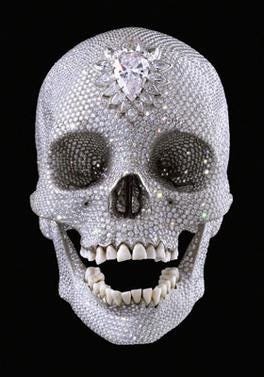
Damien Hirst's diamond covered platinum skull, For the Love of God
Damien Hirst, For the Love of God, 2007, platinum, diamonds and human teeth

In the twentieth century, the reminder of death became a product.

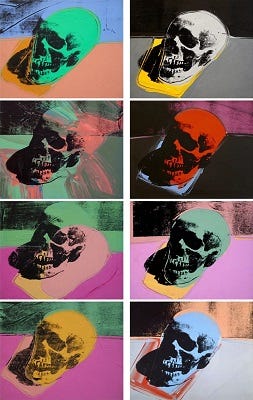
For his 1976 "Skull" series, Andy Warhol sent his assistant Ronnie Cutrone to a Paris flea market to buy a human skull. Cutrone photographed it under changing light, and Warhol turned the photographs into acrylic and silkscreen canvases. In May 2022, one of them, a 72 by 80 inch canvas showing a blue skull, sold at Christie's in New York for 25.6 million dollars.

Damien Hirst pushed the logic to its endpoint. "For the Love of God," from 2007, is a platinum cast of an eighteenth century human skull covered in 8,601 diamonds. That year, Hirst and the White Cube gallery announced it had been sold to anonymous investors for 50 million pounds, roughly 100 million dollars, which would have made it the most expensive contemporary artwork ever sold.

It had not been sold. In a 2022 profile, Hirst admitted the sale never happened. The object that was supposed to remind us nothing lasts turned out to be an announcement that did not last either.

The skull was not the only way painters gave death a body. Some drew it as a full figure instead, a subject we cover in the angel of death in painting, and others painted whole processions of skeletons in the danse macabre. This page is about the version that fits on a table.

FAQ

  • What does memento mori mean? It is Latin for "remember you must die." In art, the phrase describes any work built around a symbolic reminder of mortality, most commonly a human skull.

  • Is memento mori the same as vanitas? They overlap but are not identical. Vanitas is a specific genre of still life, mostly Dutch and seventeenth century, that combines mortality symbols with objects of worldly pleasure. Memento mori is the broader idea, and it appears in portraits and religious scenes too, like Caravaggio's Saint Jerome.

  • Why is the skull the main memento mori symbol? Because it is the one human remnant everyone recognizes instantly, stripped of age, wealth, and identity. Painters paired it with objects that measure or mock time, like the hourglass and tulip in Champaigne's 1671 still life.

  • Did artists really paint from actual human skulls? Yes. Van Gogh painted a real classroom skeleton in Antwerp, and Warhol's 1976 series started with a genuine human skull his assistant bought at a Paris flea market.

  • What is the most expensive memento mori painting? At auction, a blue Warhol "Skull" from 1976 sold for 25.6 million dollars at Christie's New York in May 2022. Hirst's diamond skull was announced at 50 million pounds in 2007, but that sale never took place.

  • Where can I see these paintings? The National Gallery in London (Hals), the Galleria Borghese in Rome (Caravaggio), LACMA in Los Angeles (La Tour), the Musee de Tesse in Le Mans (Champaigne), and the Van Gogh Museum in Amsterdam (Van Gogh). Cezanne's "Pyramid of Skulls" is in a private collection.

Enjoyed this? Join the readers who learn art the fun way, free every week.

Van Gogh's classroom skeleton with a lit cigarette between its teeth
Vincent van Gogh, Head of a Skeleton with a Burning Cigarette, winter 1885 to 1886, Van Gogh Museum, Amsterdam

As of 2022, "For the Love of God" had never left storage: the diamond skull sits in a vault in London's Hatton Garden, still owned by Hirst, White Cube, and a group of smaller investors, with one art market expert putting its real worth at 7 to 10 million pounds.

Related reading