

180 000+ readers learn art the fun way.
This is a preview. Paid subscribers get the full story.
You’ll also get:
10 new stories / month
The full archive (130+ Art stories)
Your personal art guide. Comment, ask questions, DM me anytime
Apple user? Subscribe at coolstoriesabout.art, not via the app. Apple adds 30% to the price.
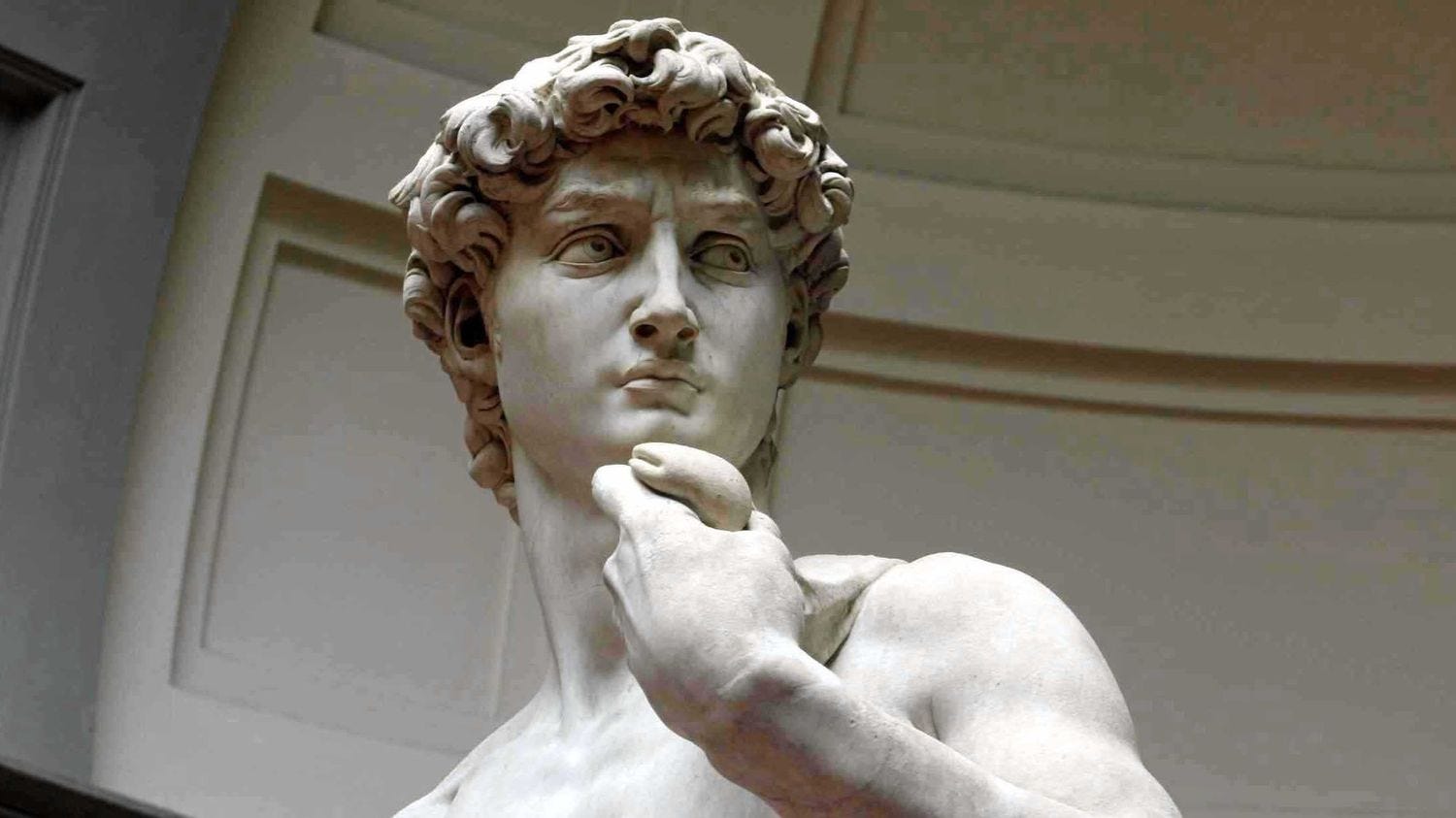
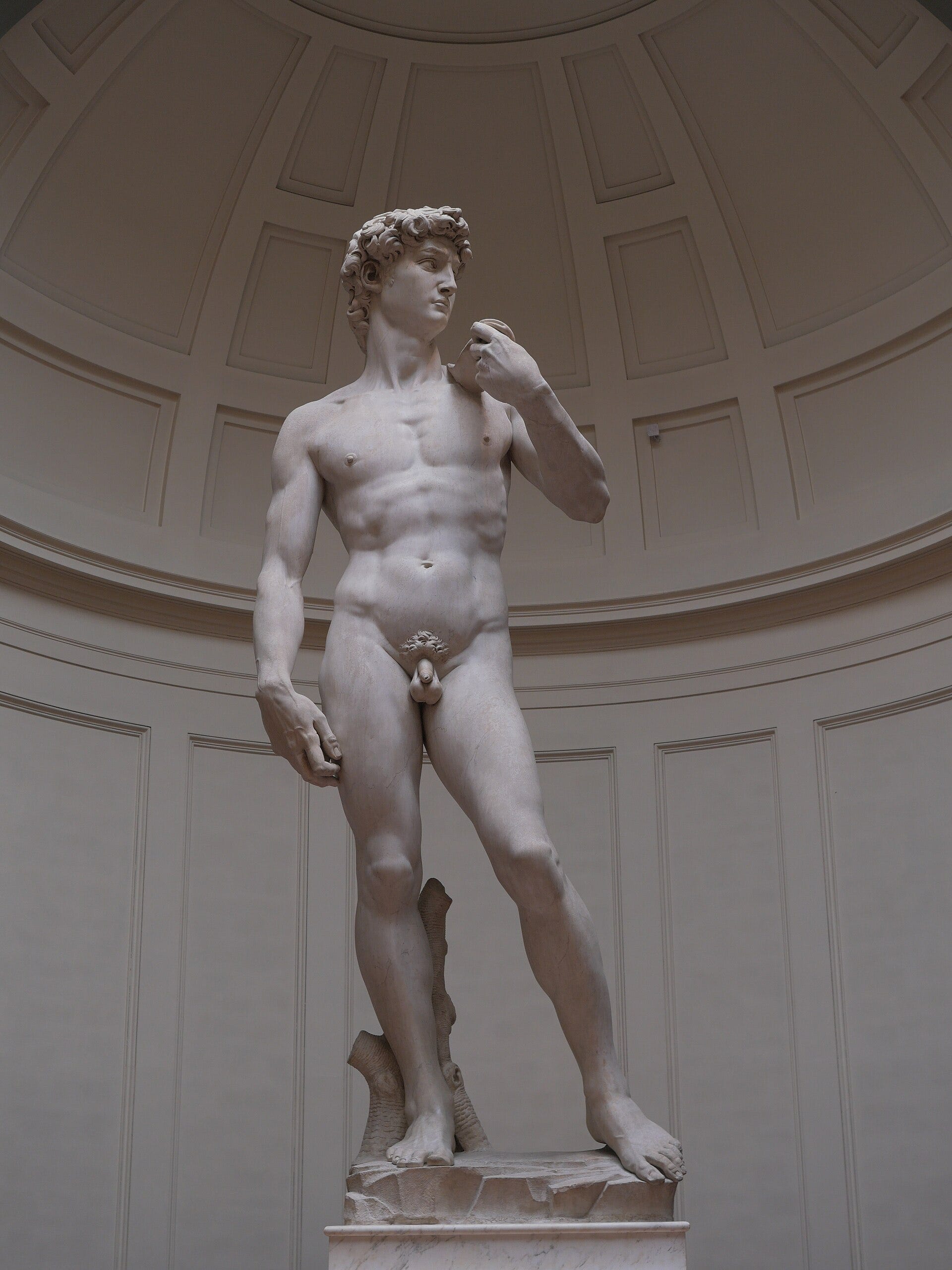
In Florence, in the streets that lead up to the cathedral, all you have to do is push open the door of a souvenir shop to find him: the same naked body, printed on kitchen aprons, or, on a fridge magnet, cropped down to a single part, the groin.
Nobody needs to be told who he is, and nobody has missed how small his penis is.
A few streets away, under the glass dome of the Accademia, the original waits, more than 5 meters of white marble. Every year, 2 million people line up on the sidewalk outside to spend a few minutes at his feet.
This David was born of a fight. Not the one in the Bible, but a personal one.
The round chapel
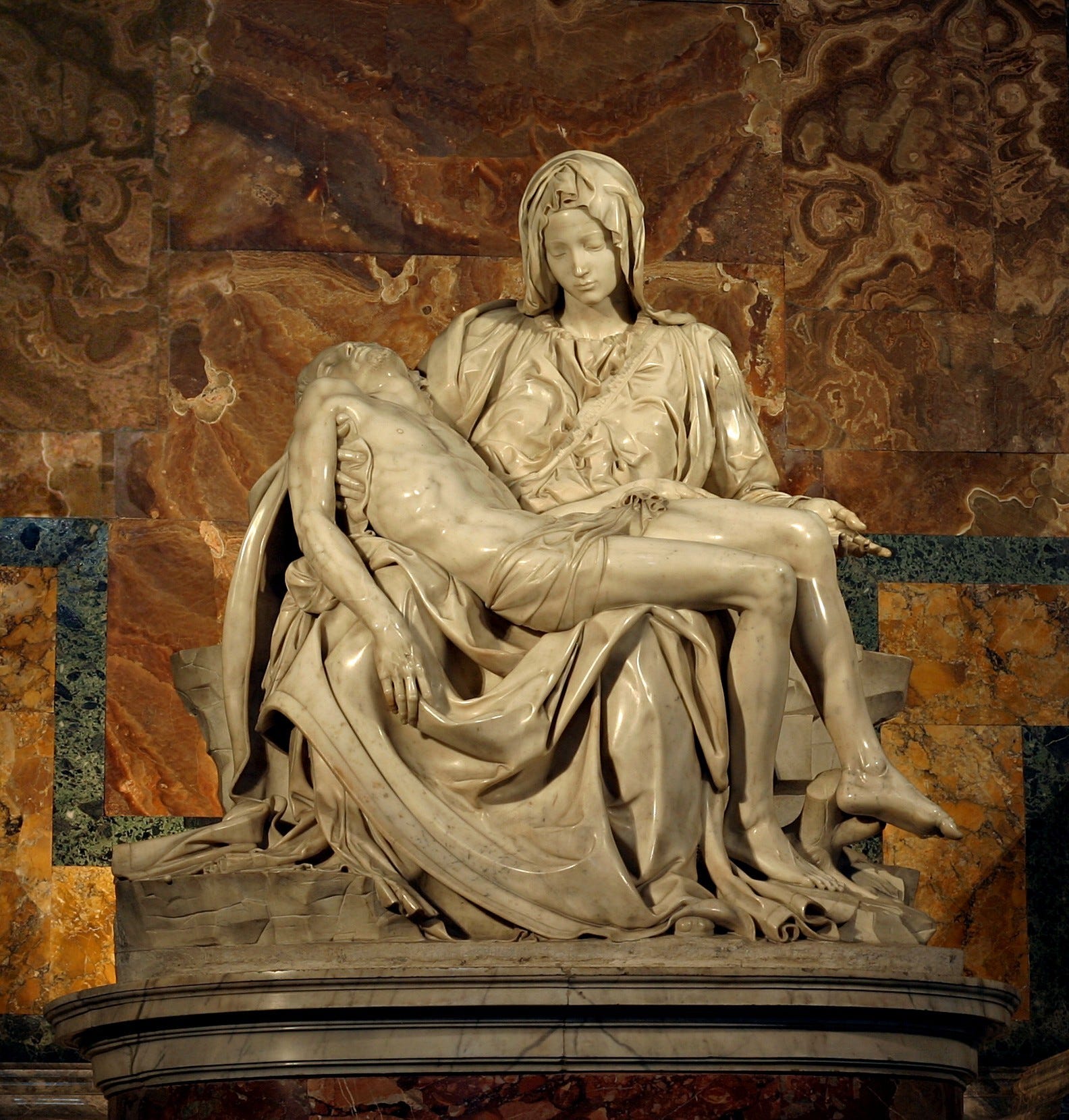
In Rome, in 1499, a round chapel leans against the flank of old St. Peter's. A marble statue has been set up inside, and ever since, the little chapel has never been empty.
Pilgrims, priests, travelers passing through: all of them lower their voices without being told to, and all of them stay longer than they meant to.
A very young woman holds the body of her dead son across her knees, and she looks younger than he does. One arm hangs loose in the air. The marble has been polished until it looks warm.
A young man comes in after the others, stops by the door, and goes no farther. Around the marble, travelers from Lombardy, the region around Milan, circle it slowly. For a long moment they say nothing, and then they all talk at once.
"Who could have carved a thing like that?"
"A Roman. Everything here is Roman."
"Look at that arm. No Roman can do that."
"It's our Gobbo, from Milan."
The man who said it speaks with the pride of someone naming a sculptor from his own town. By the door, the young man has not missed a word. He says nothing, looks at the statue a while longer, then leaves.
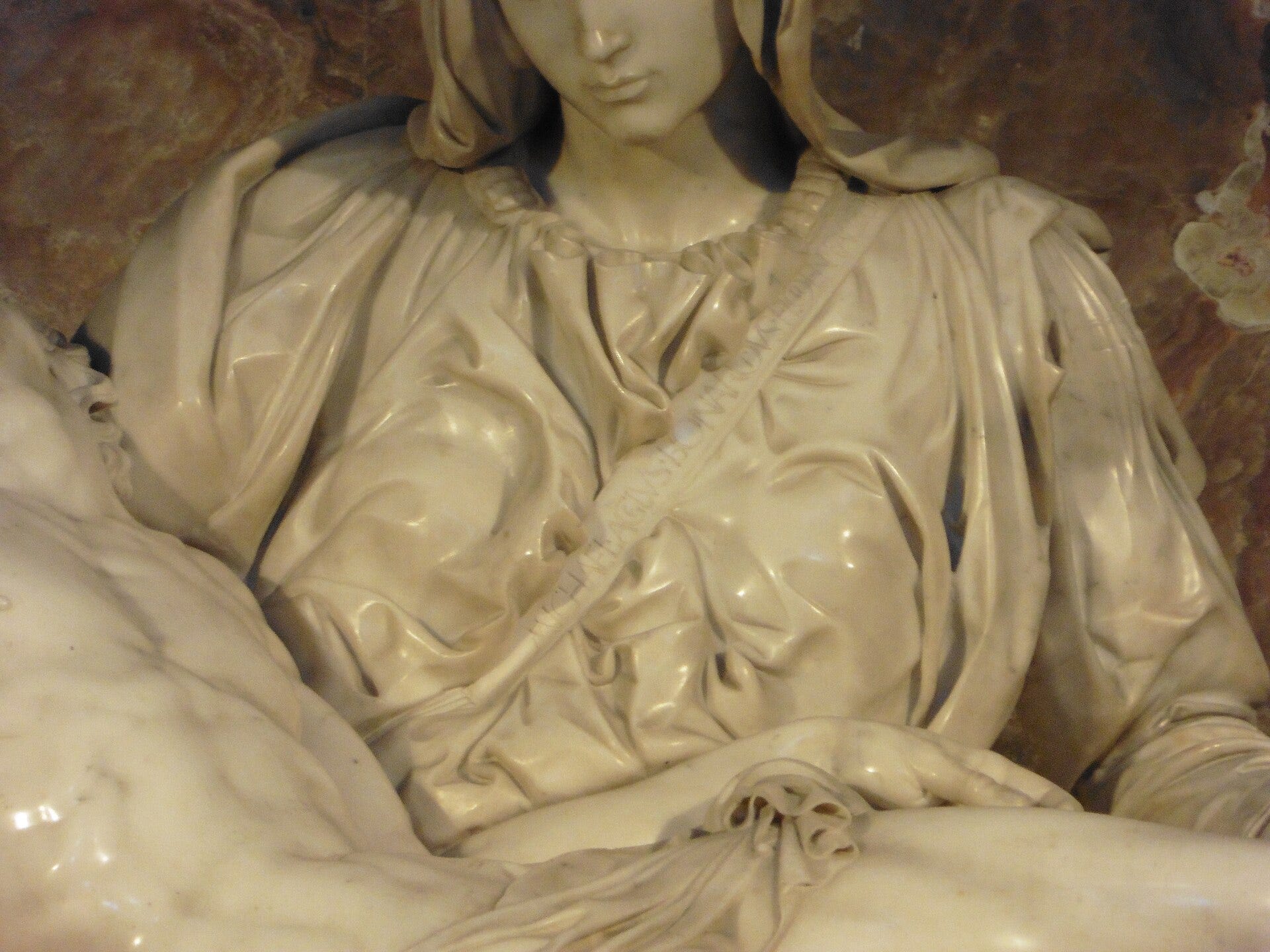
He comes back at night, a small lamp in one hand, his tools in the other, and shuts himself in the chapel. The flame catches the band of cloth across the Virgin's chest, and there, with chisel and mallet, letter by letter, he cuts a line of Latin.
That statue is the "Pietà." Since that night, a signature has run across her chest: MICHAEL ANGELUS BONAROTUS FLORENT FACIEBA. Michelangelo Buonarroti, Florentine, made this.
The piece of bread
By now Rome knows the name. The man who bears it is 24, owns no house, sleeps under someone else's roof, and works with a piece of bread in his free hand, eating it without putting down his tool. He lives like a poor man because the money he earns does not stay in Rome. Every time he is paid, part of it goes to Florence.
There, his father, Lodovico Buonarroti, has five sons to feed and almost nothing to feed them on. His small post at the customs house came from the Medici, the bankers who ran Florence; the day the city drove them out, the post went with them, and with it the household's only income.
One day, one of the brothers turns up in Rome with bad news: a merchant wants their father thrown into prison over a debt. Michelangelo puts the brother up at an inn, where he will want for nothing, then sits down and writes to their father.
"Whatever you ask of me, I will send it, even if I have to sell myself as a slave."
Nearly five years go by like this in Rome. Then family business calls him home, and he returns to Florence.
Siena
A commission is waiting for him. In nearby Siena, the cardinal-archbishop wants the man who made the "Pietà" to carve 15 marble saints for the altar of his cathedral: 500 gold coins, delivery within three years, the sculptor paying for the marble.
The cardinal sets only one condition: for those three years, nothing else is to come before his saints.
Michelangelo signs. The commission is secure and well within his abilities, and for the first time his family has three years of income ahead of it. He also has the means to keep a promise made to his brothers: to set them up in a cloth shop.
The ropes
A few weeks later, errands for the shop he has yet to open send him across the city, and his route leads past the workshop of Florence Cathedral, whose yard opens onto the street. Men are hauling on ropes.
At the end of the ropes, slowly, a stone that has lain there for years rises to its feet. What stands before him is a block of marble as tall as three men, stained by years of rain, scarred with old chisel marks.
He knows this block; every Florentine does. The cathedral ordered it in 1464 for an enormous statue meant for the upper reaches of the building, and the marble that arrived proved awkward: very tall, narrow, and shallow from front to back.
Agostino di Duccio, the first to touch it, attacked it at an angle and abandoned the work unfinished, a barely begun figure with a lump of marble sitting in the middle of its chest. Ten years later, Antonio Rossellino, one of the most in-demand sculptors in the city, was handed the block in turn, and he too gave up.
In the 35 years since, the block has stood outdoors, in the rain. The water has softened it, and no one dares touch it anymore.
The cathedral has not given up. It wants a David carved from the block: the little shepherd of the Bible whose sling brings down Goliath, the one Florence has adopted as its emblem. It has the stone raised that day, with Michelangelo looking on from the edge of the yard, to find out whether it can still be used.
At the foot of the stone
Upright, it can be used, if someone dares. The cathedral's overseers happen to have a Florentine sculptor on hand, just back in town, the man who made the "Pietà." They bring him to the foot of the block and tell him what they are offering.
"Two years of work, and 144 gold coins, guaranteed."
"The marble is ours. You won't have to buy a thing."
He has everything to lose. Siena is promising him 500 gold coins; here, they guarantee him 144. He has just given the cardinal his word, and taking this block means making the cardinal wait, with his family's money at stake.
It also means taking on a stone that two masters abandoned before him. And if he fails, he fails at home, in front of all Florence, and the name he cut one night into the Virgin's chest goes down with him.
And yet, on August 16, 1501, Michelangelo says yes.
That yes has a reason, and this David carries it. You will discover:
Where Goliath went.
Why he is entirely naked.
Why David, who is Jewish, is not circumcised.
Why his penis is so small.
Why Michelangelo said yes.