
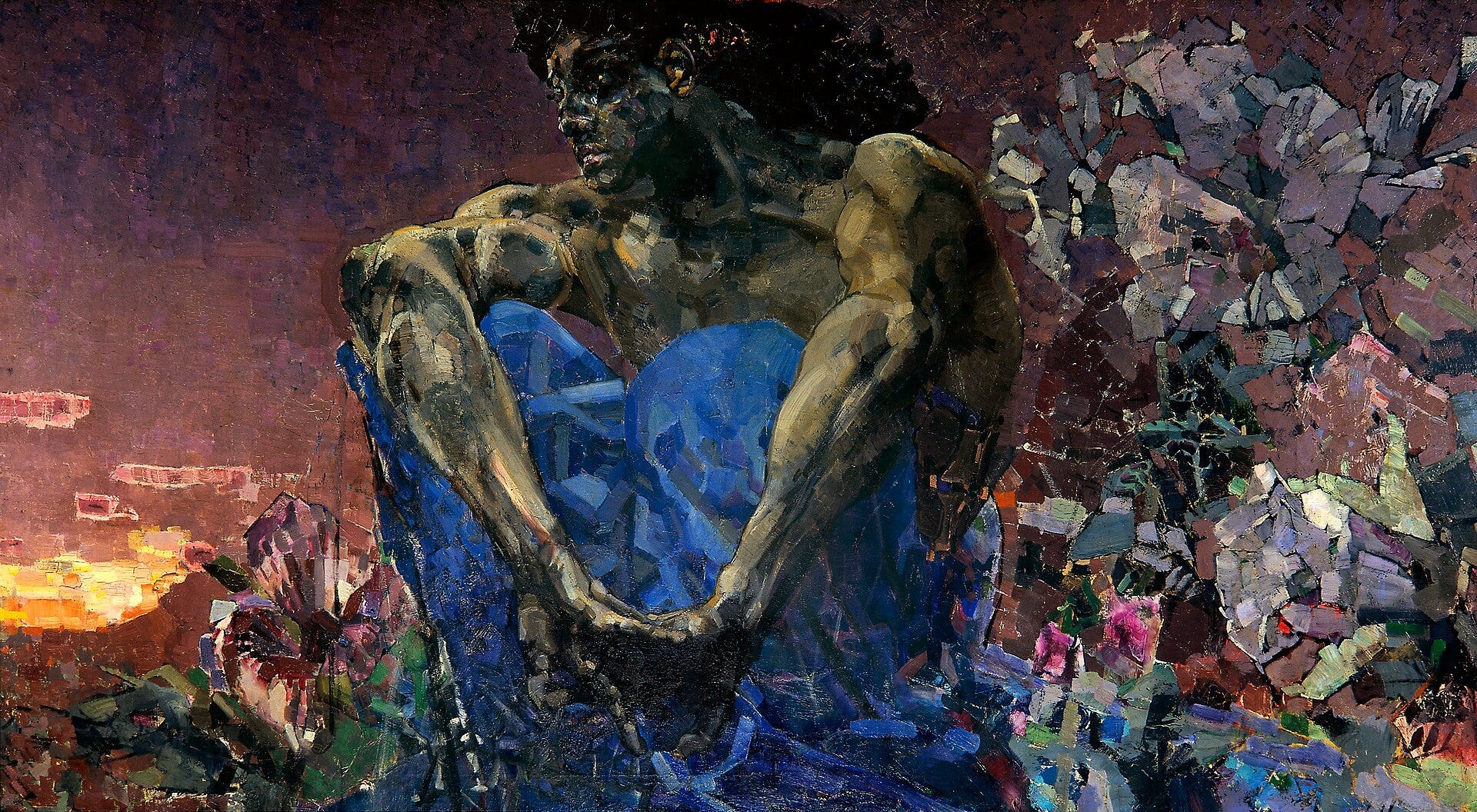
Mikhail Vrubel (1856 to 1910) was a Russian painter, famous for his pictures of the Demon, the fallen angel of a Russian poem. His best-known paintings, The Demon Seated and The Swan Princess, hang in Moscow's Tretyakov Gallery, the great museum of Russian art.
Cool Stories About Art is a newsletter to learn art the fun way.
Join 200,000+ readers and get:
10 new art stories / month
The entire archive of content (140+ articles)
Comment, ask questions, and chat with other readers
In 1896, a telegram called two giant paintings by Vrubel "monstrous," and the Imperial Academy of Arts, the state art school of St. Petersburg that also ran Russia's official exhibitions, had them taken down. Nine years later, the same Academy gave Vrubel its title of academician of painting.
Mikhail Vrubel was born in Omsk, in Siberia, in the Russian Empire. His older sister, Anna, became his confidante for life.
Vrubel first studied law in St. Petersburg, then the capital of Russia. In 1880, he began attending classes at the Academy.
Vrubel was still a student when, in 1884, Adrian Prakhov, an art historian restoring St. Cyril's Church in Kyiv, a church of the 1100s, called him there to repair its old wall paintings and paint icons, the holy images of the Orthodox Church. Kyiv, today the capital of Ukraine, was then a city of the Russian Empire.
Kyiv also brought Vrubel a refusal. In 1887, his sketches for St. Vladimir's, a new cathedral in the city, were turned down. The great wall paintings went to Viktor Vasnetsov, a famous painter of Russian legends.
In 1889, Vrubel left Kyiv for Moscow. There, Savva Mamontov, a railroad tycoon who housed and paid artists, took him into his home, and in 1890 Vrubel painted The Demon Seated there.
The Demon is the hero of a long poem by Mikhail Lermontov, a Russian poet of the 1830s. Cast out of heaven, the Demon falls in love with Tamara, a princess of Georgia, a country between the Black Sea and the Caspian Sea.
Vrubel gave his Demon no horns and no tail, only the body of a sad young man. He laid on the paint in flat strokes with a palette knife, so that the flowers around him look like cut crystal.
In 1896, Mamontov found Vrubel the biggest order of his life: two giant paintings for the art pavilion of a national exhibition. The Academy, Vrubel's old school, ran that pavilion.
What would make the Academy honor a painter whose panels it had thrown out?
In the rest of the story
Whose voice Vrubel fell in love with before he saw her face.
What Vrubel did to his Demon every morning before visitors arrived.
What sign Mamontov put up after the Academy's verdict.
Where the rejected panel turned up sixty years later.