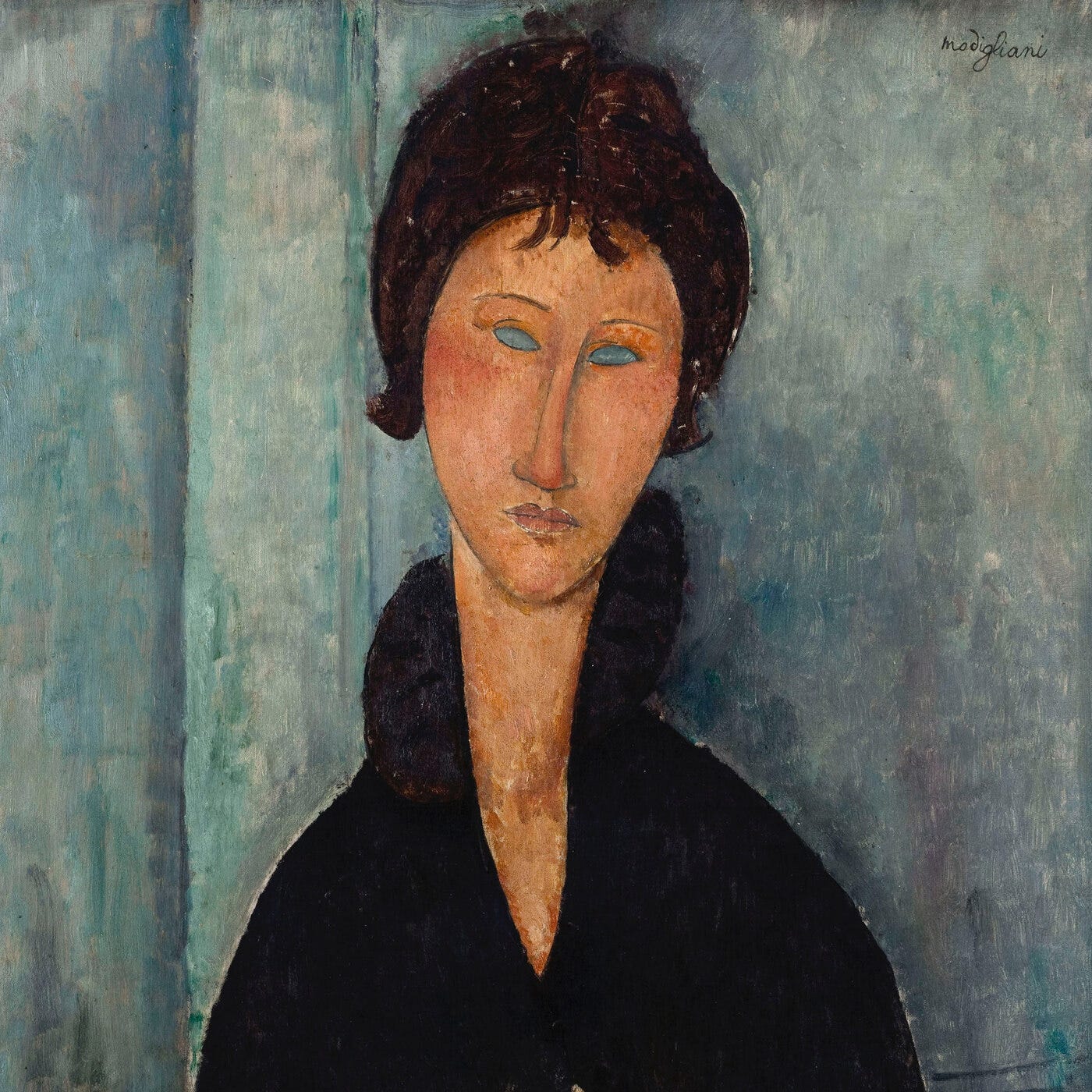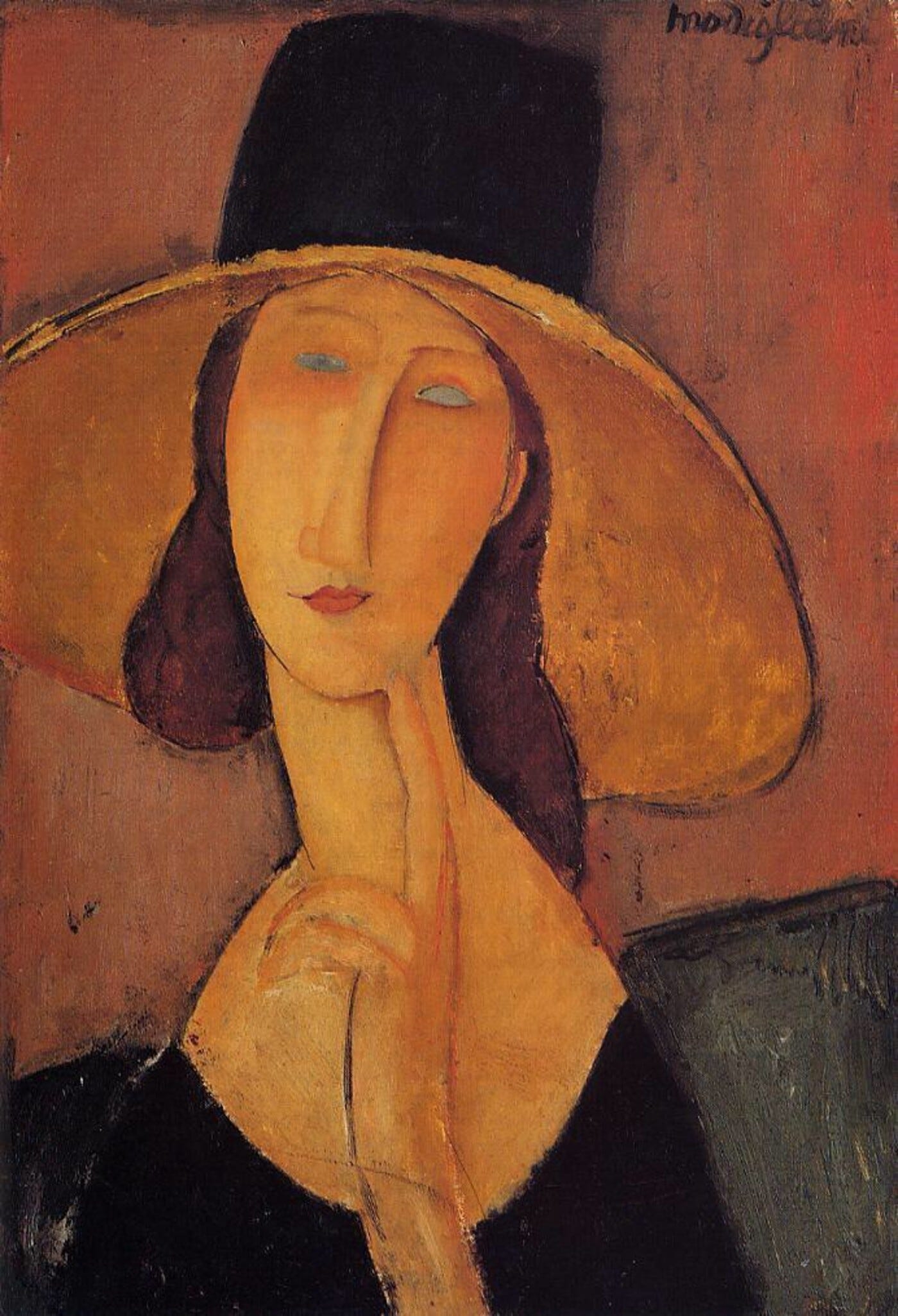
Some say Modigliani once murmured this line to one of his models: "When I know your soul, I will paint your eyes."
No one ever heard it. Yet it has traveled for a century now, from biography to biography, all the way onto museum labels, with the quiet confidence of a fact that has never needed checking. Who first repeated it, in what room, in what year, nobody knows.
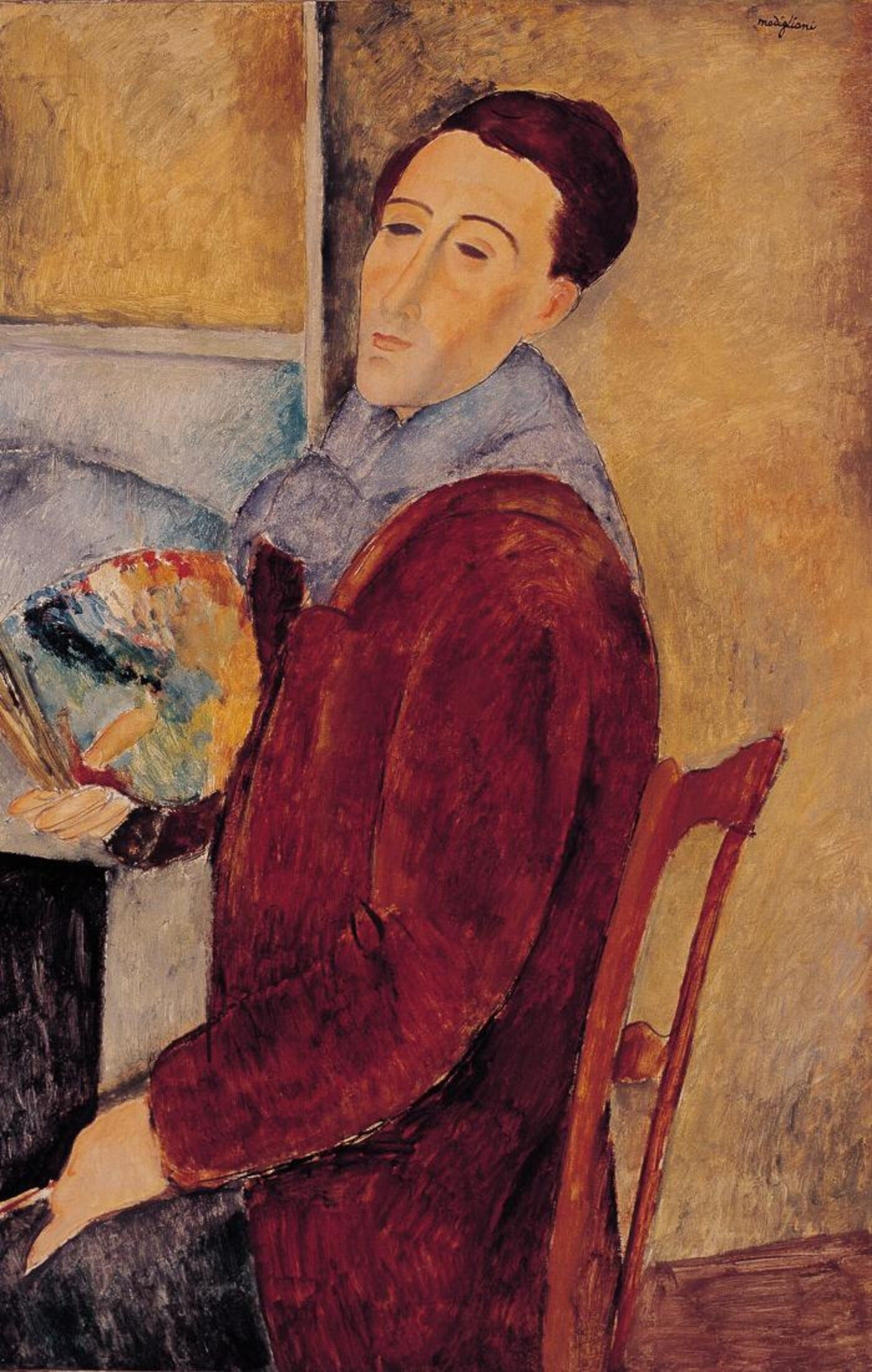
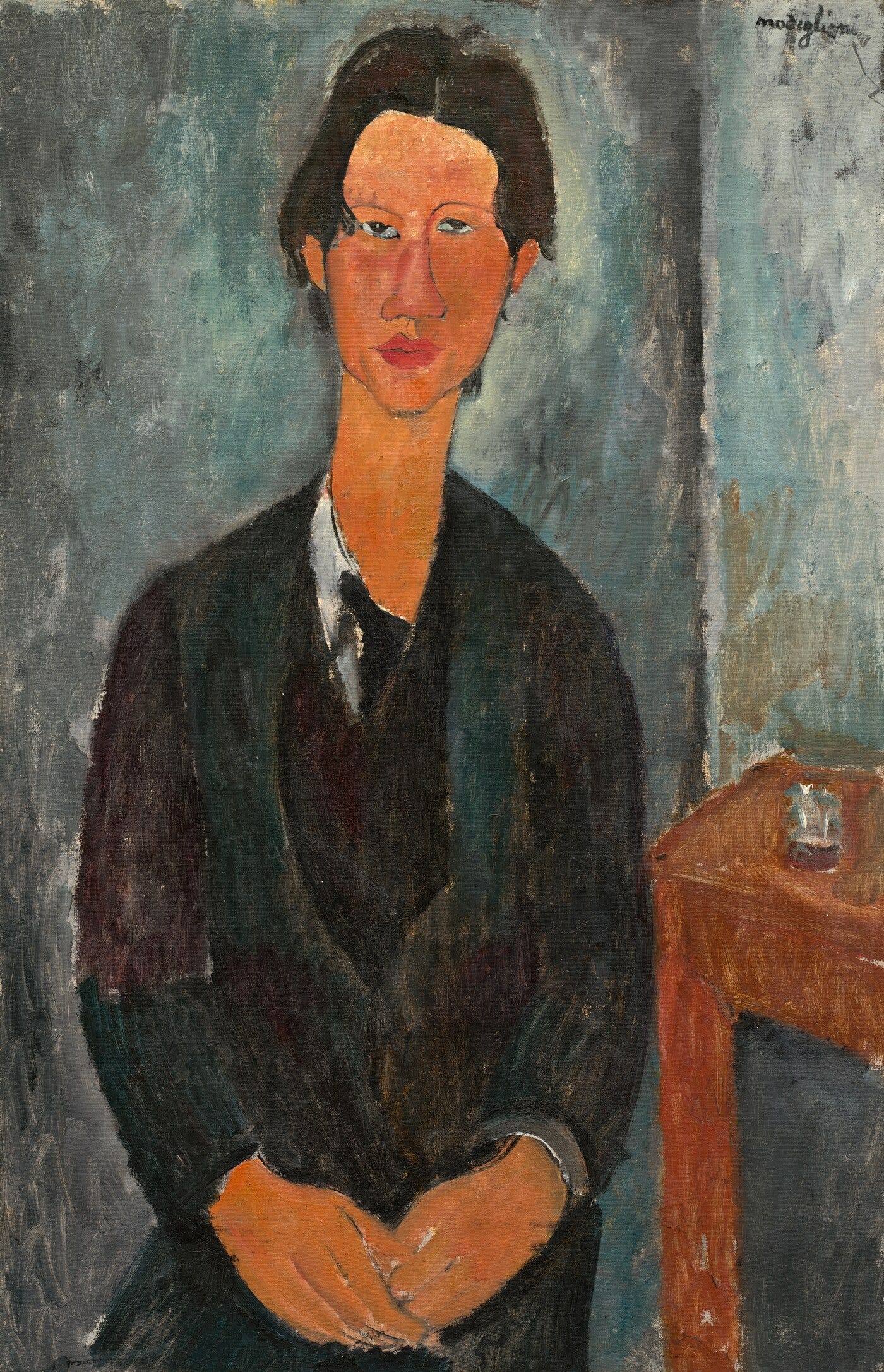
It is easy to see why the line caught on. In his fourteen years in Paris, the Italian prodigy of the School of Paris, the circle of foreign artists then working in the city, stretches faces, lengthens necks, erases gazes, and builds a style recognizable from across a room.
A line about the soul settles the matter of those empty eyes in ten words, with nothing left to puzzle out, and that is exactly what makes it suspect.
So why did Modigliani paint eyes without pupils?
180 000+ readers learn art the fun way.
This is a preview. Paid subscribers get the full story.
You’ll also get:
10 new stories / month
The full archive (130+ Art stories)
Your personal art guide. Comment, ask questions, DM me anytime
Apple user? Subscribe at coolstoriesabout.art, not via the app. Apple adds 30% to the price.
A Bed of Mattresses
Livorno, Italy, July 12, 1884.
Eugénie Modigliani is in labor, and the contractions are coming faster. The whole house already knows the child will be a boy, and that his name will be Amedeo.
That same day, a bailiff walks through the door. The father's bankruptcy has swallowed up everything, and the man has come to take what is left, the furniture, any object still worth reselling.
An Italian law ties his hands on one point: nothing can be seized from the bed of a woman giving birth. The family immediately sees what can be made of it.
They rush into the room, pile everything of value onto Eugénie's bed, throw mattresses on top, and the bailiff waits in the next room, unable to do a thing about it.
That is how, on this bed turned hiding place, between his mother's cries and the bailiff's footsteps behind the door, Amedeo Modigliani comes into the world.
Childhood brings him to the edge of the grave more than once. First pleurisy, then typhoid fever, then a second bout of pleurisy that leaves behind tuberculosis of the lungs.
He is sent off to breathe milder air, to Naples, to Capri, to Amalfi, to Rome, and between bouts of convalescence he studies painting in Florence, then in Venice, where an uncle pays for his enrollment at the Academy of Fine Arts.
In 1906, his mother agrees to pay for his departure. Destination: Paris.
There he conceals the illness that has already nearly killed him, and he paints. Year after year, one detail shifts across his canvases without anyone noticing at first: the eyes of his models lose their pupils, one by one.
In Montparnasse, people know about his rages, his nights, the drinking, the hashish people claim he uses. The poet André Salmon will go so far as to claim that a sober Modigliani is worth no more than an ordinary painter, and that his light comes to him only through debauchery.
For many, this emptiness in the gaze only confirms what the whole neighborhood believes it already knows. They read it as alcohol, nerves, a mind coming apart and finally spilling onto the canvas, the painted proof of a man destroying himself.
His fellow painters think highly of him. The market, meanwhile, ignores him just as steadily: not a single sale, not one exhibition that matters.
At the Académie Colarossi, a Paris art school where he comes to draw, he meets a student of nineteen, Jeanne Hébuterne. She is shy, reserved, the exact opposite of the reputation trailing behind him, that of a penniless seducer.
They fall in love almost at once. Jeanne's family wants nothing to do with this Italian painter, Jewish and penniless, and the couple settles into a poverty that keeps them on the margins of almost everything.
He paints her, again and again. In almost all these canvases, Jeanne has no pupils.
The following year, Jeanne gives birth to a daughter. They name her Jeanne too.
The Sixth Floor
A year later, in January 1920, Modigliani has not left his bed in two days. Through the apartment wall, a neighbor hears him talking with people who are not in the room.
She finally pushes open the door and finds him half conscious, unable to stand. He is carried to the Charité, a Paris hospital.
He dies on January 24, 1920. The illness he has hidden since adolescence has finally taken him.
His friends give him an immense funeral, and the whole young crowd from the studios of Montparnasse follows the procession to Père Lachaise cemetery.
Jeanne does not walk behind the coffin. She waits at her parents' home, eight months pregnant with their second child, and around her everyone works to keep the news from her, because no one dares be the one to tell her.
Nothing works. She eventually finds out. The next morning, she jumps from the sixth floor.
Her Catholic parents refuse to let her rest beside him, and for ten years the two graves remain separate.
In 1930, the couple is finally reunited at Père Lachaise, under two epitaphs that echo each other, stone to stone.
"Struck down by death at the moment of glory."
"Devoted companion to the ultimate sacrifice."
Discover my new newsletter !

Les Montparnos
During his lifetime, the Paris press ignored Modigliani. It named him only once, in 1917, and it was to tear him down.
His death, followed the next day by Jeanne's, changes everything. Those who never bothered to put a single word about him on paper now pick up their pens.
Among them, Michel Georges Michel, a chronicler of Montparnasse nightlife, who publishes "Les Montparnos" in 1924, a novel drawn from the bohemian world he has shared tables with for years.
In it, he places an Italian painter, generous, undisciplined, dead young for his art. The character matches, point for point, the couple Modigliani and Jeanne have just formed without meaning to.
Other witnesses, without coordinating, reshape their memories the same way, and the undisciplined young painter they once knew becomes, in their telling, a genius sacrificed to his art.
It is in this climate that the line begins to circulate.
"When I know your soul, I will paint your eyes."
No one knows who first said it, or to whom, and no document allows it to be dated.
It fits, exactly, the shape of the character the novel has just created, a tormented genius who paints what he feels.
26 Portraits
If the line is true, it speaks of intimacy. It should then apply first to the woman Modigliani loved most, the one who stays until the end and follows him into the grave: Jeanne.
He paints her 26 times in three years. Of those 26 portraits, only four keep their pupils.
In one of these portraits with empty eyes, beneath the final layer of paint, the outline of the irises can still be made out, drawn with a light stroke. He had begun them. Then he painted over them with pale blue, with his own hand, in the same motion, and left the eyes empty.
If the gaze were earned by coming to know someone, she, of all people, should have kept it every time. The emptiness, then, tracks neither time, nor closeness, nor love.
The explanation lies elsewhere.
It is not the alcohol, whatever Salmon said. It is not the particular psychology of a cursed artist. It is not even love. All that is left, now, is to understand the real reason behind the missing pupils in the Italian painter's work.