
This is a preview. Paid subscribers get the full story.
You know this woman.
You’ve seen her on a poster, a mug, a notebook, a phone screen.
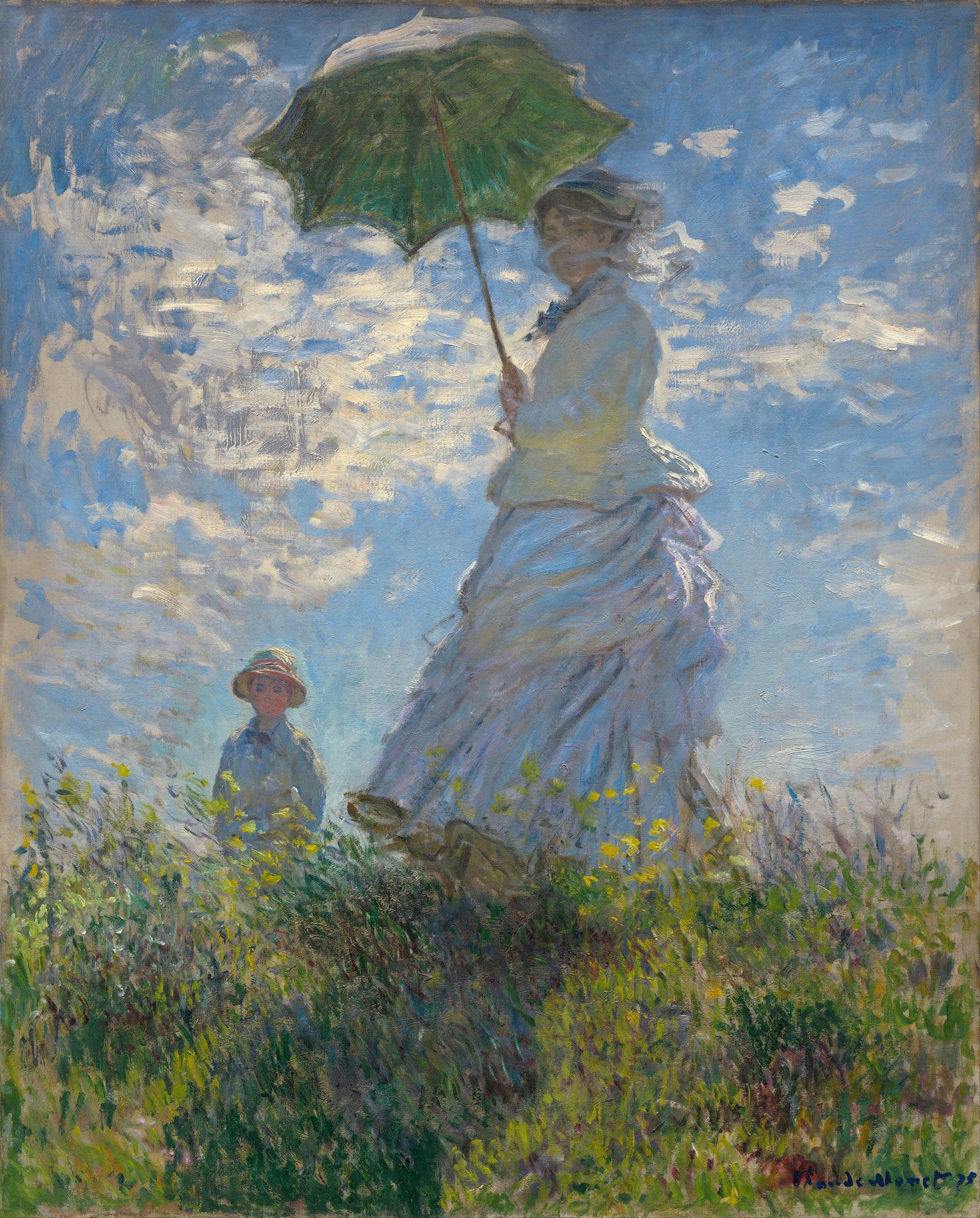
A woman in a white dress stands at the top of a hill, a green parasol in her hand. The wind presses her dress against her legs, and everything streams the same way: the veil, the grass, the clouds. Farther down, half-hidden in the grass, a little boy is watching her.
It’s one of Claude Monet’s most famous paintings.
Last summer, I walk into the National Gallery of Art in Washington for the first time. I have no idea this painting is there. I step into a gallery of French paintings, and suddenly I’m face to face with it.
Like you, I’ve seen it a thousand times in photos. Never in person. In person, it’s smaller than you’d think, just over three feet tall. I stand in front of it for a long time. Just looking at it is a pleasure.
It takes you to a day in early summer, the kind a family remembers. It’s sunny but not too hot. The sun comes from behind the hill, the wind flattens the grass, and you could almost tell the time: three in the afternoon. A mother turns around, as if someone had just called her name. The little boy has run on ahead and is waiting for the grown-ups. Everyone finds an afternoon of their own in it: a memory of a mother, a father, a child.
This canvas is Monet in a nutshell: a fleeting moment caught like a snapshot, but painted in small dabs of light.
And then there’s the face. It stops you. A sheer veil floats in front of it, and behind that veil, the young woman is looking at the painter.
Who is she?
Her name is Camille. She is Monet’s wife, and the little boy is their son, Jean, age seven. We’re in Argenteuil, just outside Paris, on a summer day in 1875. Monet has set up his easel below her so that Camille stands out against the sky, and he paints fast, in a single sitting, before the light changes.
Their story begins ten years earlier, in Paris. Camille is eighteen. She lives with her parents in the Batignolles, a neighborhood full of artists, and earns her living posing for painters.
Monet is twenty-four. One day in 1865, he meets her and asks her to pose. She comes back a second time, then a third. Somewhere between sittings, he falls in love. A few months later, she moves in with him. “She is very sweet, very easygoing,” he writes to a friend.
From then on, she turns up in painting after painting: “The Woman in the Green Dress,” “Women in the Garden,” “Poppies,” “La Japonaise.”


Over the next ten years, Camille poses for some fifty paintings. But those years are nothing like a gentle summer afternoon.
Everything seems stacked against them. Monet’s family, shopkeepers from Le Havre, wants nothing to do with a girl who poses for painters. When Camille gets pregnant, Monet’s father tells his son to leave her. Monet holds firm, but it will be three more years before he marries her.
The Salon, the great official exhibition in Paris, rejects his paintings, and almost no one buys them. Money is always short, and some nights there is nothing to eat. One summer, Monet writes to a friend: “For a week now, no bread, no wine, no fire to cook on, no light.” Renoir brings them bread from his own table so they won’t starve. In Argenteuil, while Monet paints his wife and son in the sunshine, creditors are laying siege to the house.
What Monet paints on that hill is an afternoon of happiness, snatched from years of poverty.
On top of the poverty comes illness. Camille suffers from a condition that Monet describes to a doctor friend as “ulcerations of the womb.” The doctors talk about operating, and the idea terrifies her. She does not get better. In her last months, her belly and legs swell and she can no longer stand. Monet is so poor he can’t even afford paint.
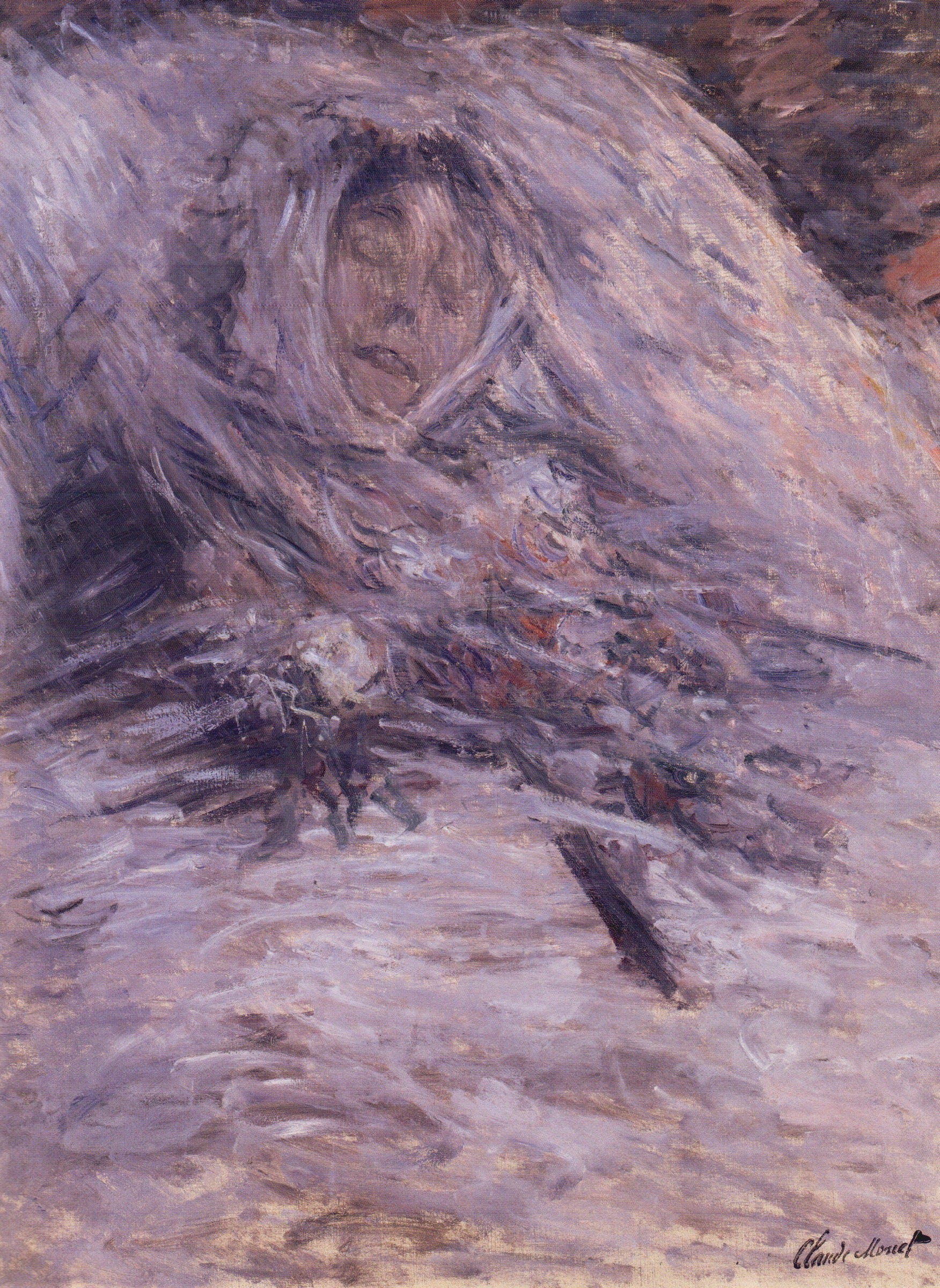
In September 1879, Camille dies at thirty-two. The little boy on the hill is twelve. Monet paints his wife’s face one last time, on her deathbed.
Know someone who would love these stories? Give them a month or a year, with a note from you. 🎁
I thought I knew the story of the woman with the parasol. I thought that was all there was to it.
A few months after Washington, I’m at the Musée d’Orsay in Paris. I’m walking through the Impressionist galleries when I stop dead. Two paintings, side by side.
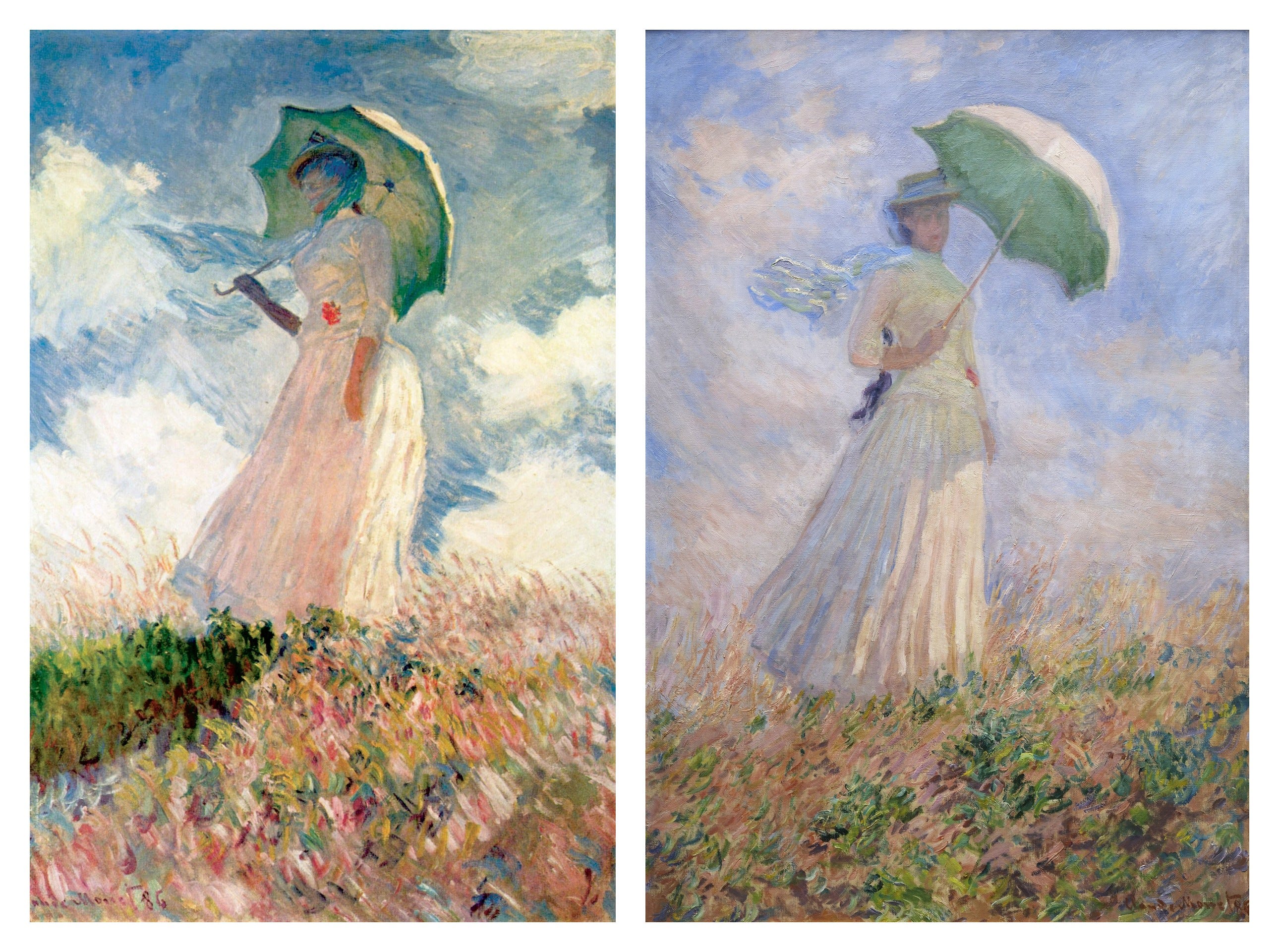
The same parasol as in Washington, the same cloudy sky, the same wind. In one, the woman faces left. In the other, right.
So Monet painted the scene again. Twice. My first thought is that they must be sketches, studies for the Washington painting. Except each one is over four feet tall, bigger than the Washington picture. And the little boy is gone.
I step in closer to look at the faces. In Washington, behind the veil, Camille was looking at the painter. Here, the veil hides everything. No eyes, no mouth. A pink smudge in the shade of the parasol, and nothing else.
In the lower-left corner of one of them, Monet has signed and dated the canvas: “Claude Monet 86.”
1886… Camille has been dead for seven years.
The woman under the veil at the Orsay is not Camille.
What You’ll Discover
Why you can’t see her face
Why Monet paints the same scene again, seven years after Camille’s death
Why one faces left and the other faces right
What connects this young woman to Camille
Who the woman with the parasol really is
200,000+ readers learn art the fun way.
Paid subscribers get the full story. You’ll also get:
10 new stories / month
The full archive (150+ Art stories)
Your personal art guide. Comment, ask questions, DM me anytime
There’s only one person behind Cool Stories: me. Paid subscribers make it possible.
Less than a coffee a month. Cancel anytime.
Apple user? Subscribe at coolstoriesabout.art, not via the app. Apple adds 30% to the price.