
Monkeys in European painting almost always mean the same thing: humans behaving badly. A monkey chained to a table is greed, a monkey in fine clothes is vanity, and a monkey holding a brush is the painter mocking his own trade.
Learn art the fun way
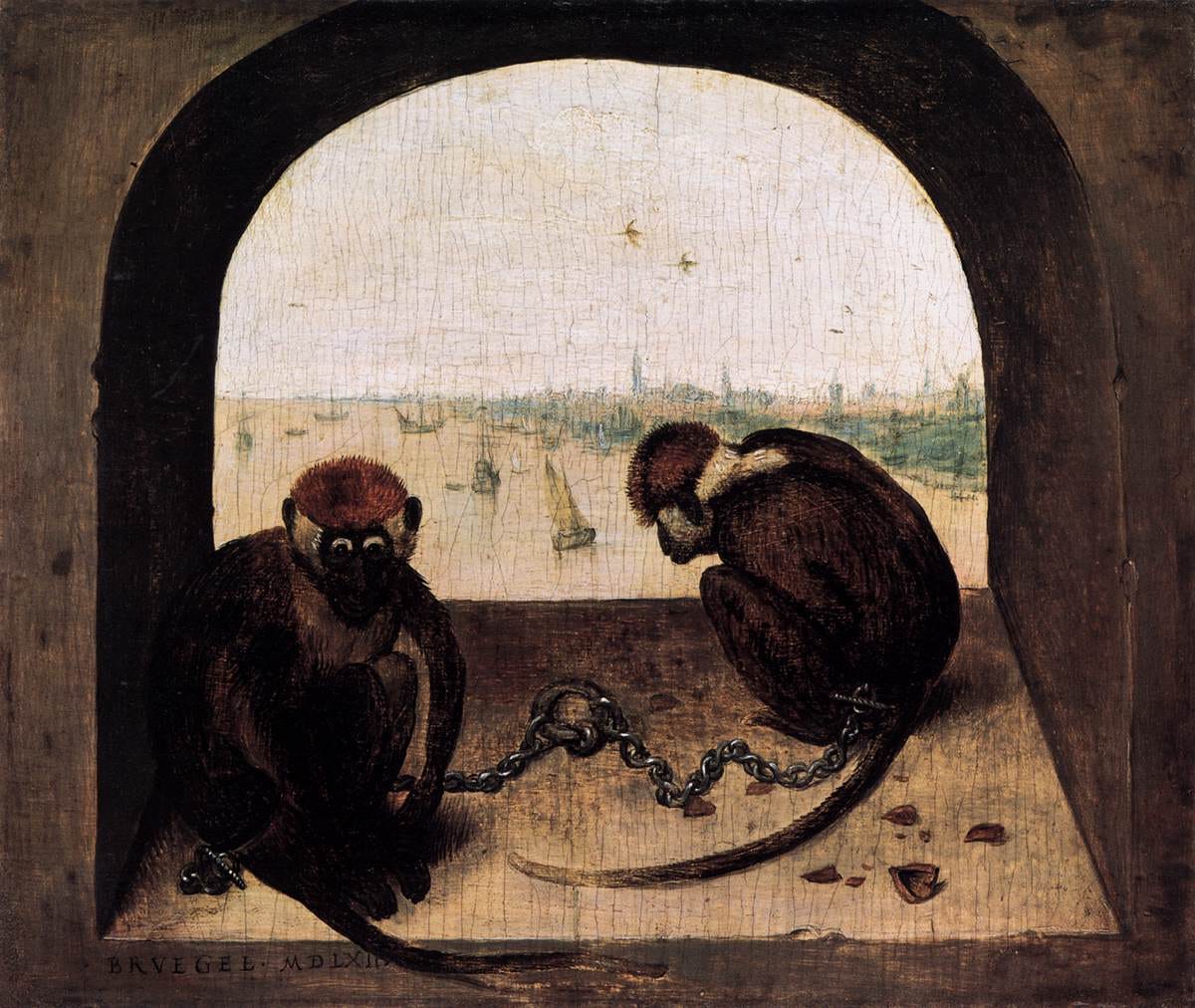
1 | Two Monkeys, Pieter Bruegel the Elder (1562)
Two monkeys chained in a stone window arch, hazelnut shells at their feet, and the harbour of Antwerp behind them. The panel is small, around twenty by twenty three centimetres.
Readings range from the sin of greed to the city itself in chains. More on him in Pieter Bruegel the Elder.
2 | The singerie, or monkeys as people
From the seventeenth century, painters filled rooms with monkeys smoking, barbering, gambling and painting. David Teniers the Younger made a speciality of monkey guardrooms and monkey kitchens.
The joke only works if the viewer recognises the human scene being copied. More in what is genre painting.
3 | The monkey painter
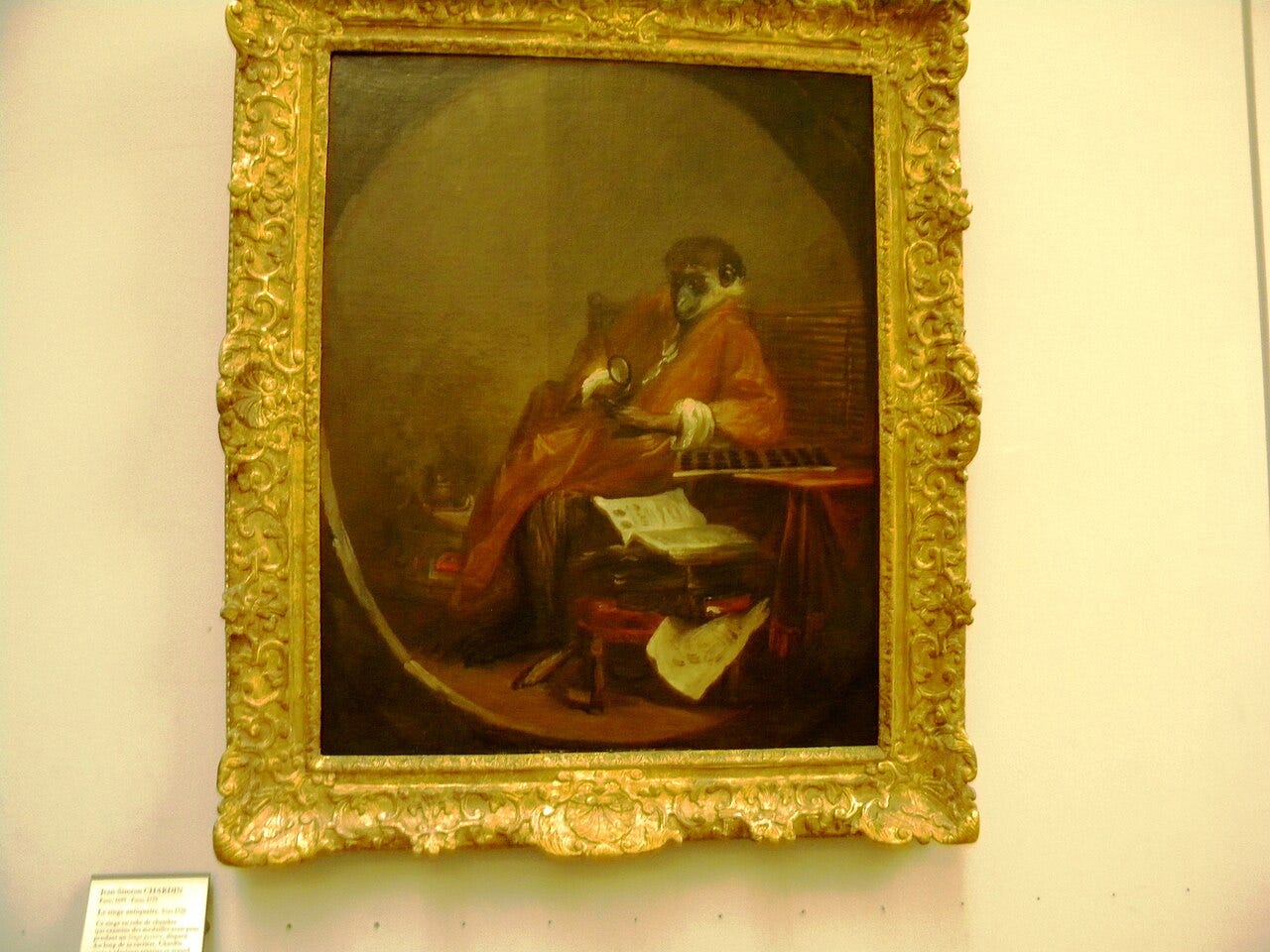
Chardin painted a monkey at an easel, dressed and concentrating, and a second one examining an antique. It is the artist admitting that painting is imitation.
More on him in Jean Simeon Chardin.
Chardin exhibited Le Singe Peintre at the Salon of 1740, along with a companion piece of a monkey studying an antique. Both were popular enough that he repeated them, and versions hang in the Louvre and in Chartres.
My favourite monkey on this list, and the one it beats
Of every monkey on this list, my favourite is Chardin's, alone at his easel. Teniers went the opposite direction and painted his monkeys by the company.
His Festival of Monkeys, from 1633, puts a whole troop of monkey soldiers in front of a tent, with food and wine laid out and a painted owl in spectacles pinned above the scene. The owl nods to an old Flemish proverb about spectacles wasted on an owl that refuses to read, which turns the party into a joke about fools in positions of power.
Chardin needs one animal to make his point about painting. Teniers needs a tent, a feast, a proverb and a whole company of monkey soldiers to make his about the military.
Chardin was not even the first to use a monkey this way. A few decades earlier, Watteau painted The Monkey Sculptor, the same joke aimed at sculptors instead of painters, and the trick itself goes back to Pieter van der Borcht the Elder, who turned monkeys acting like people into an independent subject around 1575.
4 | Monkeys in Bosch
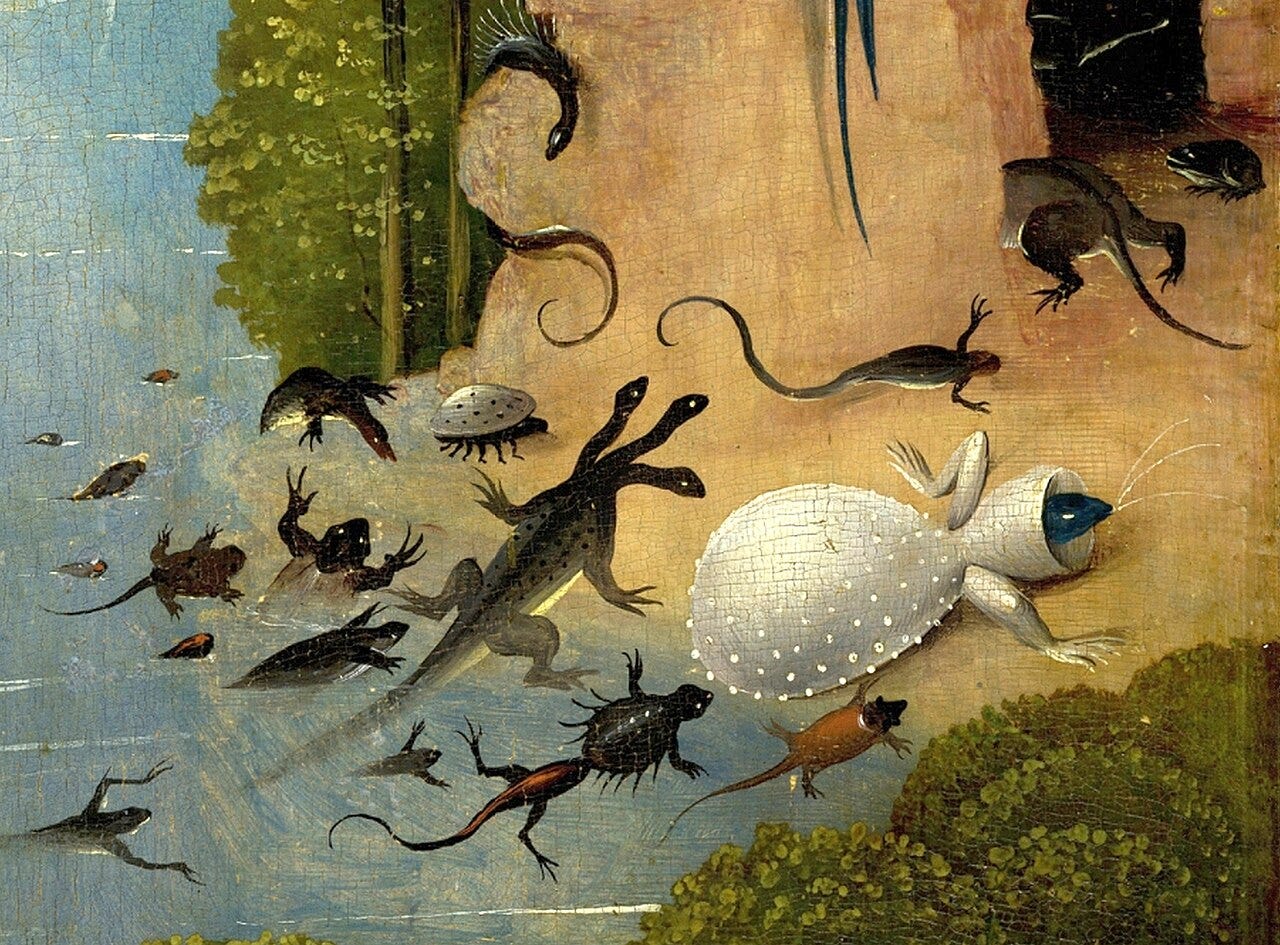
Bosch drops apes into hell scenes and into the crowded middle panel, where they ride, carry and torment, sitting exactly on the line between animal and demon.
More on him in Hieronymus Bosch.
Bosch hides more in that panel than animals. I pull a few of them out in 7 secrets hidden in famous paintings.
5 | The chained monkey in portraits
An exotic pet on a chain told the viewer the sitter had money and reach. It also told a moralising viewer that the sitter had appetites.
The reading system is set out in what is iconography.
Live monkeys reached Europe through Lisbon and Antwerp from the sixteenth century, and only wealthy households could keep one. The chain in the picture is real, not symbolic, and it doubles as a status claim.
6 | Rubens, Jordaens and the Flemish menagerie
Antwerp had a port, so it had animals, and painters had live models. Rubens and his circle painted monkeys from life rather than from bestiaries.
More on him in Peter Paul Rubens.
Antwerp had a menagerie trade because of its port, and Rubens kept exotic animals to draw from. Frans Snyders specialised in the animals in other painters’ pictures, including Rubens’ own.
7 | Frida Kahlo and her spider monkeys
Kahlo kept spider monkeys at the Casa Azul and painted them wrapped around her shoulders, close to her face, sometimes with an arm across her chest.
Here the animal is protective, not accusing. More on her in Frida Kahlo.
She kept several at the Casa Azul, one of them called Fulang Chang, and painted herself with them at least six times between 1937 and 1945. Diego Rivera gave her the first one.
8 | The monkey and the mirror
A monkey holding a mirror is a double joke: vanity twice over, since the mirror already meant vanity and the ape already meant imitation.
Painters loaded symbols on top of each other when they wanted a moral to be unmissable.
The mirror is the attribute of Vanitas and of Prudence, depending on who holds it. Put it in a monkey’s hand and only the first reading survives, which is the joke.
9 | When the monkey stopped being a moral
By the eighteenth century, natural history changed the terms. Monkeys began to be painted as specimens, observed and recorded rather than moralised.
That shift ends the singerie almost completely.
Buffon’s Histoire Naturelle, published from 1749, described primates as specimens rather than as fallen men. Illustrators followed, and the moralising singerie effectively dies out by 1800.
10 | Monkeys in Mughal and Persian painting
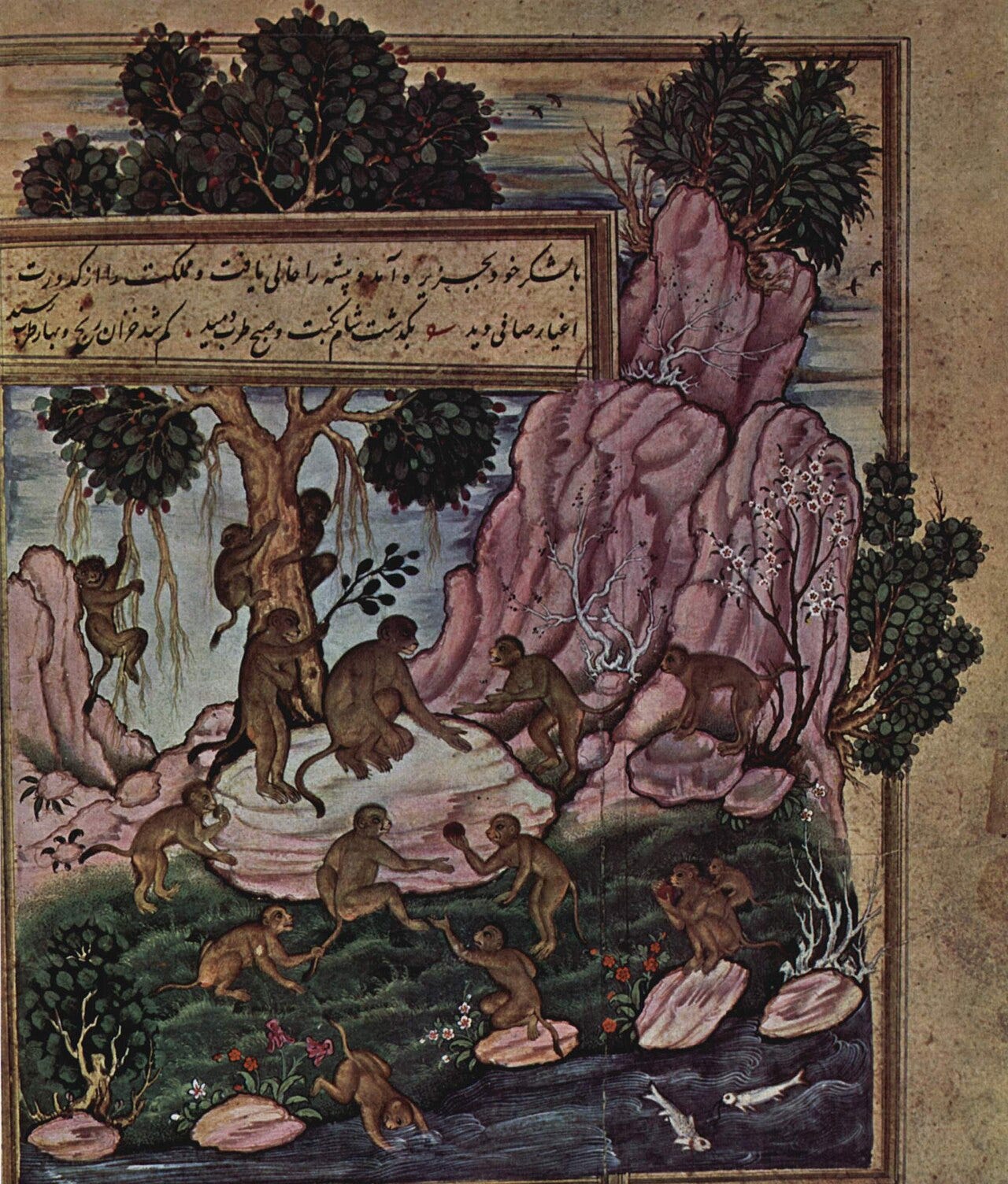
In Mughal miniatures monkeys appear as court entertainers and in fables, and the tone is closer to observation than to moral warning.
More on the format in what is miniature painting.
11 | Landseer and the Victorian human animal
Victorian painting gave animals human expressions on purpose, and the public loved it. The monkey was the easiest sell, since it already looked halfway there.
Darwin’s Origin of Species appeared in 1859, and the imagery changed meaning around it.
12 | Why the monkey survived every style
Every century used it for the same job: to say something about people without saying it directly. The animal is a disguise the painter can hide a criticism inside.
The monkey is never the subject. We are.
Apes on canvas, questions people ask
What does a monkey symbolise in painting? Usually foolishness, greed, lust or imitation. Chained, it means appetite controlled or wealth displayed.
What is a singerie? A picture of monkeys dressed as humans doing human activities, popular from the seventeenth century, notably by David Teniers the Younger.
What does Bruegel’s Two Monkeys mean? Nobody agrees. Readings include greed, the enslavement of Antwerp, and the soul in captivity. The panel is dated 1562.
Why did Frida Kahlo paint monkeys? She kept spider monkeys as pets at the Casa Azul and painted them as companions rather than as symbols of vice.
Where is Two Monkeys today? The Gemaldegalerie in Berlin for Bruegel, the Louvre for Chardin, the Prado for Bosch.
Ars simia naturae, art is the ape of nature. When a painter put a monkey at an easel, he was calling his own profession a clever act of copying, and he did it in paint.
You will find plenty more of it at the Met and the Rijksmuseum.