
Mushrooms in art have stood for death, hallucination, fairyland and pure science, sometimes in the same picture. A Dutch painter kept live snakes in his garden to paint them next to toadstools. A Victorian illustrator placed a fly agaric at the center of a fairy gathering.
I went looking for every register mushrooms have played in painting, not just the pretty ones. The ten pictures below run from a medieval fresco to a 1995 print, and they cover still life, folklore, book illustration, hard science and one controversial theory that most art historians reject.
In 30 seconds:
Mushrooms in art usually stand for one of four things: decay, altered perception, fairy folklore or scientific record.
The oldest example here is a French chapel fresco from the 12th or 13th century, tied to a mushroom cult theory that most scholars reject.
Otto Marseus van Schrieck kept snakes and toads in an enclosure behind his Amsterdam house so he could paint them next to real fungi.
Beatrix Potter painted mushrooms as a scientist for a decade before she wrote a single children's book.
John Tenniel's 1865 caterpillar sitting on a mushroom is one of the most reproduced illustrations in English literature.
Four reasons mushrooms keep showing up in art:
The rot. Mushrooms feed on dead wood and dead flesh, so painters use them as a quick, ugly shorthand for decay inside vanitas still lifes, the tradition I unpack in what is vanitas.
The trip. Certain species alter perception, which is why fungi turn up in art wherever painters try to show distorted scale or a changed state of mind.
The ring. Fairy rings, the circles some mushrooms grow into overnight, gave European folklore a ready made stage set for fairies, and painters borrowed it directly.
The specimen. Naturalists and scientific illustrators painted fungi for identification long before anyone called it art, which is why some of the most accurate mushroom pictures come from field guides, not galleries.
Learn art the fun way


1. The Plaincourault Chapel fresco (12th or 13th century)
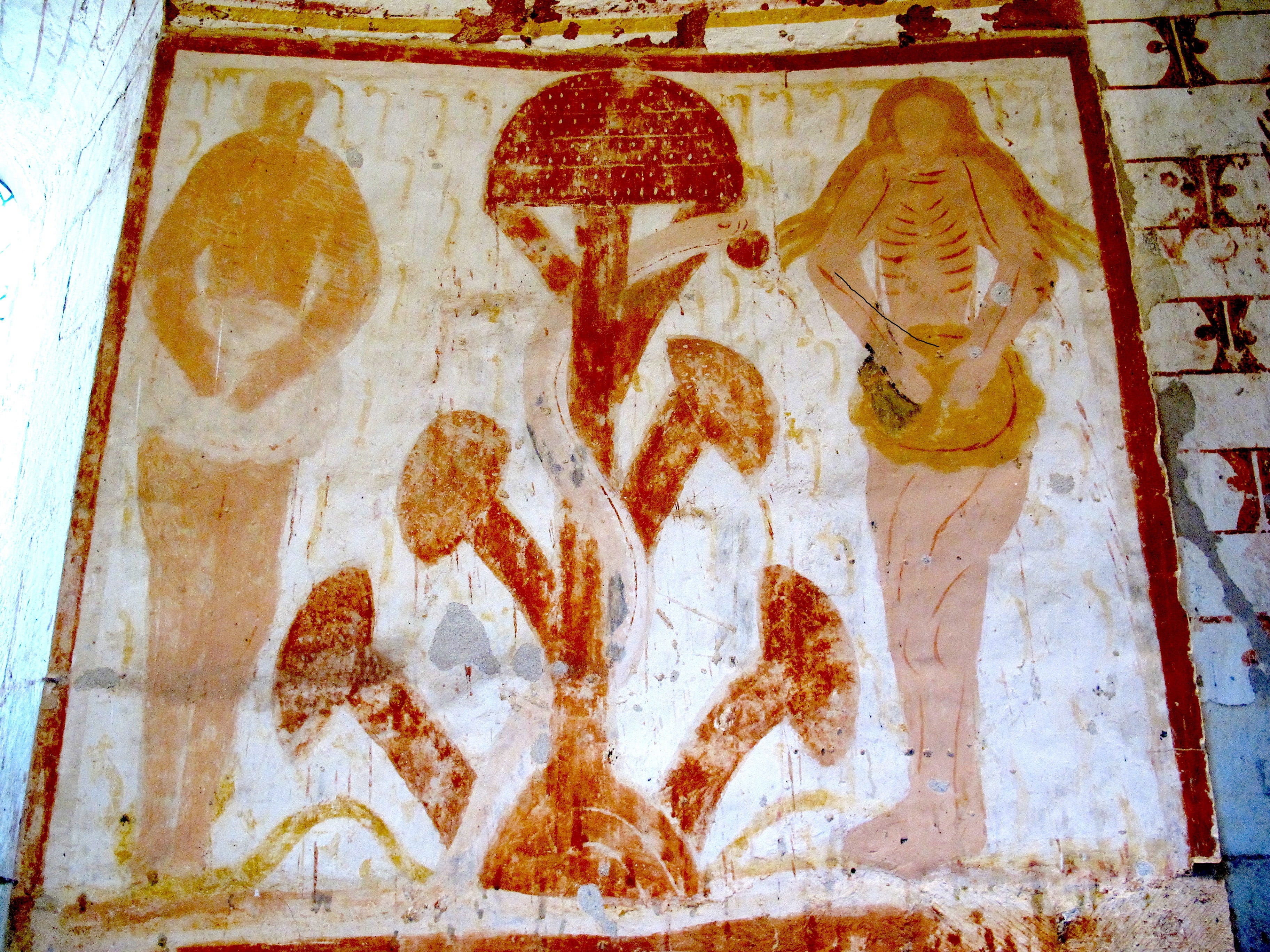
A Romanesque chapel in Merigny, in central France, has a fresco of the Garden of Eden where the Tree of Knowledge looks less like a tree and more like a mushroom, its cap round and red like a fly agaric.
In 1970 the biblical scholar John Marco Allegro used this fresco to argue that early Christianity grew out of a hallucinogenic mushroom cult. The theory made headlines and then collapsed under criticism. R. Gordon Wasson, the leading authority on sacred mushrooms at the time, dismissed Allegro's reading in public, and most art historians today treat the fresco as a stylized medieval tree, not proof of a secret cult.
2. Otto Marseus van Schrieck, forest floor still life (1671)
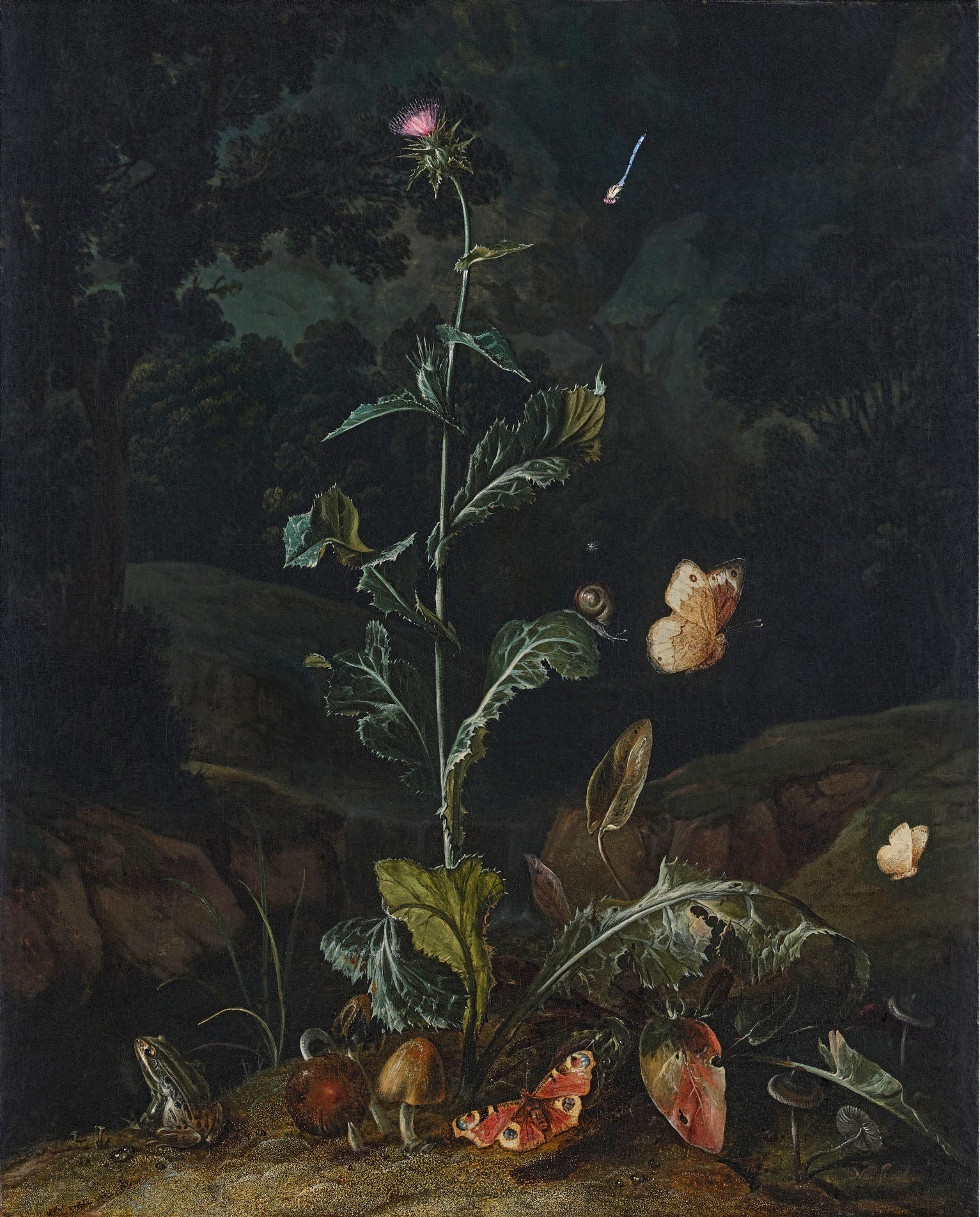
Van Schrieck built his reputation on sottobosco, the forest floor still life, a genre he is generally credited with inventing. His pictures put snakes, toads, butterflies and mushrooms on the same patch of dark undergrowth, close enough to touch.
He kept live snakes and lizards in an enclosure behind his house in Amsterdam so he could paint them from life, which earned him the nickname Snuffelaer, roughly the Sniffer. The mushrooms in his forest floors sit inside the same still life tradition I trace further back in who painted the first still life.
3. Richard Dadd, The Fairy Feller's Master-Stroke (1855 to 1864)
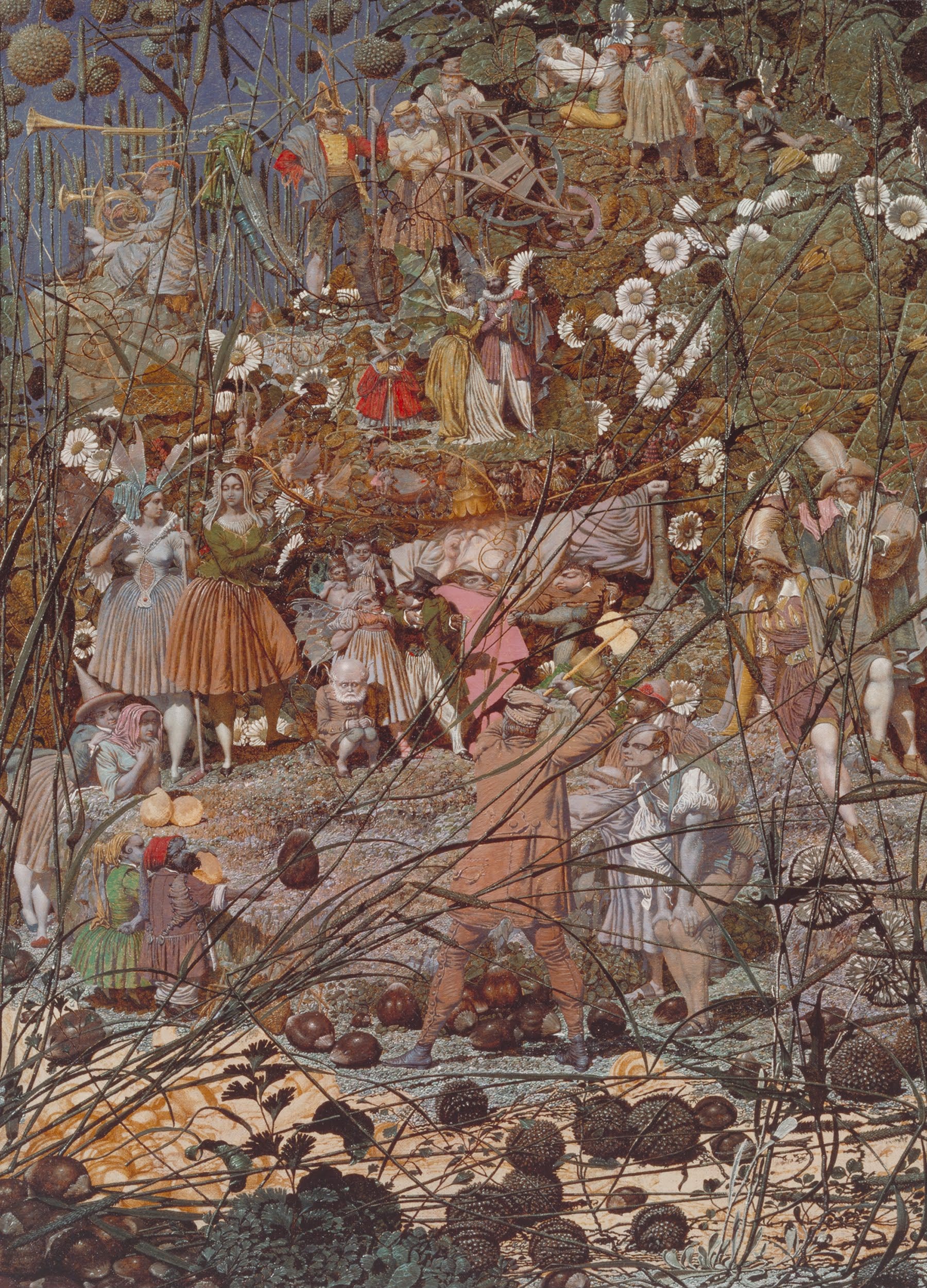
Dadd painted this picture while confined at Bethlem Royal Hospital, after killing his father in 1843 under the delusion that he was the devil. He worked on it for roughly nine years, packing the canvas with grass blades, hazelnuts, daisies and fungi rendered in obsessive, near microscopic detail.
A restorer who later copied the work noted the rust colored cap of a fungus reused as a highlight on a fairy's wing, one small sign of how densely Dadd cross referenced his own invented world. The painting now hangs at Tate Britain.
4. John Anster Fitzgerald, The Intruder (around 1860)
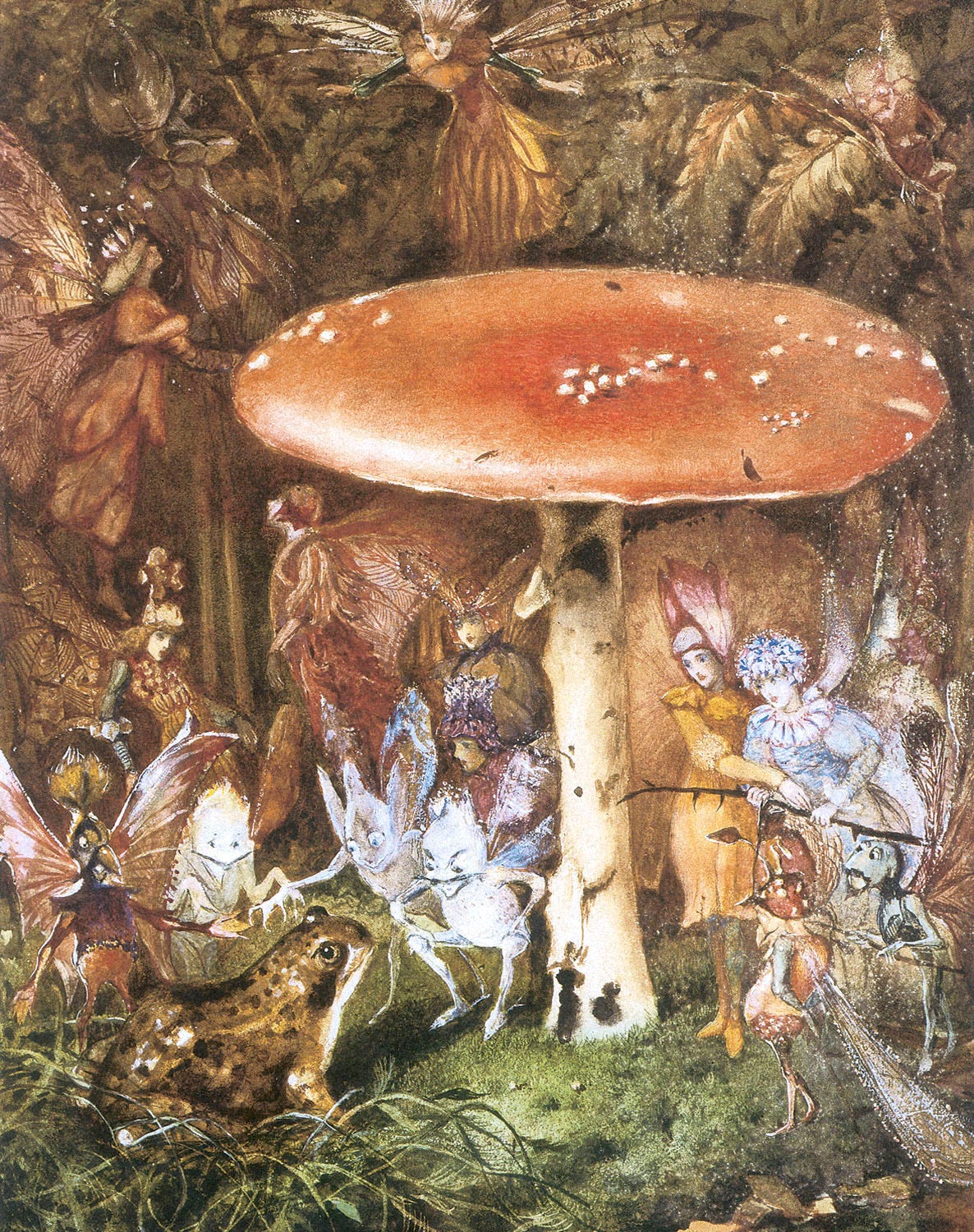
Fitzgerald painted fairies obsessively, enough that Victorians nicknamed him Fairy Fitzgerald. In The Intruder, a fly agaric mushroom, its cap the size of a dinner plate next to the tiny figures around it, sits at the exact center of the composition.
The mushroom is not decoration here. It is the stage the fairies gather on, which is exactly how English folklore used fungi: a ring of mushrooms marked the spot where the fair folk had supposedly danced overnight. The painting is now at the Chazen Museum of Art in Wisconsin.
5. John Tenniel, the Caterpillar on a mushroom (1865)
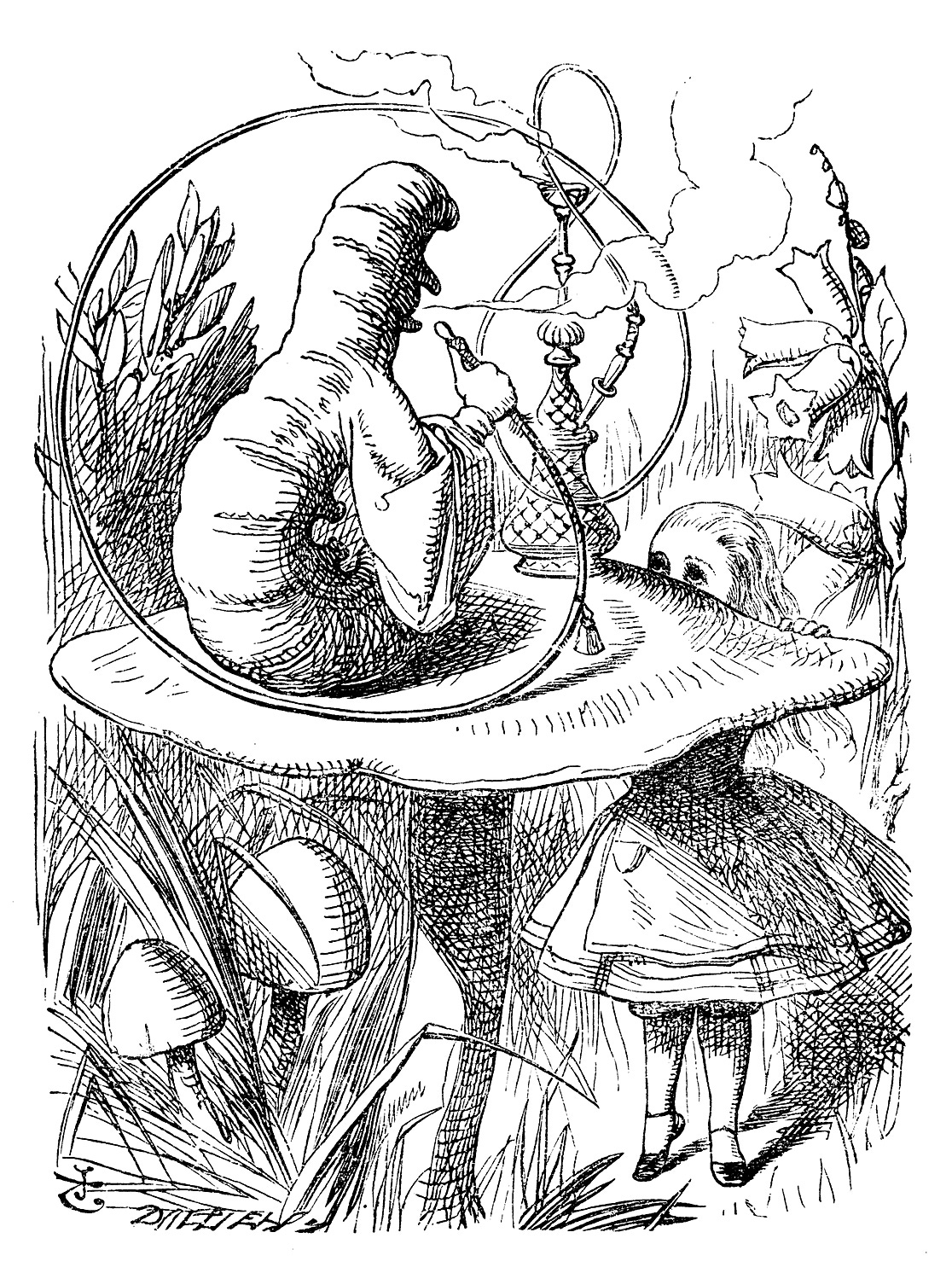
Tenniel's illustration for Alice's Adventures in Wonderland shows the hookah smoking Caterpillar seated on a mushroom, one side of which will make Alice grow and the other shrink. The engraving is deliberately ambiguous: read the caterpillar's face as a human profile, or as the head end of an actual caterpillar with its true legs showing further down its body.
It is one of the most reproduced illustrations in English publishing, still printed in nearly every edition of the book more than a century and a half later.
6. Mizuno Toshikata, Mushroom Gathering (1891)
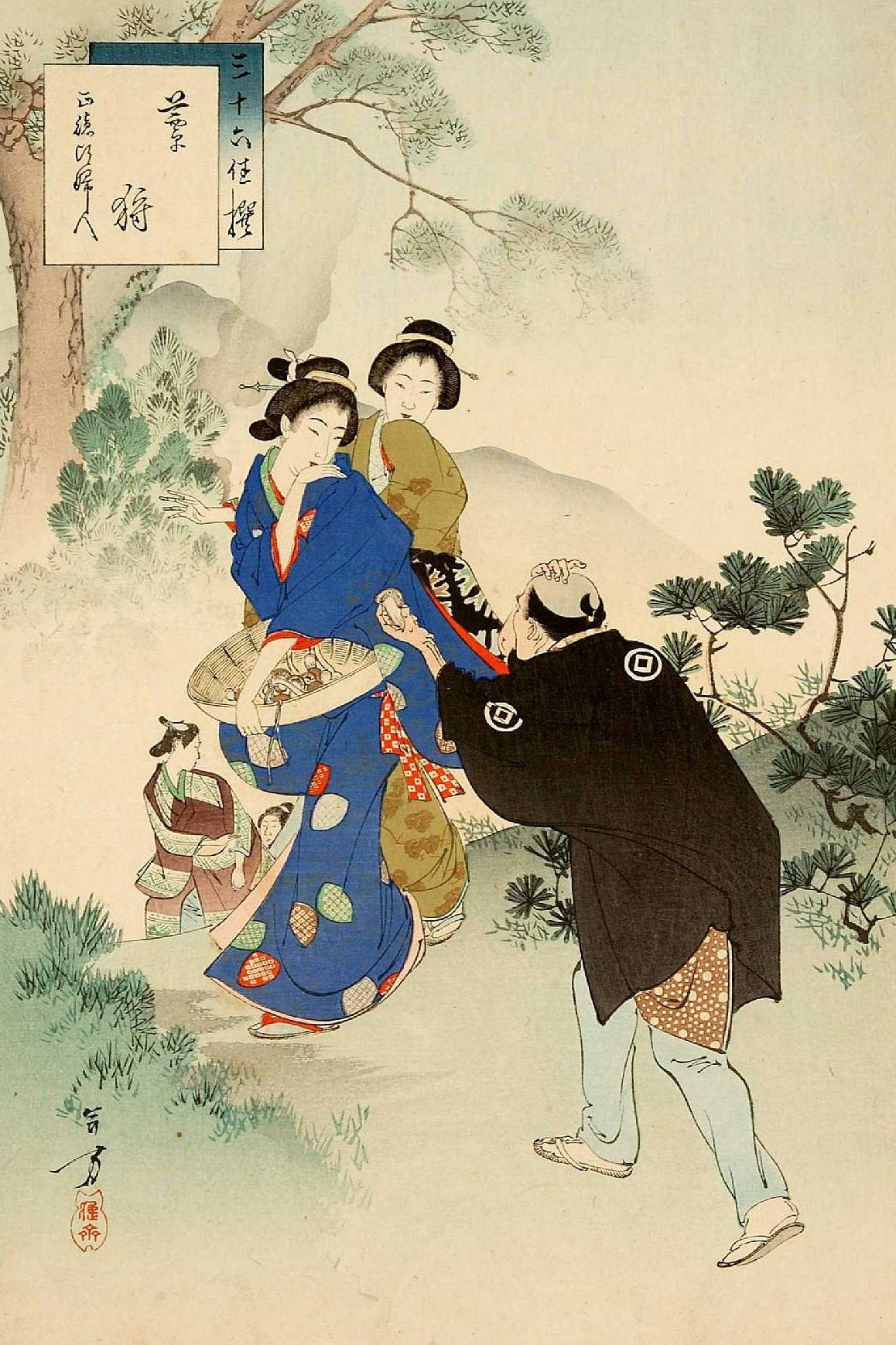
This woodblock print belongs to Toshikata's series Thirty Six Selected Beauties, each sheet showing women from a different era of Japanese history doing an everyday activity. This one places women from the Shotoku era, in the early 1700s, gathering mushrooms in an autumn wood.
Mushroom hunting was, and still is, a genuine seasonal pastime in Japan, tied especially to matsutake season. Toshikata treats it the way Western painters treated haymaking or the grape harvest: not folklore, just a recognisable, dignified slice of daily life.
7. Beatrix Potter, mycological studies (1890s)
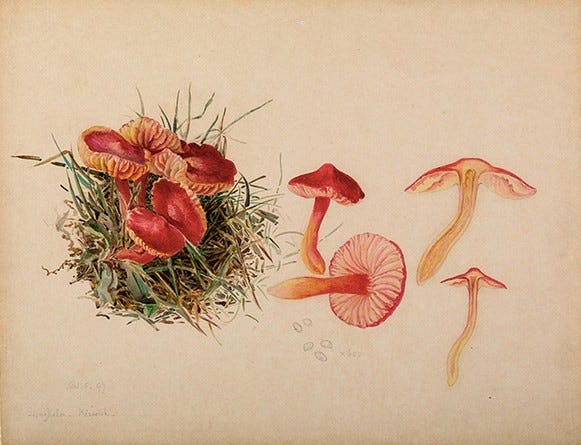
Before she wrote Peter Rabbit, Potter spent the 1890s painting fungi with the eye of a scientist, producing hundreds of watercolors accurate enough that mycologists still consult them today. One of them, showing the species Amanita aspera, is now held by the Victoria and Albert Museum as part of the Linder Bequest.
Potter developed her own theory of how fungal spores germinate and had it presented to the Linnean Society of London in 1897. She could not read the paper herself or attend the session, because the society did not admit women at the time.
8. Ernst Haeckel, Kunstformen der Natur, plate 63 (1904)
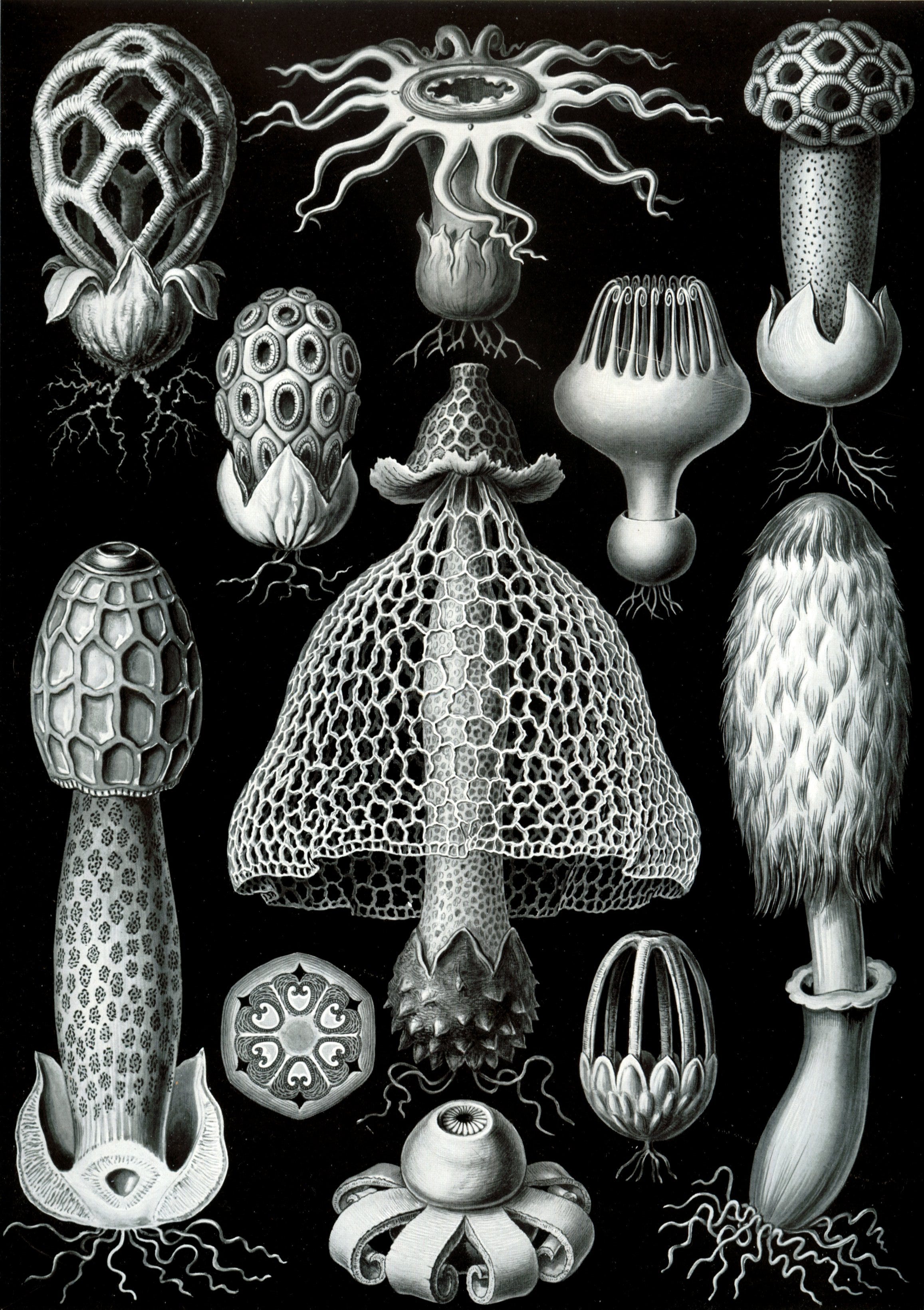
Haeckel was a biologist first, and his plate of Basidiomycetes fungi, lithographed by Adolf Giltsch from his sketches, arranges stinkhorn like species in the same symmetrical, near ornamental grid he used for jellyfish and radiolarians elsewhere in the book.
Kunstformen der Natur was aimed at scientists, not artists, but Art Nouveau designers including Emile Galle and Rene Binet borrowed its patterns directly, one of the more direct lines running from a biology textbook straight into decorative art history.
9. Arthur Rackham, fairies on mushrooms, from Peter Pan in Kensington Gardens (1906)
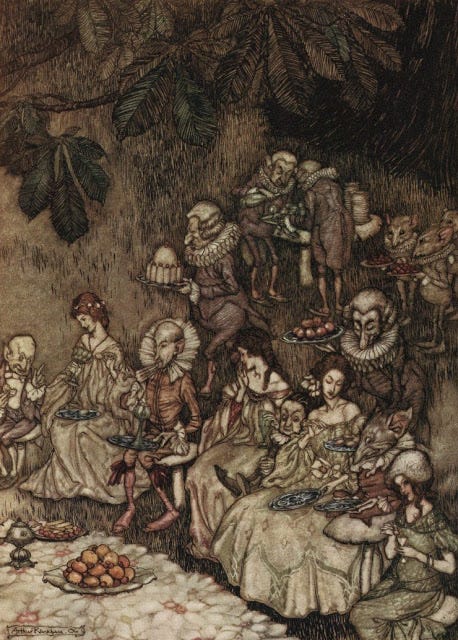
Rackham illustrated this scene of fairies seated in a ring of mushrooms for J. M. Barrie's Peter Pan in Kensington Gardens, using the ink and watercolor style that made him the best known fairy tale illustrator of the Edwardian period.
The image leans on the same folklore Fitzgerald used decades earlier: mushrooms growing in a circle overnight, taken as evidence that fairies had held a dance there. Rackham drew that belief literally, fairies sitting on the very rings that supposedly proved they existed.
10. Yayoi Kusama, Mushrooms (1995)
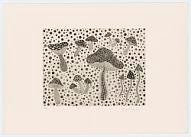
Kusama's etching Mushrooms, now held by the Smithsonian's National Museum of Asian Art, turns the fungus into her signature repeated, dotted form, the same visual language she uses for pumpkins elsewhere in her work.
Kusama has spent decades describing hallucinations she began having as a child, in which patterns seemed to multiply and swallow the room around her. I go further into her life and the rest of her work in her complete story.
Where to see these mushroom paintings today
Most of these works are on public display, a few only occasionally.
The Fairy Feller's Master-Stroke, by Richard Dadd: Tate Britain, London.
The Intruder, by John Anster Fitzgerald: Chazen Museum of Art, Madison, Wisconsin.
Mushrooms, by Yayoi Kusama: Smithsonian's National Museum of Asian Art, Washington DC.
Mycological studies, by Beatrix Potter: Victoria and Albert Museum, London, as part of the Linder Bequest.
Forest floor still lifes, by Otto Marseus van Schrieck: spread across the Rijksmuseum, the Uffizi and other Dutch and Italian collections, since he painted the subject many times.
Questions I get asked about mushrooms in paintings
Why do so many fairy paintings include mushrooms? European folklore already linked mushroom rings to fairy dances, so painters who wanted to paint fairies had a ready made stage to put them on.
Is the Plaincourault fresco really about a mushroom cult? Most historians say no. The theory came from one writer in 1970 and was rejected in public by the leading mycologist of the time, though a small number of researchers still defend versions of it.
Did Van Gogh paint mushrooms? Not in any surviving work I have found. His still lifes favor sunflowers, potatoes and shoes over fungi.
What is the most famous mushroom in art history? Tenniel's 1865 Caterpillar seated on a mushroom for Alice in Wonderland is probably the most reproduced single image of a mushroom in Western art.
Why did Beatrix Potter stop painting mushrooms? She kept painting them privately for years, but after the Linnean Society dismissed her spore research and she found success writing for children instead, illustration for a wider audience took over her time.
Are any of these mushroom species actually dangerous? Several are. The fly agaric painted by Fitzgerald and Rackham is toxic and mildly hallucinogenic if eaten, part of why it became folklore shorthand for a doorway into a fairy world.
You Might Also Like


The mushroom that outlasted the argument about it
Every register in this list still gets used today. Illustrators still put fairies on toadstools. Natural history museums still commission accurate fungal illustration. Contemporary artists like Kusama still reach for the mushroom shape to talk about altered perception. The fungus keeps reappearing across other eras too, in twelve more famous mushroom artworks worth a look.
The Plaincourault fresco is the one that keeps outliving its own argument. Allegro's theory about it was rejected within a few years of its 1970 publication, by his own field. More than fifty years later, the fresco itself is still on the chapel wall in Merigny, and visitors still stop to decide for themselves whether they are looking at a tree or a mushroom.