Music and Dance in Painting: A Guide to Sound and Movement

Painting has no sound and no motion, yet painters keep chasing both. A lute mid strum, a ballerina caught between two positions, an orchestra frozen at the downbeat. Titian, Caravaggio, Vermeer, Botticelli, and Degas each solved the same impossible problem differently.

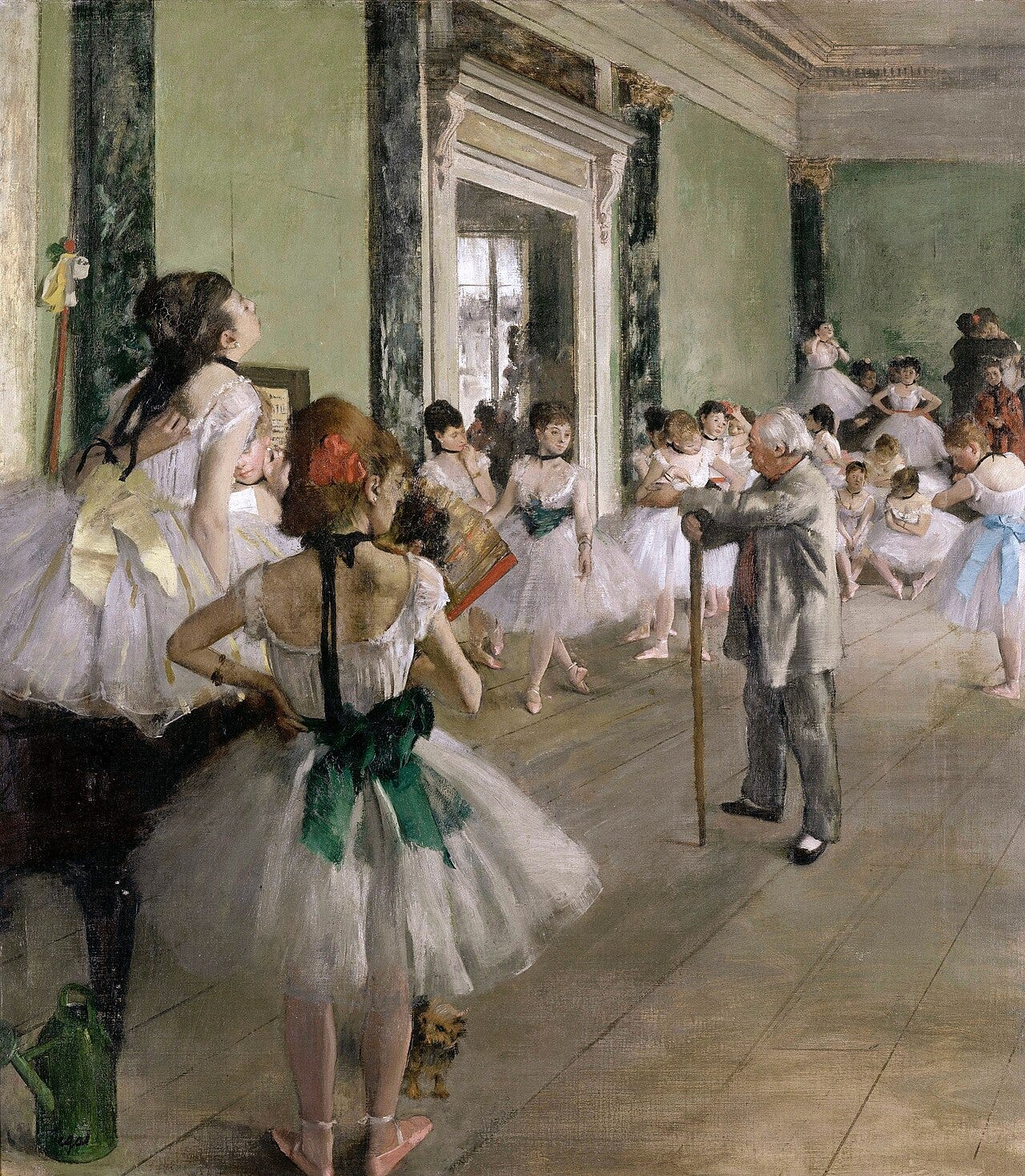
Degas's Dance Class, young ballerinas waiting while an old ballet master leans on his cane
Edgar Degas, The Dance Class, 1873 to 1876, Musee d'Orsay, Paris

In 1888, Edgar Degas told a friend that people called him the painter of dancers without understanding that what interested him was movement itself, not the tutus.

That line explains more than his own work. Painters have spent centuries trying to trap two things a flat canvas cannot hold: a note and a step. Music passes. Dance passes faster. Both are gone before the eye can finish looking.

The workaround was always the same trick, told three different ways. Freeze the instant just before the sound, or just after the step, and let the viewer's memory of real music and real dance fill in what paint cannot.

This page maps three ways painters played that trick. A page on music as a subject in its own right, a page on musicians as portrait sitters, and a page on dance. Each has its own gallery of works. Here is why each one earned its place.

Music as a coded subject

Caravaggio's Lute Player, a young musician bent over strings and an open songbook
Caravaggio, The Lute Player, about 1596, State Hermitage Museum, Saint Petersburg

A musical instrument in a painting rarely stays an instrument for long.

Titian painted an organist turning away from his keyboard to stare at a reclining Venus, around 1550. The choice was the point. He had set up a debate about which sense wins, sight or hearing, and let the organist answer with his eyes instead of his hands.

Caravaggio went further with The Lute Player, made around 1596 for the Roman collector Vincenzo Giustiniani. The notes on the songbook are a real madrigal about love, legible today, so the lute becomes a message aimed straight at whoever stands where the viewer stands.

The full page on famous music paintings walks through twelve of these works, from a single Baroque lute to a Degas orchestra pit crowded with black coats and brass.

Musicians as sitters, not scenes

Vermeer's Guitar Player, a young woman turned half away as if someone just entered
Johannes Vermeer, The Guitar Player, about 1672, Kenwood House, London

A separate tradition treats the musician as a portrait subject first, the instrument second.

Vermeer's The Guitar Player, painted around 1672, catches a young woman turned half away, smiling, as if someone has just walked into the room. It hangs at Kenwood House in London today, though it spent time in 1974 stolen from that same house and held for ransom before turning up in a churchyard.

Caravaggio's musicians reappear here too, this time as psychological studies rather than allegory: a soft faced boy lit by one hard beam, singing from a score the viewer can almost read over his shoulder.

The page on famous paintings of musicians collects twelve of these sitters, including Judith Leyster's Boy Playing the Flute, a work sold for centuries under Frans Hals's name until a scholar spotted her star shaped monogram in 1893.

New here? Learn art the fun way. Free stories every week, no boring lectures.

Dance, the subject that cannot hold still

Botticelli's Primavera, the Three Graces turning together in a garden of flowers
Sandro Botticelli, Primavera, about 1480, Uffizi Gallery, Florence
Matisse's Dance, five red figures circling in a ring on flat blue and green ground
Henri Matisse, Dance, 1910, Hermitage Museum, Saint Petersburg

Dance asks more of a painter than music does, because a dancer's whole point is to keep moving.

Degas answered by refusing to paint performance at all. The Dance Class, worked on between 1873 and 1876, shows a room of young ballerinas waiting while the aging ballet master Jules Perrot leans on his cane. Nobody dances in it. The exhaustion is the subject.

Henri Matisse answered differently a generation later. His Dance, painted in 1909 and now at the Museum of Modern Art in New York, strips five figures down to flat red bodies circling on blue and green, no faces, no detail, only the shape of the turn. He painted a second version in 1910, now in the Hermitage in Saint Petersburg, for the Russian collector Sergei Shchukin.

Between Degas's tired dressing room and Matisse's flat red ring sits most of what painting can do with a moving body: study it exactly, or reduce it to a single gesture repeated five times.

The page on famous dance paintings gathers twelve works across that range, from Botticelli's Three Graces turning in Primavera to Bruegel's stamping peasants and Degas's own tired ballerinas.

Frequently asked questions

Bruegel's Peasant Dance, villagers stamping their feet to music at an outdoor fair
Pieter Bruegel the Elder, The Peasant Dance, about 1567, Kunsthistorisches Museum, Vienna

Why did painters choose music as a subject so often?

An instrument let a painter argue about the senses without writing an essay. Titian used an organist looking away from his keys to debate sight against hearing around 1550. A lute with a broken string was also a common shorthand for pleasure that does not last, since a lute goes out of tune the moment it is set down.

Is there a difference between a music painting and a musician's portrait?

Yes. A music painting, like Caravaggio's The Musicians from 1597, stages an allegory, in that case Cupid disguised among tuning boys. A musician's portrait, like Vermeer's The Guitar Player from around 1672, treats the sitter as a person caught mid gesture, closer to a snapshot than a symbol.

Why is Degas associated with dance more than any other painter?

Degas painted dancers obsessively, but he was not interested in ballet as spectacle. The Dance Class, from 1873 to 1876, shows the waiting and the fatigue behind a rehearsal rather than a performance. He treated the ballet the way a photographer treats a backstage pass, going for what an audience never sees.

What makes Matisse's Dance different from earlier dance paintings?

Matisse stripped away everything Degas kept. His 1909 Dance, at the Museum of Modern Art, and the 1910 version at the Hermitage show five red bodies with no faces, turning in a ring against flat color. Where Degas documented real dancers in real rooms, Matisse reduced the dance to pure rhythm, closer to Poussin's allegorical ring of dancers in A Dance to the Music of Time than to any ballet class.

Did painters ever combine music and dance in one scene?

Often. Nicolas Poussin's A Dance to the Music of Time, painted around 1634 to 1636, has four allegorical figures dancing in a ring while a winged old man plays a lyre and keeps the beat. The lyre is what makes the dancers move at all, in the same way a lute or an organ drives the mood in a pure music painting.

Closing

Poussin's allegorical dancers turning in a ring while an old man plays a lyre
Nicolas Poussin, A Dance to the Music of Time, about 1634 to 1636, Wallace Collection, London

Caravaggio painted The Lute Player around 1596 for Vincenzo Giustiniani, and reportedly called it one of the finest pieces he ever made.

Enjoyed this? Join the readers who learn art the fun way, free every week.

The Giustiniani collection reached the Hermitage in 1808, by way of the director of the Louvre. A painted love song about a lute has been hanging in Saint Petersburg for over two hundred years.

Related reading