
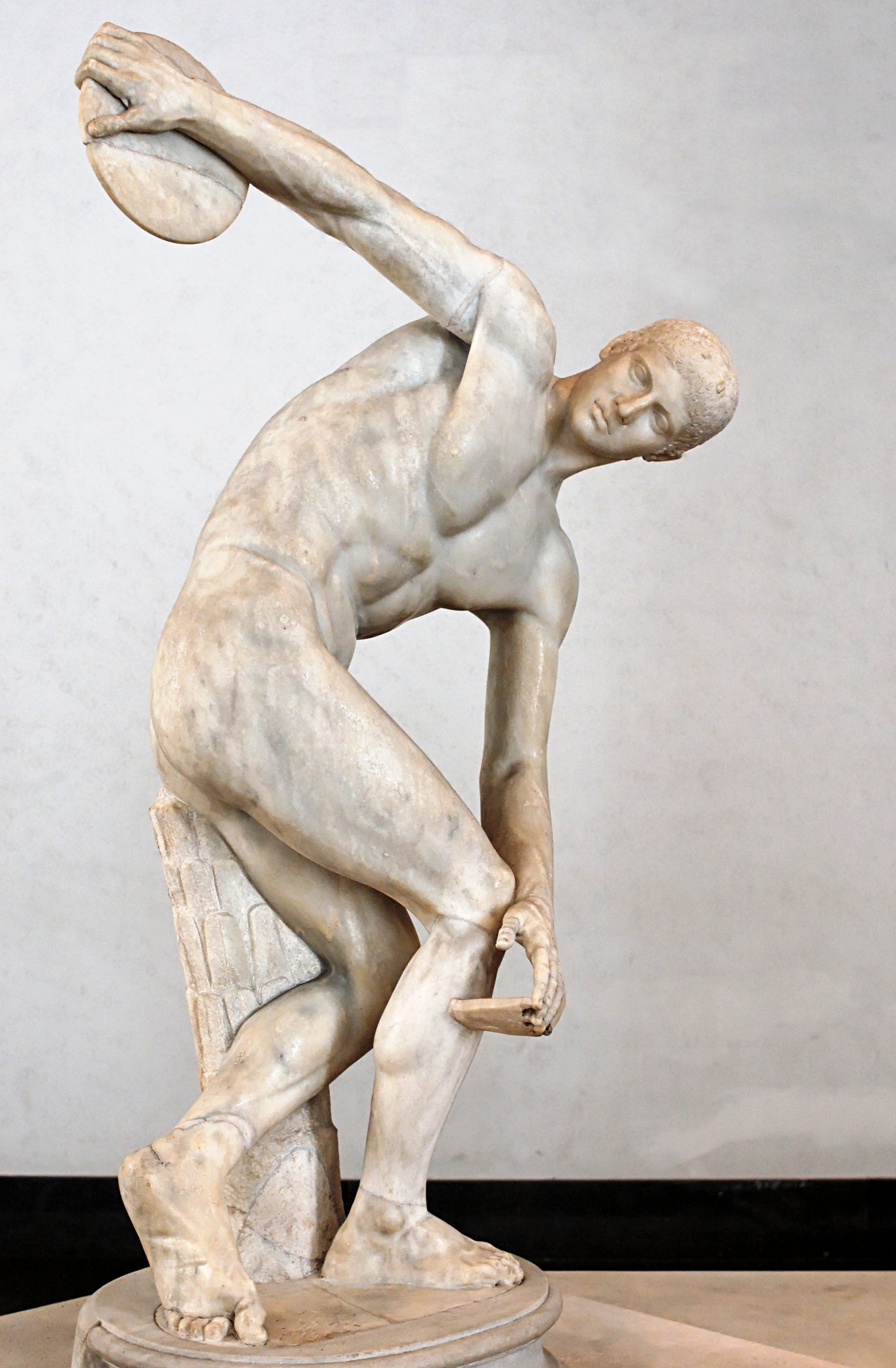
Myron was a Greek sculptor from the region of Athens who worked in bronze around 470 to 440 BC. He is famous for the Discobolus, or Discus Thrower, a nude athlete caught at the instant before his throw.
Cool Stories About Art is a newsletter to learn art the fun way.
Join 200,000+ readers and get:
10 new art stories / month
The entire archive of content (140+ articles)
Comment, ask questions, and chat with other readers
Greek writers admired Myron for bronzes that looked alive, and for centuries after his death, poets kept writing short poems about a bronze cow he made. Yet not one of his bronzes has survived, and no ancient writer recorded when or where he died.
Myron was born at Eleutherae, a small town in the mountains on the road from Athens to Boeotia, the region to the north. The town came under the rule of its powerful neighbor, Athens, and Greek writers later called the sculptor Myron the Athenian.
Myron worked almost only in bronze. The molten metal was poured into molds, and the cast pieces were joined into one hollow statue. Bronze is strong for its weight, so a bronze figure could stretch out an arm or lift a foot without breaking.
Many of Myron's statues showed athletes who had won at the Olympic Games, held every four years at Olympia, the sanctuary of Zeus, king of the gods. Bronze statues of the winners were set up there.
Around 450 BC, Myron cast his most famous statue: a young athlete throwing the discus, a heavy disk of bronze or stone. Discus throwing was one of the five events of the pentathlon, the all-around contest of the Greek games.
The athlete bends forward, his weight on his right foot. His right arm swings the discus high behind him, and his head turns back to follow it. An instant later, the whole body will uncoil and the discus will fly. Yet his face shows no strain at all.
Like nearly all Greek bronzes, Myron's athlete was eventually lost. Bronze was valuable, and over the centuries old statues were melted down so that the metal could be used again.
Even so, several ancient copies of the athlete have been dug up in Italy, and they do not agree. On one, the head looks back toward the discus. On another, it looks down at the ground.
With the bronze gone, how did anyone find out which of the copies showed the athlete exactly as Myron made him?
In the rest of the story
What a bull did, according to ancient poets, when it met Myron's bronze cow.
How a ghost story told for laughs settled the mystery of the head.
Who bought the most complete Discus Thrower in 1938, against Italy's own experts.
Why Italy gave the American people a Discus Thrower in 1956.