Napoleon Crossing the Alps: The Propaganda vs the Mule
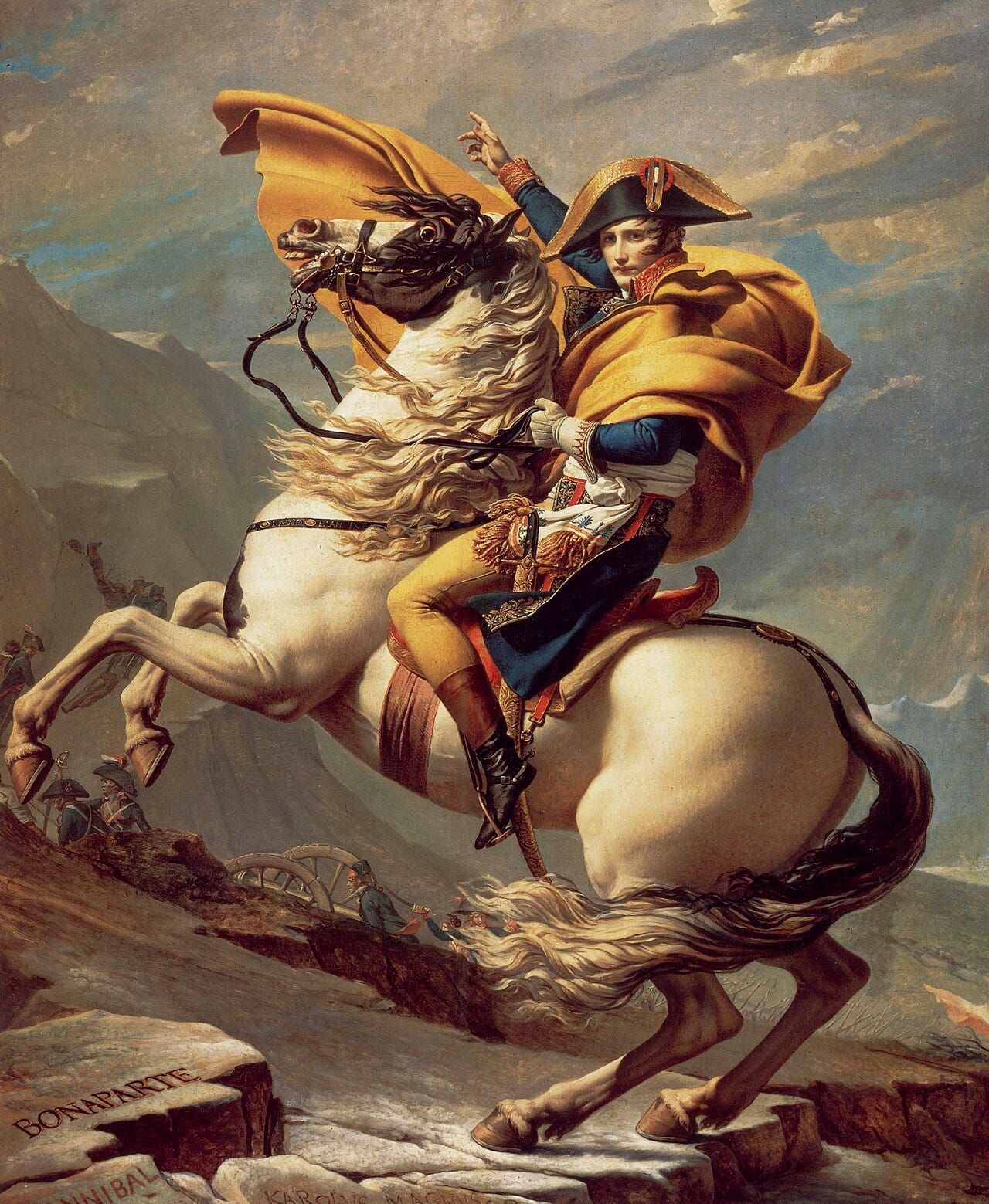
Napoleon Crossing the Alps is an 1801 painting by Jacques Louis David. It shows Napoleon on a rearing horse, calm in a storm, leading his army over the mountains.
Almost none of it is true. He crossed days behind his troops, in fair weather, on a mule.
It is the most famous piece of political image making in Western art, and it worked. Here is what really happened, why Napoleon refused to sit for it, and how two later artists answered it.
The propaganda, painted to order
David painted this in about four months, between late 1800 and early 1801, to celebrate Napoleon leading French troops over the Great Saint Bernard Pass in May 1800 and the victory at Marengo that followed.
Napoleon points up the mountain, cloak flying, while his men haul cannon in the sleet behind him. Carved into the rock at his feet are three names: Bonaparte, Hannibal, Karolus Magnus.
He is placing himself in a line with Hannibal and Charlemagne, the only other commanders who had brought an army across these Alps.
The commission did not even come from Napoleon. It came from Charles the Fourth, king of Spain, for a gallery of great military leaders. Napoleon was so pleased with the result that he ordered three more versions.
Calm on a spirited horse
Napoleon refused to pose. He told David that nobody knew whether the portraits of great men resembled them, and that it was enough for their genius to live in the picture. His only instruction was that he be shown calm on a fiery horse.
So David worked from an earlier likeness and from the uniform Napoleon had worn at Marengo, which he sent over. For the pose, one of David's own sons climbed onto a ladder and held still, which is part of why the face looks so young and smooth.
The horse, the storm, the outflung arm are all invention. David signed his own name on the horse's breastband. Napoleon later made him First Painter to the Emperor, in 1804.
What the crossing was actually like
Strip away the paint and the scene collapses. Napoleon did not lead the charge over the pass; he came across two days after the bulk of his army, once the route was secured.
The weather was mild, not a blizzard. And he made the climb not on a rearing stallion but on a sure footed mule, led by a local guide, because a mule is what you take over an icy mountain track when you would prefer to arrive alive.
David knew this. The point, and this is what I find sharpest about the picture, was never accuracy. The point was to turn a careful, sensible general into a force of nature, and for two centuries the painting has been better remembered than the crossing it describes.
The two artists who answered back
In 1850 the French painter Paul Delaroche painted the same event honestly: Napoleon wrapped against the cold, slumped and tired, on the actual mule, led by a guide up a narrow path.
It is the same man on the same day, and it looks nothing like a hero.
Then in 2005 the American artist Kehinde Wiley repainted David's picture with a young Black man in modern streetwear on the rearing horse, against a wallpaper of gold.
Wiley kept the pose exactly and changed who gets to occupy it, asking who is allowed to be painted as a hero. His version now hangs in the Brooklyn Museum, and it made David's original an argument all over again.
Five versions, and not one for sale
There is no single original. David made five versions of Napoleon Crossing the Alps between 1801 and 1805, nearly identical. Two are at Malmaison and Versailles near Paris, one is at Charlottenburg in Berlin, one at Belvedere in Vienna, and one remained in the family.
They do not come up for sale, since all five sit in public collections. The one most people picture, with the orange cloak, is the first, painted for the king of Spain.
What the real crossing was for
The theatrics hide a genuine gamble. In May 1800, months after seizing power, Napoleon marched an army over the Great Saint Bernard Pass while the snow was barely gone, to drop unexpectedly behind the Austrians in Italy.
It nearly failed, then paid off at the battle of Marengo on the 14th of June, a narrow win that secured his new government at home.
That is the real subject under the cloak and the storm: not a mountain crossing but the moment a young general turned a risky march into the political capital that made him master of France. The painting sells the bravado and quietly buries the luck.
The painter who fell with his hero
David tied his fate to Napoleon and went down with him. Named First Painter to the Emperor in 1804, he painted the coronation and the imperial myth for a decade.
When Napoleon fell for good after Waterloo in 1815, David, a regicide who had voted the king's death, chose exile rather than live under the restored monarchy.
He settled in Brussels, the same city where his Death of Marat had come to rest, and died there in 1825, struck by a carriage. For years his grand Napoleonic pictures were an embarrassment nobody wanted; only later did they become the definitive image of the age.
Napoleon Crossing the Alps, quick answers
Who painted Napoleon Crossing the Alps? Jacques Louis David, in 1801, on a commission from King Charles the Fourth of Spain.
Is the painting realistic? No. It is propaganda. Napoleon crossed two days behind his army, in mild weather, on a mule, not a rearing horse in a storm.
Did Napoleon pose for it? No. He refused, saying a portrait only needed to capture a man's genius. David used an old likeness and posed his own son on a ladder.
What are the names carved in the rock? Bonaparte, Hannibal and Charlemagne, the three commanders said to have led armies over the Alps.
Where is Napoleon Crossing the Alps? There are five versions, at Malmaison, Versailles, Charlottenburg in Berlin, and the Belvedere in Vienna, plus one held privately.
If this painting pulled you in, you will love these too:
Titian, Sacred and Profane Love, which of the two women is which
Twelve famous portraits and the real people, the faces behind the paintings
The Last Supper, detail by detail, the detail hiding at that table
The mule that history forgot
Napoleon understood the painting perfectly. He never claimed the crossing had looked like this; he simply let the picture do the work the truth could not.
The real mule was led over the pass by a guide named Pierre Nicholas Dorsaz, whom Napoleon ordered paid twelve hundred francs for the day, a sum said to be enough to buy a house.
Strip the picture down and the whole legend rests on a borrowed mule and a hired guide almost no one has heard of.
You can see Napoleon Crossing the Alps in person at the Belvedere in Vienna. For more by the artist, browse the Metropolitan Museum collection.
What people ask about Napoleon Crossing the Alps
Who painted Napoleon Crossing the Alps? The French Neoclassical painter Jacques Louis David, who made the first version in 1801.
How many versions are there? There are five, painted by David and his studio between 1801 and 1805. They differ mainly in the color of the cloak and horse.
Is the painting historically accurate? No. Napoleon actually crossed the Alps a few days behind his army, in fair weather, riding a mule led by a local guide. David turned that into a heroic image on a rearing horse.
Where are the paintings today? The versions are spread across museums, including the Chateau de Malmaison near Paris and the Belvedere in Vienna.
What is carved into the rocks? Three names in the foreground stones: Bonaparte, Hannibal and Karolus Magnus, which is Charlemagne. They tie Napoleon to the great commanders who crossed the Alps before him.