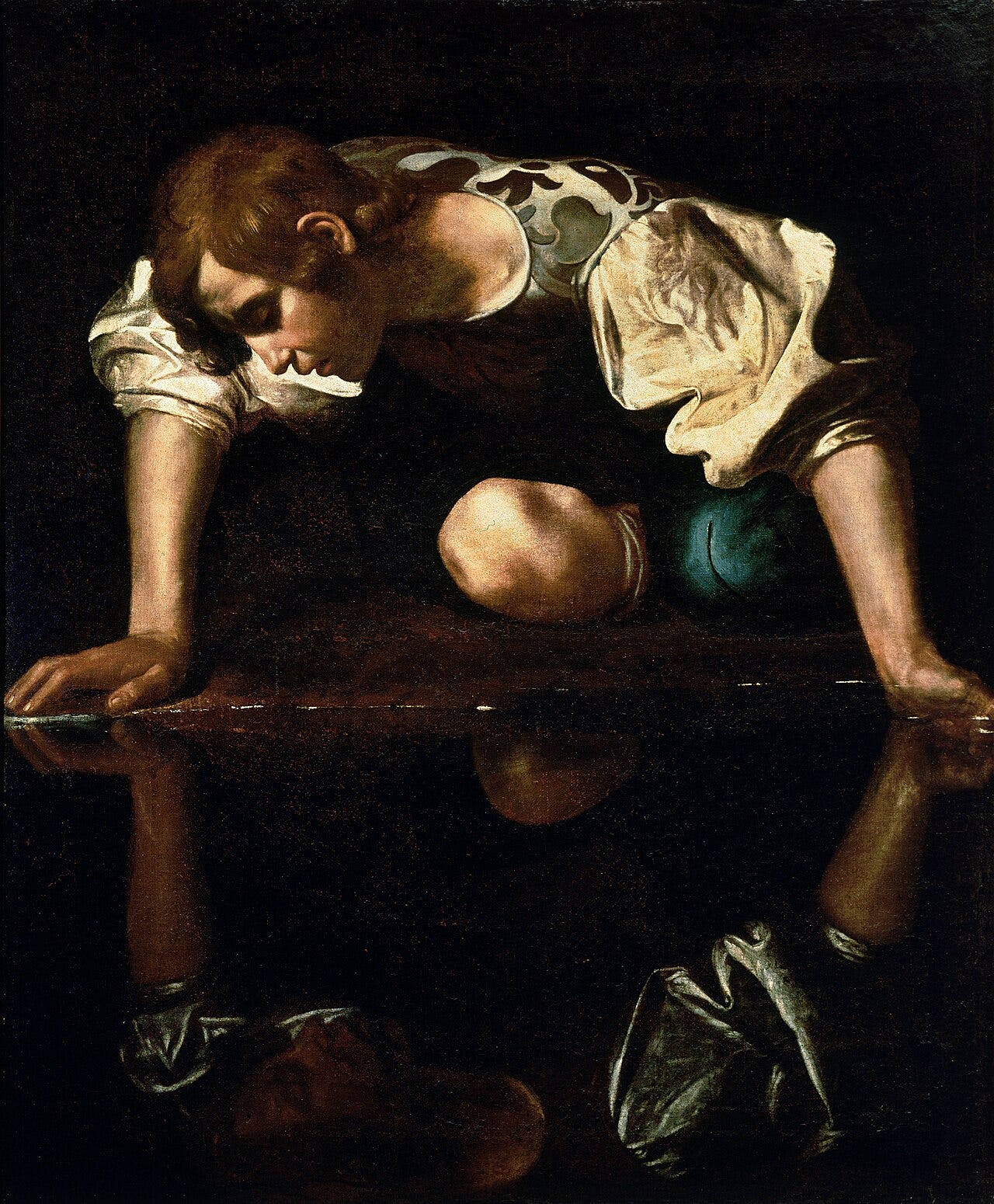
Take Caravaggio's Narcissus and turn it upside down. You get almost the same picture.
The lower half of the canvas, the reflection in the water, repeats the upper half, the young man himself, rotated 180 degrees. The painter did not just depict a boy looking at his reflection. He built the reflection the way a mirror would, by flipping the image.
Caravaggio's Narcissus, painted around 1597 to 1599 and held at the Galleria Nazionale d'Arte Antica in Palazzo Barberini, Rome, generates its reflection by repeating the upper half of the canvas upside down, locking the figure and his double into one closed circular loop.
That loop is the whole point. The composition performs the myth instead of illustrating it.
What Caravaggio Removed
Look at what is missing. No trees, no sky, no flowers, no Echo watching from the rocks. Around the kneeling figure there is near total darkness, with no background detail at all.
Every other element of the story has been cut. What remains is a young man and his own image, joined at the water line, arms and reflection forming a ring with nothing outside it.
That absence changes the reading. In Ovid, Narcissus is surrounded by a world he ignores: a nymph who loves him, admirers he rejects, a landscape he no longer sees. Caravaggio paints the ignoring itself. There is no outside world on this canvas, not even a witness.
It is the myth reduced to its psychological core. Self obsession as a sealed room.
Waterhouse Paints the Opposite Picture
Three centuries later, John William Waterhouse chose everything Caravaggio had thrown out.
Echo and Narcissus, painted in 1903 and held at the Walker Art Gallery in Liverpool, shows Narcissus stretched at the edge of a pool, absorbed in his reflection. Among the rocks and flowers nearby sits the nymph Echo, watching him.
She cannot speak first. Hera cursed her to only repeat the words of others, so she waits for a sentence that will never come.
Where Caravaggio sealed the loop, Waterhouse opens the scene. The tragedy here is not the boy alone with his image. It is the person a few feet away who loves him and has no way to say so.
The Myth Behind Both Paintings
Narcissus was the son of the river god Cephissus and the nymph Liriope. The blind prophet Tiresias predicted the boy would live a long life "if he never knows himself," a warning that self recognition would be fatal.
Echo fell in love with him, could not declare it because of her curse, and was rejected. In Ovid's version, a scorned admirer then invoked the goddess Nemesis, who cursed Narcissus to fall in love with his own reflection in a pool.
He could not leave it. He died there, or in some tellings wasted away and was transformed into the narcissus flower, which in Greek tradition still grows near water.
Tiresias was right. The moment Narcissus finally knew himself, he was finished.
How to Recognize a Narcissus Scene
The core signal is simple: a young man gazing down at still water.
If a female figure watches from a distance without approaching, that is Echo, and the painter is telling the love story. Her distance is not shyness. It is the curse, made visible as empty space between two bodies.
If narcissus or daffodil type flowers appear near the pool, the painter is pointing at the ending, the transformation into the flower. Waterhouse includes them. Caravaggio includes neither flowers nor Echo, which is exactly what makes his version unusual.
Count what is in the frame and you know which part of the story you are looking at.
Quick Answers
Where can I see Caravaggio's Narcissus? At the Galleria Nazionale d'Arte Antica in the Palazzo Barberini, Rome. The painting is an oil on canvas dated to around 1597 to 1599.
Where is Waterhouse's Echo and Narcissus? At the Walker Art Gallery in Liverpool, which purchased it in 1903, the same year Waterhouse painted it.
Is this where the word narcissism comes from? Yes. Modern psychology borrowed the name of the mythological figure to describe excessive self absorption. The clinical concept came much later, but the image behind it is the boy at the pool.
Why did Tiresias say Narcissus would live long "if he never knows himself"? In the myth, self recognition is the fatal event. Narcissus survives as long as he never truly sees himself. The moment he does, at the pool, he cannot pull away.
One Fact to Keep
The Walker Art Gallery in Liverpool bought Echo and Narcissus in 1903, the year Waterhouse finished it, and the painting has belonged to the museum ever since.