Nighthawks by Hopper: Meaning and the Diner With No Door
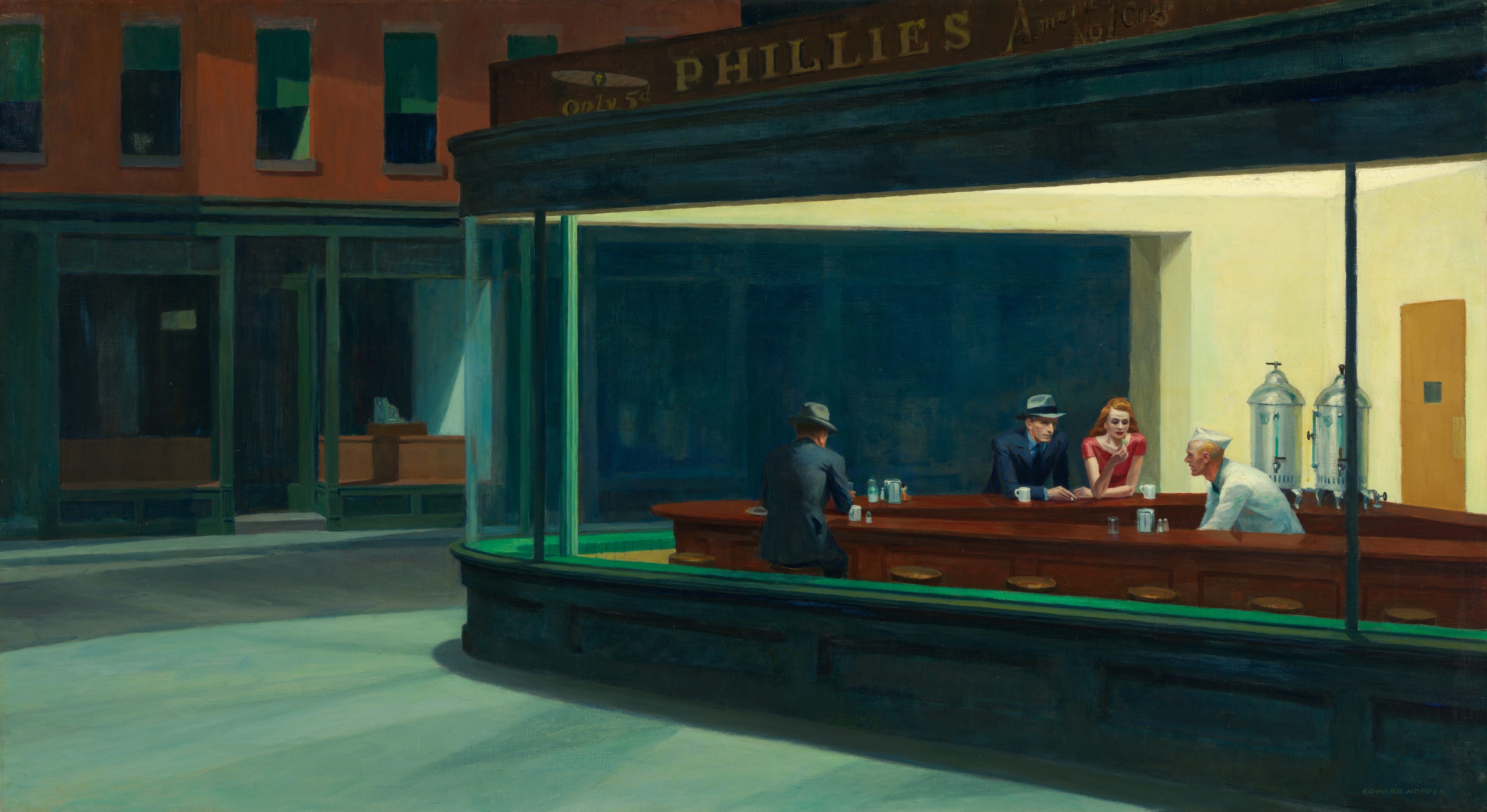
Nighthawks is a 1942 painting by Edward Hopper, in the Art Institute of Chicago. It shows three customers and a server inside a brightly lit late night diner, seen from the dark empty street.
Look closely and you notice the thing that makes it so uneasy: the diner has no door. There is no way in and no way out.
It is the most famous image of loneliness in American art. Here is what it means, why the diner is not a real place, and who the four silent people are.
The diner you cannot enter
A wedge shaped counter glows behind a huge curved window. Inside are four people: a man and a woman side by side, a second man alone with his back to us, and a server bent below the counter.
Outside, the street is deserted, the shops dark, the hour clearly very late.
The detail that unsettles everyone, once they see it, is that there is no door into the diner from the street. The glass wraps around with no visible entrance.
You are locked out, looking in at people who are sealed off from you and, somehow, from each other. Hopper never explained it, and it may not have been fully deliberate, but it is why the picture feels like a trap.
What Nighthawks means
Hopper resisted grand explanations. When pressed, he said that he had not especially set out to paint loneliness, but that, unconsciously, he was probably painting the loneliness of a large city.
That is the whole picture. Four people share a small bright box in the middle of the night and, this is the part that stays with me, not one of them looks at another.
The couple do not speak. The lone man is turned away. The city outside is empty. It is an image of being together and alone at the same time, the particular solitude of a modern city where you are surrounded by strangers, and it has spoken to every generation since.
A place that does not exist
People still search for the real diner, and there is nothing to find. Hopper said it was suggested by a restaurant on a corner in Greenwich Village in New York, where two streets met, but he simplified and invented freely.
The diner in the painting is an amalgam, a place built for a mood rather than copied from an address.
He finished it in January 1942, weeks after the attack on Pearl Harbor dragged America into the Second World War. The city was blacked out and anxious, and although Hopper began the picture before the attack, its emptiness caught the mood of a country suddenly at war.
The harsh light is worth noting too: this is one of the earliest paintings to capture the cold glare of the new fluorescent tube, a light that had only recently appeared.
Who are the people
They have no names and no story, and that is on purpose. But the models are known: Hopper posed for both men himself, working from his own reflection in a mirror, and his wife Josephine, a painter herself, posed for the red haired woman.
Jo also kept the household record book, and it is in her notes that the title appears. She wrote that one of the men had a beak like nose, a night hawk, and the phrase became the name of the painting.
So the couple at the counter are, in a sense, Edward and Jo Hopper, sitting in a diner that was never real, not speaking.
In Chicago, and its long shadow
Nighthawks has been in the Art Institute of Chicago since 1942, when the museum bought it within months of its completion, and it is one of the most recognized paintings in the country.
It is not for sale. Its composition has been borrowed, quoted and parodied endlessly, its four figures swapped for movie stars, cartoon characters and comic book heroes on posters and album covers, which is the surest measure of how deep it has sunk into the culture.
The light that drains the warmth
A late diner should be a haven. Hopper made this one feel like a specimen jar. The counter glows a hard, sour yellow green, the color of the fluorescent tube, which had only just started to light American interiors when he painted it.
It is often called one of the first paintings anywhere to catch that particular cold glare.
Everything outside is deep shadow. There is no streetlight, no moon, no warm window across the road, so the only light in the whole picture is this chemical glow leaking out of the diner onto empty pavement.
Hopper took the one bright, populated spot in a dark city and made its light the most alienating thing in the frame.
The couple who almost touch
The man and woman sit side by side, and their hands come close on the counter without meeting. It is the same withheld contact as Michelangelo's fingers, drained of all hope.
He stares straight ahead, she looks down at something in her hand, and the small gap between them says more than any argument could.
The lone man has the beak of a nose that Jo's notes singled out as the night hawk. The woman, like every woman in his mature work, was posed by his wife Josephine.
The Hoppers had a combative marriage and Jo kept meticulous ledgers of their life together, including the notes that gave the picture its name.
She guarded her role as his only female model fiercely, which means the loneliest couple in American art is, quietly, a self portrait of a marriage.
The silence he refused to explain
Hopper hated being asked what his pictures meant, and Jo's diaries are much of what we know. He once shrugged that he did not think he had painted it as especially lonely.
Look at how little is in the diner: no menu, no clutter, an unnaturally clean counter, three customers who do not speak, only one of them turned so far away you never see his face.
He stripped the scene down to almost nothing, and it is the emptiness, not any story, that does the work.
Nighthawks, quick answers
What does Nighthawks mean? The loneliness of a big city. Four people share a late night diner and none of them connect. Hopper said he was unconsciously painting the solitude of a large city.
Where is the diner in Nighthawks? Nowhere real. Hopper based it loosely on a Greenwich Village corner but invented the rest. There is no door into it, and no actual location to visit.
Who are the people in the painting? Anonymous by design. Hopper posed for both men from his own reflection, and his wife Jo posed for the woman.
Who painted it and when? Edward Hopper, in 1942, finished weeks after Pearl Harbor.
Where is Nighthawks? The Art Institute of Chicago.
If this painting pulled you in, you will love these too:
The secret behind Hopper Soir Bleu, the clown picture that went wrong
The Ambassadors, detail by detail, the object at the bottom that only works from one side
Luncheon of the Boating Party, detail by detail, who everybody at that table actually was
The painting that borrowed from Van Gogh
The scholar Gail Levin, Hopper's biographer, noticed something few people spot. In January 1942, just as Hopper was finishing Nighthawks, Van Gogh's Cafe Terrace at Night, another painting of a lit cafe at night seen from a dark street, was on show in New York.
She argued that Hopper, consciously or not, was answering it. Where Van Gogh's terrace glows warm and inviting under the stars, Hopper's diner is cold, sealed and alone.
One is an invitation, the other a window you cannot open.
You can see Nighthawks in person at the Art Institute of Chicago. For more by the artist, browse the Metropolitan Museum collection.
What people ask about the diner
What does Nighthawks show? Four people in a brightly lit corner diner late at night, seen through a large curved window, with the surrounding street empty and dark. Edward Hopper painted it in 1942.
Is there a door into the diner? No visible door or entrance is shown. The glass seals the customers in, which deepens the sense of isolation.
What does the painting mean? It is usually read as an image of modern urban loneliness. Hopper played this down, saying he did not consciously set out to paint isolation, though he admitted it may have crept in.
Where is Nighthawks? It hangs in the Art Institute of Chicago.
Who painted it? Edward Hopper, the great painter of quiet American cities, in 1942.